

517
12 Species Case Studies
12.19.3 Data Gaps
There is still much to be learned about spawning of Moorish idols, but the present
information provides a basis for further study. The criteria of SCRFA for occurrence
of spawning aggregations have been met, including the criteria of a four times higher
density and actual spawning observations. The females with hydrated eggs (a criterion that indicates imminent spawning) were collected from isolated non-aggregating, individuals and the lunar phase of their capture differs somewhat from that of
aggregation and spawning observations. These females could have engaged in pairspawning either within or outside of aggregations.
The Moorish idol spawning aggregations documented here are quite different
from those known for other species. By present defi nitions these would certainly be
considered as transient aggregations (TA) with strong seasonal and lunar periodicity. But contrary to most TA species the Moorish idol is small and common; the
opposite of a goliath grouper or cubera snapper.
12.20 Ocean Surgeonfi sh – Acanthurus bahianus and Blue
Tang – Acanthurus coeruleus in Puerto Rico
Patrick L. Colin and Ileana J. Clavijo
Coral Reef Research Foundation, P.O. Box 1765 , Koror , Palau 96940
e-mail: crrf@palaunet.com
Department of Biology and Marine Biology, University of North Carolina, Wilmington,
NC, USA
e-mail: clavijo@uncw.edu
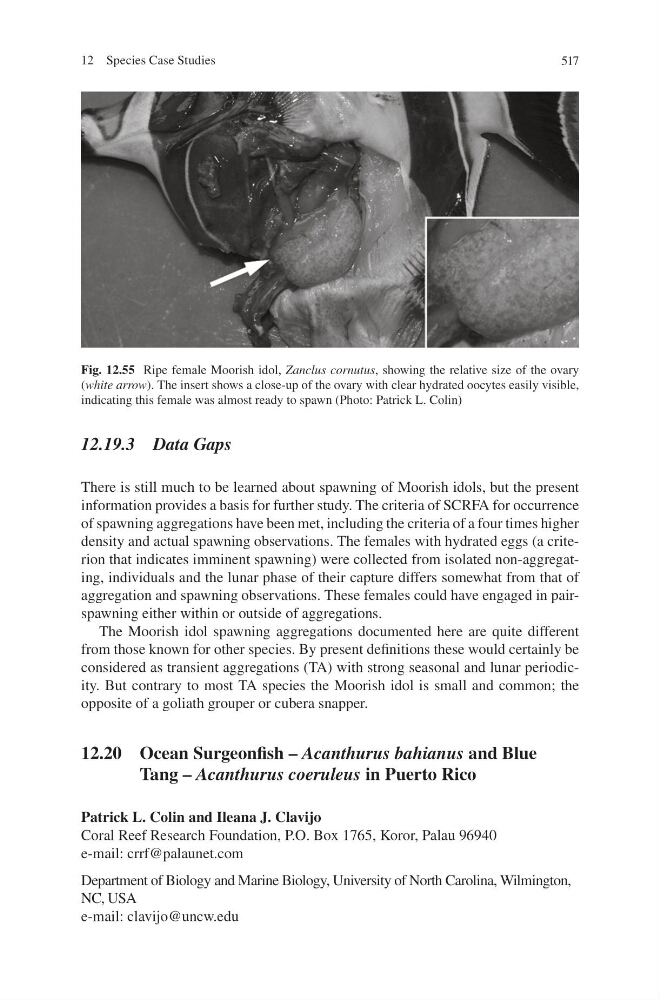
Fig. 12.55 Ripe female Moorish idol, Zanclus cornutus , showing the relative size of the ovary
( white arrow ). The insert shows a close-up of the ovary with clear hydrated oocytes easily visible,
indicating this female was almost ready to spawn (Photo: Patrick L. Colin)
12 Species Case Studies
12.19.3 Data Gaps
There is still much to be learned about spawning of Moorish idols, but the present
information provides a basis for further study. The criteria of SCRFA for occurrence
of spawning aggregations have been met, including the criteria of a four times higher
density and actual spawning observations. The females with hydrated eggs (a criterion that indicates imminent spawning) were collected from isolated non-aggregating, individuals and the lunar phase of their capture differs somewhat from that of
aggregation and spawning observations. These females could have engaged in pairspawning either within or outside of aggregations.
The Moorish idol spawning aggregations documented here are quite different
from those known for other species. By present defi nitions these would certainly be
considered as transient aggregations (TA) with strong seasonal and lunar periodicity. But contrary to most TA species the Moorish idol is small and common; the
opposite of a goliath grouper or cubera snapper.
12.20 Ocean Surgeonfi sh – Acanthurus bahianus and Blue
Tang – Acanthurus coeruleus in Puerto Rico
Patrick L. Colin and Ileana J. Clavijo
Coral Reef Research Foundation, P.O. Box 1765 , Koror , Palau 96940
e-mail: crrf@palaunet.com
Department of Biology and Marine Biology, University of North Carolina, Wilmington,
NC, USA
e-mail: clavijo@uncw.edu
Fig. 12.55 Ripe female Moorish idol, Zanclus cornutus , showing the relative size of the ovary
( white arrow ). The insert shows a close-up of the ovary with clear hydrated oocytes easily visible,
indicating this female was almost ready to spawn (Photo: Patrick L. Colin)