

516
12 Species Case Studies
Spawning was seen on 16 Feb 2011, 2 days before full moon, when an aggregation in excess of 100 individuals was observed at 4 pm on a rising tide at a reef point
called Siaes Corner. The aggregation was videotaped for approximately 40 min
moving from one side of the reef point corner, and as described earlier, the fi sh were
“herded” (forced by the sharks to move back and forth around this reef corner at
depths of 11–20 m) and occasionally attacked by approximately 80 grey reef sharks.
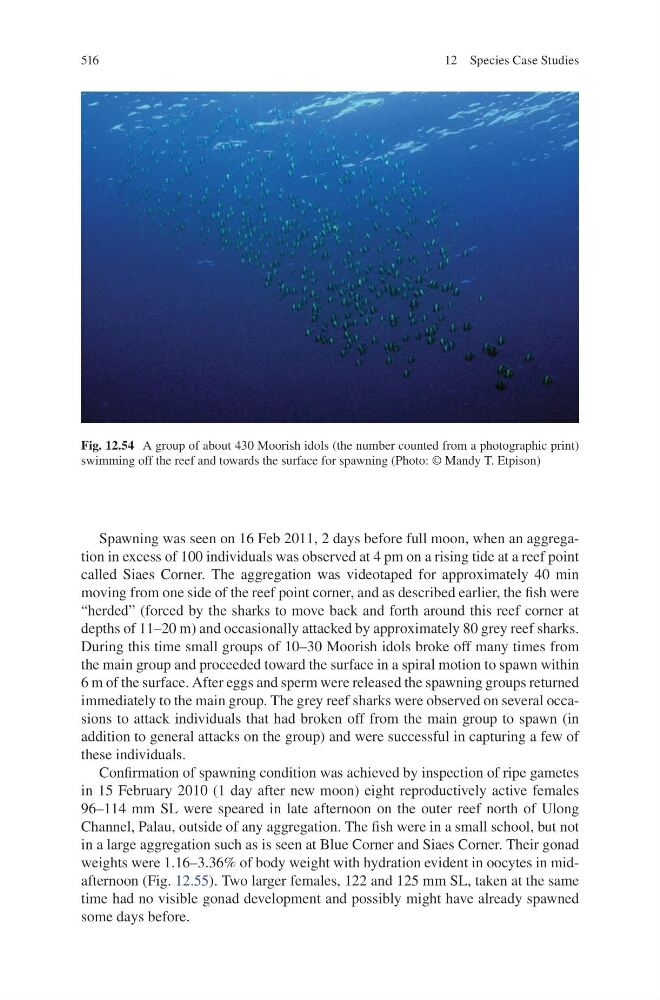
During this time small groups of 10–30 Moorish idols broke off many times from
the main group and proceeded toward the surface in a spiral motion to spawn within
6 m of the surface. After eggs and sperm were released the spawning groups returned
immediately to the main group. The grey reef sharks were observed on several occasions to attack individuals that had broken off from the main group to spawn (in
addition to general attacks on the group) and were successful in capturing a few of
these individuals.
Confi rmation of spawning condition was achieved by inspection of ripe gametes
in 15 February 2010 (1 day after new moon) eight reproductively active females
96–114 mm SL were speared in late afternoon on the outer reef north of Ulong
Channel, Palau, outside of any aggregation. The fi sh were in a small school, but not
in a large aggregation such as is seen at Blue Corner and Siaes Corner. Their gonad
weights were 1.16–3.36% of body weight with hydration evident in oocytes in midafternoon (Fig. 12.55 ). Two larger females, 122 and 125 mm SL, taken at the same
time had no visible gonad development and possibly might have already spawned
some days before.
Fig. 12.54 A group of about 430 Moorish idols (the number counted from a photographic print)
swimming off the reef and towards the surface for spawning (Photo: © Mandy T. Etpison)
12 Species Case Studies
Spawning was seen on 16 Feb 2011, 2 days before full moon, when an aggregation in excess of 100 individuals was observed at 4 pm on a rising tide at a reef point
called Siaes Corner. The aggregation was videotaped for approximately 40 min
moving from one side of the reef point corner, and as described earlier, the fi sh were
“herded” (forced by the sharks to move back and forth around this reef corner at
depths of 11–20 m) and occasionally attacked by approximately 80 grey reef sharks.
During this time small groups of 10–30 Moorish idols broke off many times from
the main group and proceeded toward the surface in a spiral motion to spawn within
6 m of the surface. After eggs and sperm were released the spawning groups returned
immediately to the main group. The grey reef sharks were observed on several occasions to attack individuals that had broken off from the main group to spawn (in
addition to general attacks on the group) and were successful in capturing a few of
these individuals.
Confi rmation of spawning condition was achieved by inspection of ripe gametes
in 15 February 2010 (1 day after new moon) eight reproductively active females
96–114 mm SL were speared in late afternoon on the outer reef north of Ulong
Channel, Palau, outside of any aggregation. The fi sh were in a small school, but not
in a large aggregation such as is seen at Blue Corner and Siaes Corner. Their gonad
weights were 1.16–3.36% of body weight with hydration evident in oocytes in midafternoon (Fig. 12.55 ). Two larger females, 122 and 125 mm SL, taken at the same
time had no visible gonad development and possibly might have already spawned
some days before.
Fig. 12.54 A group of about 430 Moorish idols (the number counted from a photographic print)
swimming off the reef and towards the surface for spawning (Photo: © Mandy T. Etpison)