

511
12 Species Case Studies
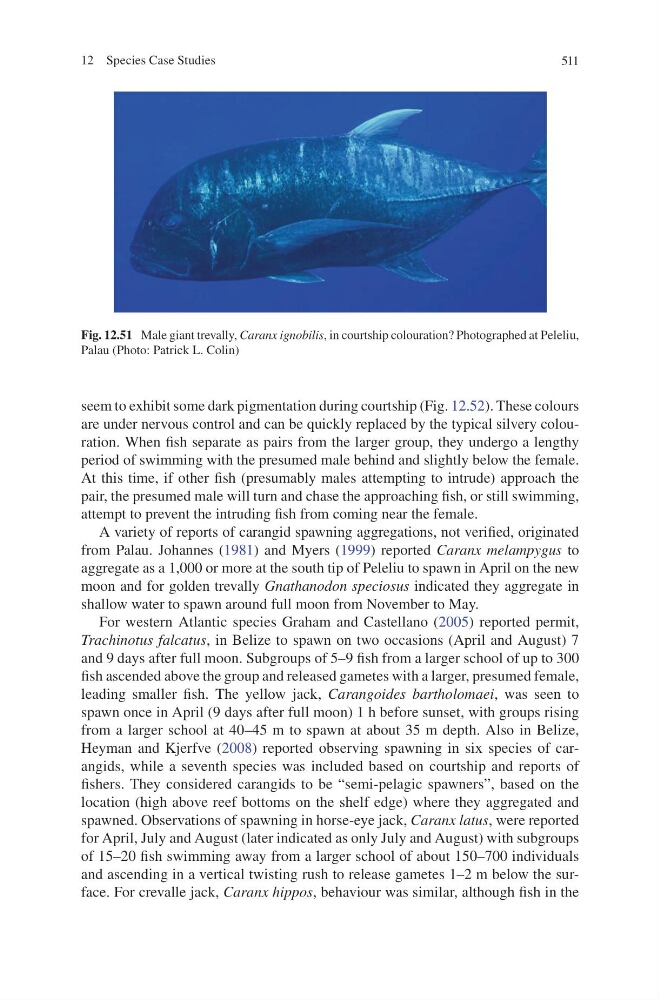
seem to exhibit some dark pigmentation during courtship (Fig. 12.52 ). These colours
are under nervous control and can be quickly replaced by the typical silvery colouration. When fi sh separate as pairs from the larger group, they undergo a lengthy
period of swimming with the presumed male behind and slightly below the female.
At this time, if other fi sh (presumably males attempting to intrude) approach the
pair, the presumed male will turn and chase the approaching fi sh, or still swimming,
attempt to prevent the intruding fi sh from coming near the female.
A variety of reports of carangid spawning aggregations, not verifi ed, originated
from Palau. Johannes ( 1981 ) and Myers ( 1999 ) reported Caranx melampygus to
aggregate as a 1,000 or more at the south tip of Peleliu to spawn in April on the new
moon and for golden trevally Gnathanodon speciosus indicated they aggregate in
shallow water to spawn around full moon from November to May.
For western Atlantic species Graham and Castellano ( 2005 ) reported permit,
Trachinotus falcatus , in Belize to spawn on two occasions (April and August) 7
and 9 days after full moon. Subgroups of 5–9 fi sh from a larger school of up to 300
fi sh ascended above the group and released gametes with a larger, presumed female,
leading smaller fi sh. The yellow jack, Carangoides bartholomaei , was seen to
spawn once in April (9 days after full moon) 1 h before sunset, with groups rising
from a larger school at 40–45 m to spawn at about 35 m depth. Also in Belize,
Heyman and Kjerfve ( 2008 ) reported observing spawning in six species of carangids, while a seventh species was included based on courtship and reports of
fi shers. They considered carangids to be “semi-pelagic spawners”, based on the
location (high above reef bottoms on the shelf edge) where they aggregated and
spawned. Observations of spawning in horse-eye jack, Caranx latus , were reported
for April, July and August (later indicated as only July and August) with subgroups
of 15–20 fi sh swimming away from a larger school of about 150–700 individuals
and ascending in a vertical twisting rush to release gametes 1–2 m below the surface. For crevalle jack, Caranx hippos , behaviour was similar, although fi sh in the
Fig. 12.51 Male giant trevally, Caranx ignobilis , in courtship colouration? Photographed at Peleliu,
Palau (Photo: Patrick L. Colin)
12 Species Case Studies
seem to exhibit some dark pigmentation during courtship (Fig. 12.52 ). These colours
are under nervous control and can be quickly replaced by the typical silvery colouration. When fi sh separate as pairs from the larger group, they undergo a lengthy
period of swimming with the presumed male behind and slightly below the female.
At this time, if other fi sh (presumably males attempting to intrude) approach the
pair, the presumed male will turn and chase the approaching fi sh, or still swimming,
attempt to prevent the intruding fi sh from coming near the female.
A variety of reports of carangid spawning aggregations, not verifi ed, originated
from Palau. Johannes ( 1981 ) and Myers ( 1999 ) reported Caranx melampygus to
aggregate as a 1,000 or more at the south tip of Peleliu to spawn in April on the new
moon and for golden trevally Gnathanodon speciosus indicated they aggregate in
shallow water to spawn around full moon from November to May.
For western Atlantic species Graham and Castellano ( 2005 ) reported permit,
Trachinotus falcatus , in Belize to spawn on two occasions (April and August) 7
and 9 days after full moon. Subgroups of 5–9 fi sh from a larger school of up to 300
fi sh ascended above the group and released gametes with a larger, presumed female,
leading smaller fi sh. The yellow jack, Carangoides bartholomaei , was seen to
spawn once in April (9 days after full moon) 1 h before sunset, with groups rising
from a larger school at 40–45 m to spawn at about 35 m depth. Also in Belize,
Heyman and Kjerfve ( 2008 ) reported observing spawning in six species of carangids, while a seventh species was included based on courtship and reports of
fi shers. They considered carangids to be “semi-pelagic spawners”, based on the
location (high above reef bottoms on the shelf edge) where they aggregated and
spawned. Observations of spawning in horse-eye jack, Caranx latus , were reported
for April, July and August (later indicated as only July and August) with subgroups
of 15–20 fi sh swimming away from a larger school of about 150–700 individuals
and ascending in a vertical twisting rush to release gametes 1–2 m below the surface. For crevalle jack, Caranx hippos , behaviour was similar, although fi sh in the
Fig. 12.51 Male giant trevally, Caranx ignobilis , in courtship colouration? Photographed at Peleliu,
Palau (Photo: Patrick L. Colin)