

510
12 Species Case Studies
Von Westernhagen ( 1974 ) reported giant trevally to spawn as pairs from a school
located on a shoal 35–45 m deep in a channel between two islands in the Philippines.
At the edges of the school, three to four males could be seen vigorously pursuing
females and eventually one male remained with a single female and the pair sank to
the bottom, swam in tight circles and released gametes. In Palau schools of giant
trevally are often found in high current areas, particularly at the southern end of
Peleliu, and some evidence of courtship by pairs has been seen at times. Males, like
other carangids, appear to become dark during courtship (Fig. 12.51 ).
For those carangids in which spawning has been observed, all known spawning
occurs as pairs or small groups which separate from a larger school or aggregation.
Males become dark, often black for silvery species, but females of some species
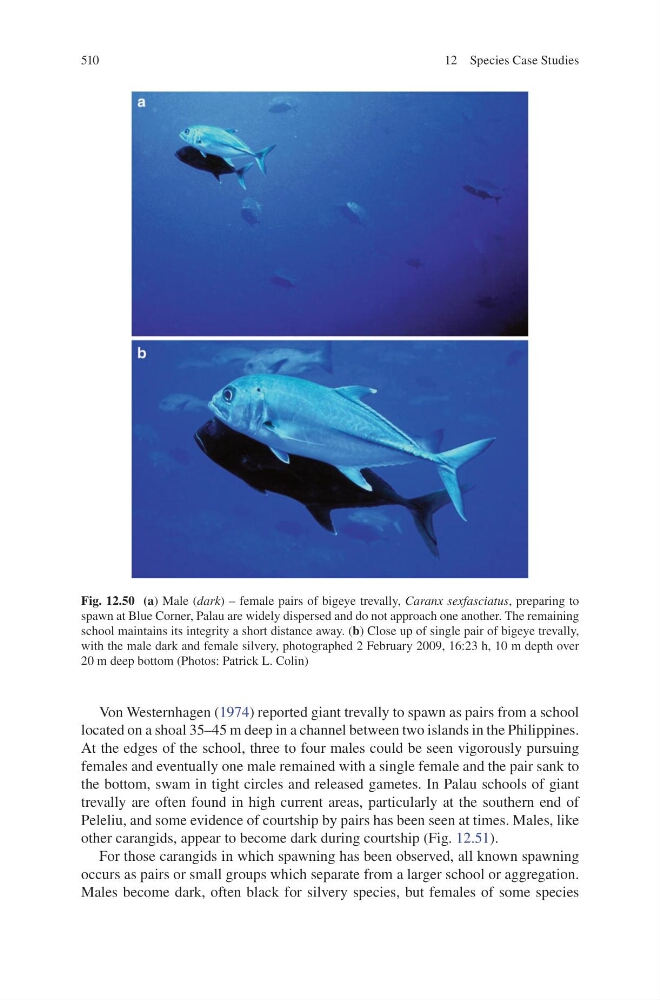
Fig. 12.50 (a ) Male ( dark ) – female pairs of bigeye trevally, Caranx sexfasciatus , preparing to
spawn at Blue Corner, Palau are widely dispersed and do not approach one another. The remaining
school maintains its integrity a short distance away. ( b ) Close up of single pair of bigeye trevally,
with the male dark and female silvery, photographed 2 February 2009, 16:23 h, 10 m depth over
20 m deep bottom (Photos: Patrick L. Colin)
12 Species Case Studies
Von Westernhagen ( 1974 ) reported giant trevally to spawn as pairs from a school
located on a shoal 35–45 m deep in a channel between two islands in the Philippines.
At the edges of the school, three to four males could be seen vigorously pursuing
females and eventually one male remained with a single female and the pair sank to
the bottom, swam in tight circles and released gametes. In Palau schools of giant
trevally are often found in high current areas, particularly at the southern end of
Peleliu, and some evidence of courtship by pairs has been seen at times. Males, like
other carangids, appear to become dark during courtship (Fig. 12.51 ).
For those carangids in which spawning has been observed, all known spawning
occurs as pairs or small groups which separate from a larger school or aggregation.
Males become dark, often black for silvery species, but females of some species
Fig. 12.50 (a ) Male ( dark ) – female pairs of bigeye trevally, Caranx sexfasciatus , preparing to
spawn at Blue Corner, Palau are widely dispersed and do not approach one another. The remaining
school maintains its integrity a short distance away. ( b ) Close up of single pair of bigeye trevally,
with the male dark and female silvery, photographed 2 February 2009, 16:23 h, 10 m depth over
20 m deep bottom (Photos: Patrick L. Colin)