

499
12 Species Case Studies
The aggregation in which spawning was seen numbered about 200–300 fi sh,
which either stayed together in a single group or occasionally broke into two separate groups located a short distance apart. The fi sh swam relatively close to the
substrate, and gradually rose up from the bottom, constantly changing direction as
a whole. Some individuals at the top of the group swam excitedly and more fi sh join
them, culminated in a spawning rush. In some cases at least 70 fi sh are seen in photos of a single group rising in a spawning rush (Fig. 12.45 ). It appears that not all
fi sh release at the top of the rush, however, subgroups within the ascending fi sh may
release a separate batch of eggs and sperm close to the initial release (Fig. 12.45d ).
In another spawn there were about 30 fi sh in the starting group, but several more
rushed in from open-water directly towards the rising lead female as the group
ascended. The rush is quick, lasting only a few seconds, as has been seen in most
parrotfi shes. It appears that a single, probably female leads the ascent (Fig. 12.45a )
with a number of probable males clustering around her as they rise (Fig. 12.45b ). At
the peak the lead female spurts forward, probably releasing eggs at that point, and
then turns above and back towards the group. Multiple males also appear to release
sperm and other groups within the ascending fi sh may also release gametes at
slightly different locations (Fig. 12.45 ). In photographs of two spawns the lead
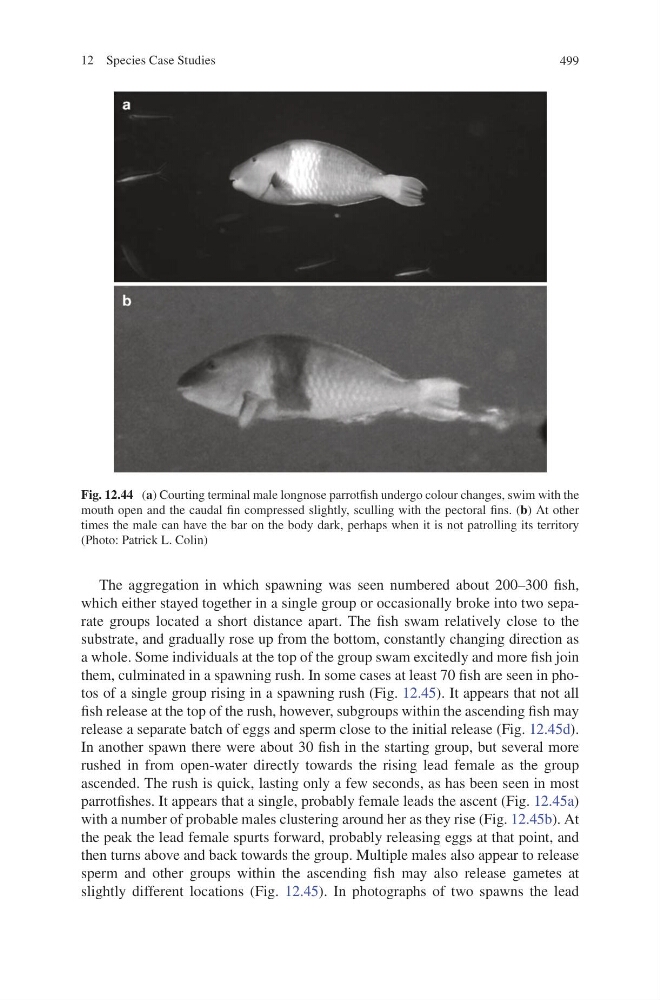
Fig. 12.44 ( a ) Courting terminal male longnose parrotfi sh undergo colour changes, swim with the
mouth open and the caudal fi n compressed slightly, sculling with the pectoral fi ns. ( b ) At other
times the male can have the bar on the body dark, perhaps when it is not patrolling its territory
(Photo: Patrick L. Colin)
12 Species Case Studies
The aggregation in which spawning was seen numbered about 200–300 fi sh,
which either stayed together in a single group or occasionally broke into two separate groups located a short distance apart. The fi sh swam relatively close to the
substrate, and gradually rose up from the bottom, constantly changing direction as
a whole. Some individuals at the top of the group swam excitedly and more fi sh join
them, culminated in a spawning rush. In some cases at least 70 fi sh are seen in photos of a single group rising in a spawning rush (Fig. 12.45 ). It appears that not all
fi sh release at the top of the rush, however, subgroups within the ascending fi sh may
release a separate batch of eggs and sperm close to the initial release (Fig. 12.45d ).
In another spawn there were about 30 fi sh in the starting group, but several more
rushed in from open-water directly towards the rising lead female as the group
ascended. The rush is quick, lasting only a few seconds, as has been seen in most
parrotfi shes. It appears that a single, probably female leads the ascent (Fig. 12.45a )
with a number of probable males clustering around her as they rise (Fig. 12.45b ). At
the peak the lead female spurts forward, probably releasing eggs at that point, and
then turns above and back towards the group. Multiple males also appear to release
sperm and other groups within the ascending fi sh may also release gametes at
slightly different locations (Fig. 12.45 ). In photographs of two spawns the lead
Fig. 12.44 ( a ) Courting terminal male longnose parrotfi sh undergo colour changes, swim with the
mouth open and the caudal fi n compressed slightly, sculling with the pectoral fi ns. ( b ) At other
times the male can have the bar on the body dark, perhaps when it is not patrolling its territory
(Photo: Patrick L. Colin)