

440
12 Species Case Studies
12.7.2 Biology
The life-cycle of the gag is relatively complex, exhibiting ontogenetically distinct
habitat preferences. After a pelagic larval stage of 40–60 days, a post-larval stage
recruits through inlets, harbours and saltmarsh creeks from March through June to
settle in estuaries and other shallow coastal areas for 4–6 months, and an adult stage
associated with offshore reefs of varying depths (Keener et al. 1988 ) . Juveniles prefer
natural or artifi cial structure, including seagrass beds, oyster reefs, wrecks, pilings
and dredged canals as habitat. Off South Carolina oyster reefs seem to be the favoured
juvenile habitat (Keener et al. 1988 ; Mullaney 1994 ; Mullaney and Gale 1996 ) while
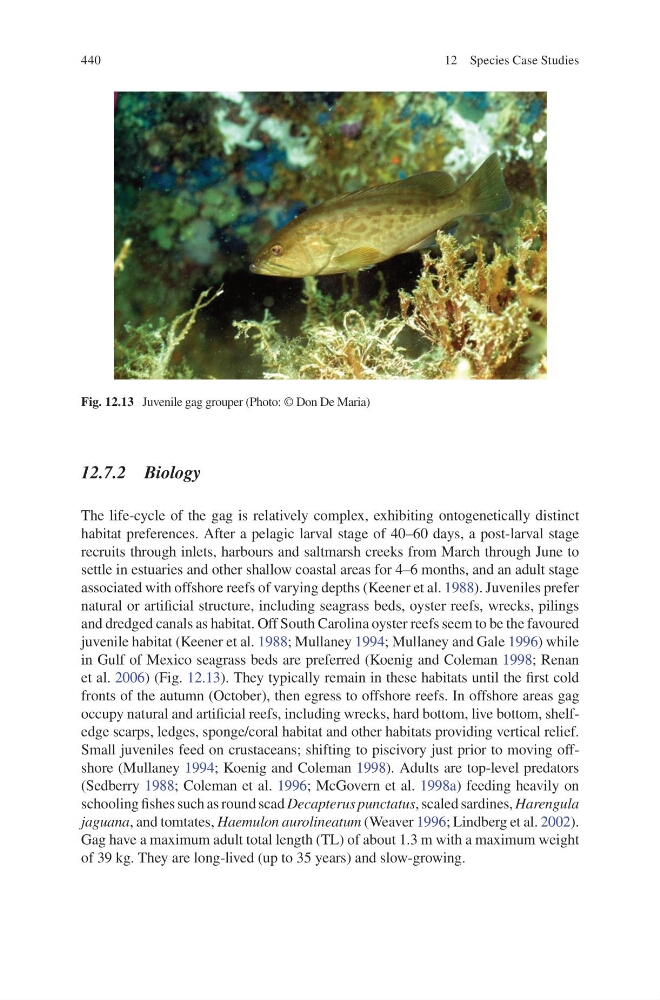
in Gulf of Mexico seagrass beds are preferred (Koenig and Coleman 1998 ; Renan
et al. 2006 ) (Fig. 12.13 ). They typically remain in these habitats until the fi rst cold
fronts of the autumn (October), then egress to offshore reefs. In offshore areas gag
occupy natural and artifi cial reefs, including wrecks, hard bottom, live bottom, shelfedge scarps, ledges, sponge/coral habitat and other habitats providing vertical relief.
Small juveniles feed on crustaceans; shifting to piscivory just prior to moving offshore (Mullaney 1994 ; Koenig and Coleman 1998 ) . Adults are top-level predators
(Sedberry 1988 ; Coleman et al. 1996 ; McGovern et al. 1998a ) feeding heavily on
schooling fi shes such as round scad Decapterus punctatus , scaled sardines, Harengula
jaguana , and tomtates, Haemulon aurolineatum (Weaver 1996 ; Lindberg et al. 2002 ) .
Gag have a maximum adult total length (TL) of about 1.3 m with a maximum weight
of 39 kg. They are long-lived (up to 35 years) and slow-growing.
Fig. 12.13 Juvenile gag grouper (Photo: © Don De Maria)
12 Species Case Studies
12.7.2 Biology
The life-cycle of the gag is relatively complex, exhibiting ontogenetically distinct
habitat preferences. After a pelagic larval stage of 40–60 days, a post-larval stage
recruits through inlets, harbours and saltmarsh creeks from March through June to
settle in estuaries and other shallow coastal areas for 4–6 months, and an adult stage
associated with offshore reefs of varying depths (Keener et al. 1988 ) . Juveniles prefer
natural or artifi cial structure, including seagrass beds, oyster reefs, wrecks, pilings
and dredged canals as habitat. Off South Carolina oyster reefs seem to be the favoured
juvenile habitat (Keener et al. 1988 ; Mullaney 1994 ; Mullaney and Gale 1996 ) while
in Gulf of Mexico seagrass beds are preferred (Koenig and Coleman 1998 ; Renan
et al. 2006 ) (Fig. 12.13 ). They typically remain in these habitats until the fi rst cold
fronts of the autumn (October), then egress to offshore reefs. In offshore areas gag
occupy natural and artifi cial reefs, including wrecks, hard bottom, live bottom, shelfedge scarps, ledges, sponge/coral habitat and other habitats providing vertical relief.
Small juveniles feed on crustaceans; shifting to piscivory just prior to moving offshore (Mullaney 1994 ; Koenig and Coleman 1998 ) . Adults are top-level predators
(Sedberry 1988 ; Coleman et al. 1996 ; McGovern et al. 1998a ) feeding heavily on
schooling fi shes such as round scad Decapterus punctatus , scaled sardines, Harengula
jaguana , and tomtates, Haemulon aurolineatum (Weaver 1996 ; Lindberg et al. 2002 ) .
Gag have a maximum adult total length (TL) of about 1.3 m with a maximum weight
of 39 kg. They are long-lived (up to 35 years) and slow-growing.
Fig. 12.13 Juvenile gag grouper (Photo: © Don De Maria)