

432
12 Species Case Studies
complex sexual and social system; outside of the spawning season, adult Nassau
grouper are relatively sedentary and solitary. During spawning, Nassau grouper
aggregate in large groups with reproduction occurring within the large aggregations
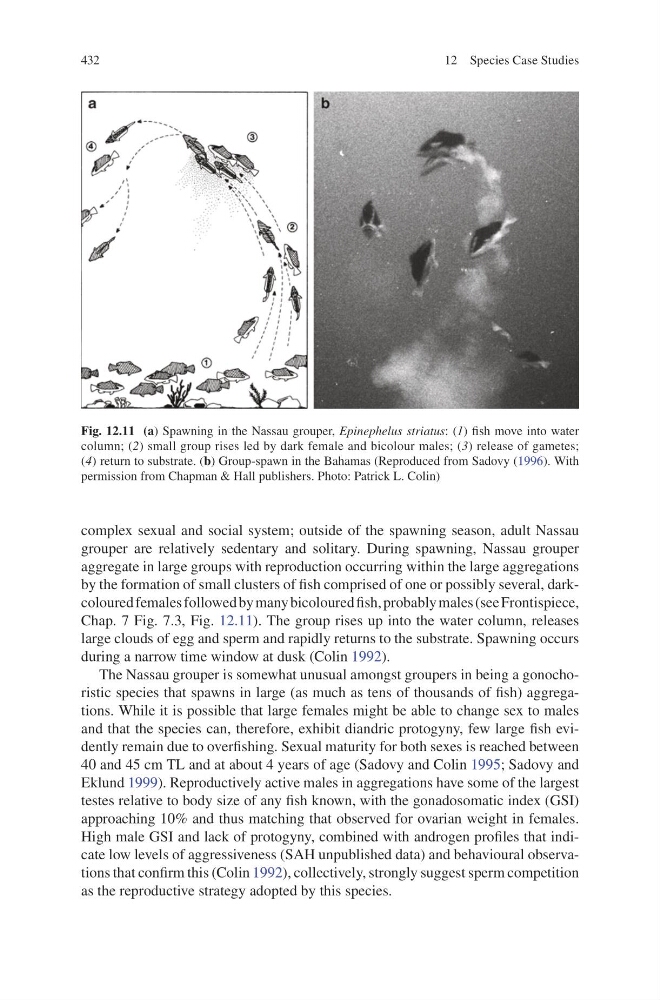
by the formation of small clusters of fi sh comprised of one or possibly several, darkcoloured females followed by many bicoloured fi sh, probably males (see Frontispiece,
Chap. 7 Fig. 7.3, Fig. 12.11 ). The group rises up into the water column, releases
large clouds of egg and sperm and rapidly returns to the substrate. Spawning occurs
during a narrow time window at dusk (Colin 1992 ) .
The Nassau grouper is somewhat unusual amongst groupers in being a gonochoristic species that spawns in large (as much as tens of thousands of fi sh) aggregations. While it is possible that large females might be able to change sex to males
and that the species can, therefore, exhibit diandric protogyny, few large fi sh evidently remain due to overfi shing. Sexual maturity for both sexes is reached between
40 and 45 cm TL and at about 4 years of age (Sadovy and Colin 1995 ; Sadovy and
Eklund 1999 ) . Reproductively active males in aggregations have some of the largest
testes relative to body size of any fi sh known, with the gonadosomatic index (GSI)
approaching 10% and thus matching that observed for ovarian weight in females.
High male GSI and lack of protogyny, combined with androgen profi les that indicate low levels of aggressiveness (SAH unpublished data) and behavioural observations that confi rm this (Colin 1992 ) , collectively, strongly suggest sperm competition
as the reproductive strategy adopted by this species.
Fig. 12.11 (a ) Spawning in the Nassau grouper, Epinephelus striatus : ( 1 ) fi sh move into water
column; ( 2 ) small group rises led by dark female and bicolour males; ( 3 ) release of gametes;
( 4 ) return to substrate. ( b ) Group-spawn in the Bahamas (Reproduced from Sadovy ( 1996 ) . With
permission from Chapman & Hall publishers. Photo: Patrick L. Colin)
12 Species Case Studies
complex sexual and social system; outside of the spawning season, adult Nassau
grouper are relatively sedentary and solitary. During spawning, Nassau grouper
aggregate in large groups with reproduction occurring within the large aggregations
by the formation of small clusters of fi sh comprised of one or possibly several, darkcoloured females followed by many bicoloured fi sh, probably males (see Frontispiece,
Chap. 7 Fig. 7.3, Fig. 12.11 ). The group rises up into the water column, releases
large clouds of egg and sperm and rapidly returns to the substrate. Spawning occurs
during a narrow time window at dusk (Colin 1992 ) .
The Nassau grouper is somewhat unusual amongst groupers in being a gonochoristic species that spawns in large (as much as tens of thousands of fi sh) aggregations. While it is possible that large females might be able to change sex to males
and that the species can, therefore, exhibit diandric protogyny, few large fi sh evidently remain due to overfi shing. Sexual maturity for both sexes is reached between
40 and 45 cm TL and at about 4 years of age (Sadovy and Colin 1995 ; Sadovy and
Eklund 1999 ) . Reproductively active males in aggregations have some of the largest
testes relative to body size of any fi sh known, with the gonadosomatic index (GSI)
approaching 10% and thus matching that observed for ovarian weight in females.
High male GSI and lack of protogyny, combined with androgen profi les that indicate low levels of aggressiveness (SAH unpublished data) and behavioural observations that confi rm this (Colin 1992 ) , collectively, strongly suggest sperm competition
as the reproductive strategy adopted by this species.
Fig. 12.11 (a ) Spawning in the Nassau grouper, Epinephelus striatus : ( 1 ) fi sh move into water
column; ( 2 ) small group rises led by dark female and bicolour males; ( 3 ) release of gametes;
( 4 ) return to substrate. ( b ) Group-spawn in the Bahamas (Reproduced from Sadovy ( 1996 ) . With
permission from Chapman & Hall publishers. Photo: Patrick L. Colin)