

359
10 The Role of Local Ecological Knowledge in the Conservation and Management...
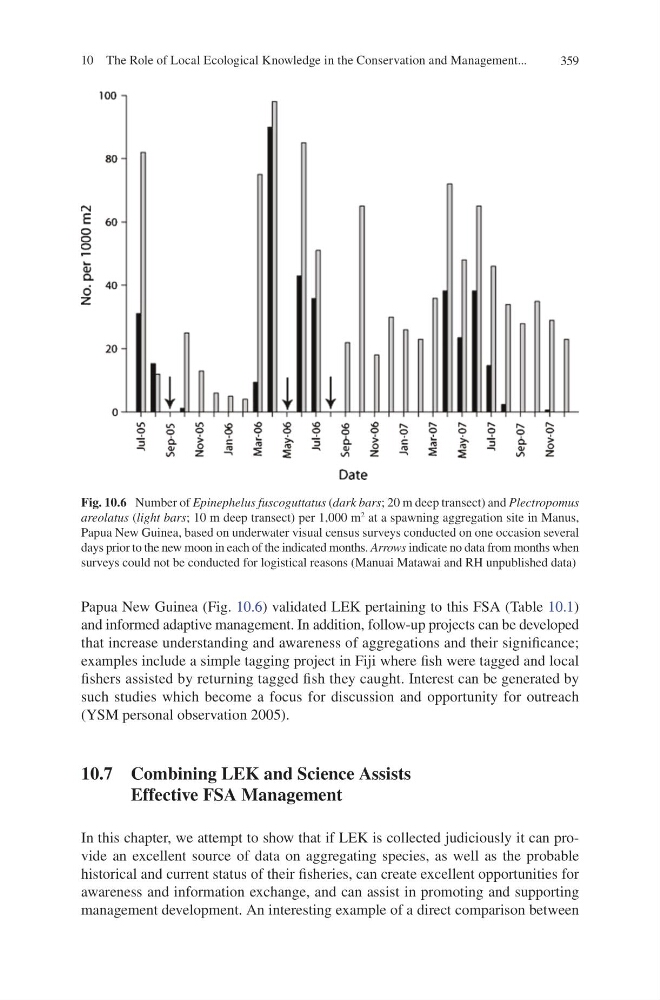
Papua New Guinea (Fig. 10.6 ) validated LEK pertaining to this FSA (Table 10.1 )
and informed adaptive management. In addition, follow-up projects can be developed
that increase understanding and awareness of aggregations and their signifi cance;
examples include a simple tagging project in Fiji where fi sh were tagged and local
fi shers assisted by returning tagged fi sh they caught. Interest can be generated by
such studies which become a focus for discussion and opportunity for outreach
(YSM personal observation 2005).
10.7 Combining LEK and Science Assists
Effective FSA Management
In this chapter, we attempt to show that if LEK is collected judiciously it can provide an excellent source of data on aggregating species, as well as the probable
historical and current status of their fi sheries, can create excellent opportunities for
awareness and information exchange, and can assist in promoting and supporting
management development. An interesting example of a direct comparison between
Fig. 10.6 Number of Epinephelus fuscoguttatus ( dark bars ; 20 m deep transect) and Plectropomus
areolatus ( light bars ; 10 m deep transect) per 1,000 m
2 at a spawning aggregation site in Manus,
Papua New Guinea, based on underwater visual census surveys conducted on one occasion several
days prior to the new moon in each of the indicated months. Arrows indicate no data from months when
surveys could not be conducted for logistical reasons (Manuai Matawai and RH unpublished data)
10 The Role of Local Ecological Knowledge in the Conservation and Management...
Papua New Guinea (Fig. 10.6 ) validated LEK pertaining to this FSA (Table 10.1 )
and informed adaptive management. In addition, follow-up projects can be developed
that increase understanding and awareness of aggregations and their signifi cance;
examples include a simple tagging project in Fiji where fi sh were tagged and local
fi shers assisted by returning tagged fi sh they caught. Interest can be generated by
such studies which become a focus for discussion and opportunity for outreach
(YSM personal observation 2005).
10.7 Combining LEK and Science Assists
Effective FSA Management
In this chapter, we attempt to show that if LEK is collected judiciously it can provide an excellent source of data on aggregating species, as well as the probable
historical and current status of their fi sheries, can create excellent opportunities for
awareness and information exchange, and can assist in promoting and supporting
management development. An interesting example of a direct comparison between
Fig. 10.6 Number of Epinephelus fuscoguttatus ( dark bars ; 20 m deep transect) and Plectropomus
areolatus ( light bars ; 10 m deep transect) per 1,000 m
2 at a spawning aggregation site in Manus,
Papua New Guinea, based on underwater visual census surveys conducted on one occasion several
days prior to the new moon in each of the indicated months. Arrows indicate no data from months when
surveys could not be conducted for logistical reasons (Manuai Matawai and RH unpublished data)