

306
P.L. Colin
wristwatches and the clocks on cameras can be set to “GPS time”. The accurate time
allows the exact time of events fi lmed to be determined and for sequences of photos
the time between frames is also recorded.
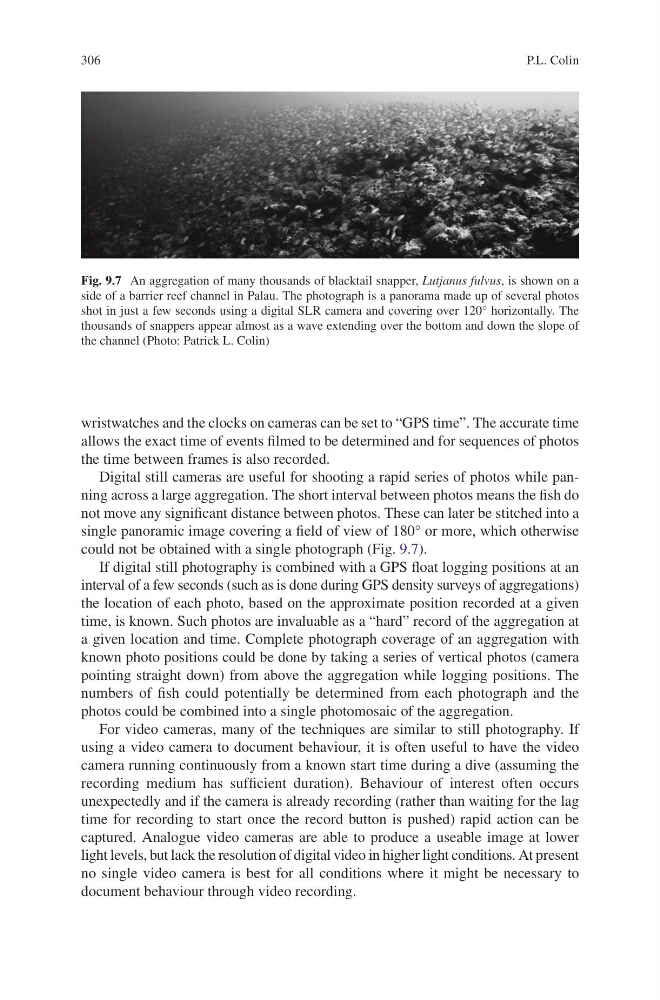
Digital still cameras are useful for shooting a rapid series of photos while panning across a large aggregation. The short interval between photos means the fi sh do
not move any signifi cant distance between photos. These can later be stitched into a
single panoramic image covering a fi eld of view of 180° or more, which otherwise
could not be obtained with a single photograph (Fig. 9.7 ).
If digital still photography is combined with a GPS fl oat logging positions at an
interval of a few seconds (such as is done during GPS density surveys of aggregations)
the location of each photo, based on the approximate position recorded at a given
time, is known. Such photos are invaluable as a “hard” record of the aggregation at
a given location and time. Complete photograph coverage of an aggregation with
known photo positions could be done by taking a series of vertical photos (camera
pointing straight down) from above the aggregation while logging positions. The
numbers of fi sh could potentially be determined from each photograph and the
photos could be combined into a single photomosaic of the aggregation.
For video cameras, many of the techniques are similar to still photography. If
using a video camera to document behaviour, it is often useful to have the video
camera running continuously from a known start time during a dive (assuming the
recording medium has suffi cient duration). Behaviour of interest often occurs
unexpectedly and if the camera is already recording (rather than waiting for the lag
time for recording to start once the record button is pushed) rapid action can be
captured. Analogue video cameras are able to produce a useable image at lower
light levels, but lack the resolution of digital video in higher light conditions. At present
no single video camera is best for all conditions where it might be necessary to
document behaviour through video recording.
Fig. 9.7 An aggregation of many thousands of blacktail snapper, Lutjanus fulvus , is shown on a
side of a barrier reef channel in Palau. The photograph is a panorama made up of several photos
shot in just a few seconds using a digital SLR camera and covering over 120° horizontally. The
thousands of snappers appear almost as a wave extending over the bottom and down the slope of
the channel (Photo: Patrick L. Colin)
P.L. Colin
wristwatches and the clocks on cameras can be set to “GPS time”. The accurate time
allows the exact time of events fi lmed to be determined and for sequences of photos
the time between frames is also recorded.
Digital still cameras are useful for shooting a rapid series of photos while panning across a large aggregation. The short interval between photos means the fi sh do
not move any signifi cant distance between photos. These can later be stitched into a
single panoramic image covering a fi eld of view of 180° or more, which otherwise
could not be obtained with a single photograph (Fig. 9.7 ).
If digital still photography is combined with a GPS fl oat logging positions at an
interval of a few seconds (such as is done during GPS density surveys of aggregations)
the location of each photo, based on the approximate position recorded at a given
time, is known. Such photos are invaluable as a “hard” record of the aggregation at
a given location and time. Complete photograph coverage of an aggregation with
known photo positions could be done by taking a series of vertical photos (camera
pointing straight down) from above the aggregation while logging positions. The
numbers of fi sh could potentially be determined from each photograph and the
photos could be combined into a single photomosaic of the aggregation.
For video cameras, many of the techniques are similar to still photography. If
using a video camera to document behaviour, it is often useful to have the video
camera running continuously from a known start time during a dive (assuming the
recording medium has suffi cient duration). Behaviour of interest often occurs
unexpectedly and if the camera is already recording (rather than waiting for the lag
time for recording to start once the record button is pushed) rapid action can be
captured. Analogue video cameras are able to produce a useable image at lower
light levels, but lack the resolution of digital video in higher light conditions. At present
no single video camera is best for all conditions where it might be necessary to
document behaviour through video recording.
Fig. 9.7 An aggregation of many thousands of blacktail snapper, Lutjanus fulvus , is shown on a
side of a barrier reef channel in Palau. The photograph is a panorama made up of several photos
shot in just a few seconds using a digital SLR camera and covering over 120° horizontally. The
thousands of snappers appear almost as a wave extending over the bottom and down the slope of
the channel (Photo: Patrick L. Colin)