

252
Y. Sadovy de Mitcheson and B. Erisman
in a taxon are more likely to spawn in aggregations than related smaller ones (Domeier
and Colin 1997 , Chap. 4 ) body size is potentially a confounding factor and further
consideration is warranted; nonetheless, the data tend to support the conclusion that
aggregating species are more vulnerable. For example, comparing similar-sized and
sympatric species pairs in the western Atlantic (red grouper, Epinephelus morio -near
threatened, no indication of strong aggregating habit, paired with Nassau grouper –
threatened, transient aggregator, hundreds to tens of thousands of fi sh in an aggregation)
and Indo-Pacifi c (leopard coralgrouper, Plectropomus leopardus –near threatened,
resident aggregator, tens to a few hundred fi sh at a single aggregation paired with
squaretail coralgrouper-threatened, transient aggregator, hundreds to thousands of
fi sh at a single aggregation) suggests that declines in populations, as judged by landings trends in the fi shery over time, have been greatest in transient species that aggregate at the fewest known sites and most predictably. This is clearly suggested by
marked declines in Nassau grouper and squaretail coralgrouper and is consistent
with the general and perhaps intuitive observation that, all else being equal, transient
spawners are likely to be more susceptible to overfi shing than resident spawners.
Of 42 species of sea bream (family Sparidae) found in South African waters
(30 are endemic) the ‘seventy-four’, Polysteganus undulosus , has undergone the
greatest overall declines in this comparatively well-monitored coastal fi shery. It is
one of the only sea breams in the region, of the 42 present, that was once fi shed
intensively at specifi c spawning aggregation sites. In the early 1900s the species
50
60
70
80
90
100
0
2
4
6
8
1 0
1 2
Maximum decline recorded (%)
Number of reproductive months
LCG
ES
LS
LA
OC
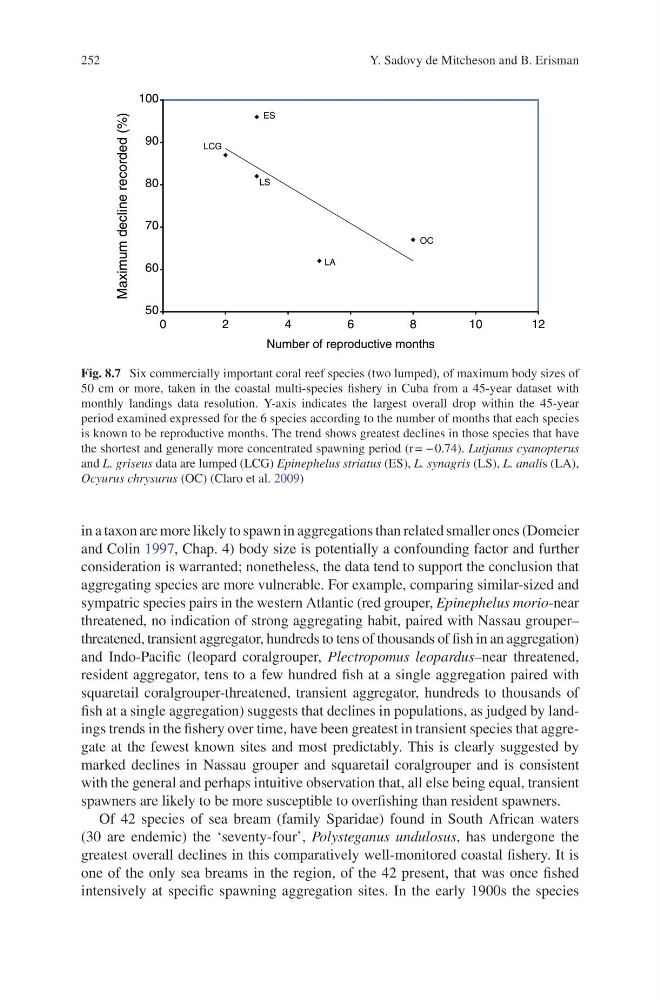
Fig. 8.7 Six commercially important coral reef species (two lumped), of maximum body sizes of
50 cm or more, taken in the coastal multi-species fi shery in Cuba from a 45-year dataset with
monthly landings data resolution. Y-axis indicates the largest overall drop within the 45-year
period examined expressed for the 6 species according to the number of months that each species
is known to be reproductive months. The trend shows greatest declines in those species that have
the shortest and generally more concentrated spawning period (r = − 0.74). Lutjanus cyanopterus
and L. griseus data are lumped (LCG) Epinephelus striatus (ES), L. synagris (LS), L. anali s (LA),
Ocyurus chrysurus (OC) (Claro et al. 2009 )
Y. Sadovy de Mitcheson and B. Erisman
in a taxon are more likely to spawn in aggregations than related smaller ones (Domeier
and Colin 1997 , Chap. 4 ) body size is potentially a confounding factor and further
consideration is warranted; nonetheless, the data tend to support the conclusion that
aggregating species are more vulnerable. For example, comparing similar-sized and
sympatric species pairs in the western Atlantic (red grouper, Epinephelus morio -near
threatened, no indication of strong aggregating habit, paired with Nassau grouper –
threatened, transient aggregator, hundreds to tens of thousands of fi sh in an aggregation)
and Indo-Pacifi c (leopard coralgrouper, Plectropomus leopardus –near threatened,
resident aggregator, tens to a few hundred fi sh at a single aggregation paired with
squaretail coralgrouper-threatened, transient aggregator, hundreds to thousands of
fi sh at a single aggregation) suggests that declines in populations, as judged by landings trends in the fi shery over time, have been greatest in transient species that aggregate at the fewest known sites and most predictably. This is clearly suggested by
marked declines in Nassau grouper and squaretail coralgrouper and is consistent
with the general and perhaps intuitive observation that, all else being equal, transient
spawners are likely to be more susceptible to overfi shing than resident spawners.
Of 42 species of sea bream (family Sparidae) found in South African waters
(30 are endemic) the ‘seventy-four’, Polysteganus undulosus , has undergone the
greatest overall declines in this comparatively well-monitored coastal fi shery. It is
one of the only sea breams in the region, of the 42 present, that was once fi shed
intensively at specifi c spawning aggregation sites. In the early 1900s the species
50
60
70
80
90
100
0
2
4
6
8
1 0
1 2
Maximum decline recorded (%)
Number of reproductive months
LCG
ES
LS
LA
OC
Fig. 8.7 Six commercially important coral reef species (two lumped), of maximum body sizes of
50 cm or more, taken in the coastal multi-species fi shery in Cuba from a 45-year dataset with
monthly landings data resolution. Y-axis indicates the largest overall drop within the 45-year
period examined expressed for the 6 species according to the number of months that each species
is known to be reproductive months. The trend shows greatest declines in those species that have
the shortest and generally more concentrated spawning period (r = − 0.74). Lutjanus cyanopterus
and L. griseus data are lumped (LCG) Epinephelus striatus (ES), L. synagris (LS), L. anali s (LA),
Ocyurus chrysurus (OC) (Claro et al. 2009 )