

236
Y. Sadovy de Mitcheson and B. Erisman
Table 8.1
(continued)
Dusky rabbitfi sh
Siganus
fuscescens
Siganidae
Throw-nets
(mainly), throw
spears, surround
nets, and spear
guns while night
fi shing with
fl ashlights
Palau
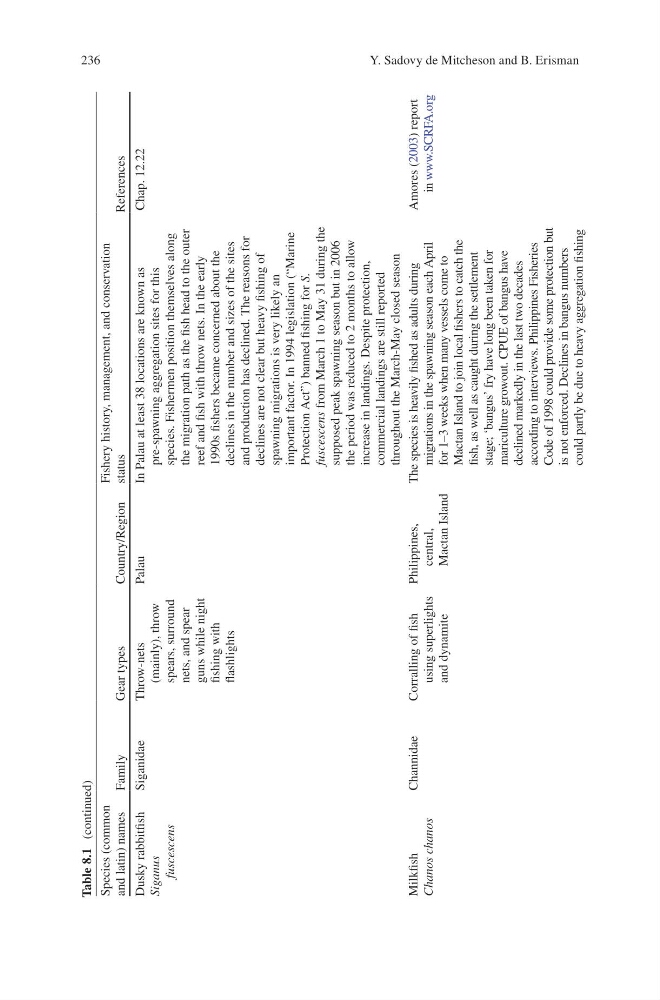
In Palau at least 38 locations are known as
pre-spawning aggregation sites for this
species. Fishermen position themselves along
the migration path as the fi sh head to the outer
reef and fi sh with throw nets. In the early
1990s fi shers became concerned about the
declines in the number and sizes of the sites
and production has declined. The reasons for
declines are not clear but heavy fi shing of
spawning migrations is very likely an
important factor. In 1994 legislation (“Marine
Protection Act”) banned fi shing for S.
fuscescens
from March 1 to May 31 during the
supposed peak spawning season but in 2006
the period was reduced to 2 months to allow
increase in landings. Despite protection,
commercial landings are still reported
throughout the March-May closed season
Chap. 12.22
Milkfi sh
Chanos chanos
Channidae
Corralling of fi sh
using superlights
and dynamite
Philippines,
central,
Mactan Island
The species is heavily fi shed as adults during
migrations in the spawning season each April
for 1–3 weeks when many vessels come to
Mactan Island to join local fi shers to catch the
fi sh, as well as caught during the settlement
stage; ‘bangus’ fry have long been taken for
mariculture growout. CPUE of bangus have
declined markedly in the last two decades
according to interviews. Philippines Fisheries
Code of 1998 could provide some protection but
is not enforced. Declines in bangus numbers
could partly be due to heavy aggregation fi shing
Amores ( 2003 ) report
in www.SCRFA.org
Species (common
and latin) names
Family
Gear types
Country/Region
Fishery history, management, and conservation
status
References
Y. Sadovy de Mitcheson and B. Erisman
Table 8.1
(continued)
Dusky rabbitfi sh
Siganus
fuscescens
Siganidae
Throw-nets
(mainly), throw
spears, surround
nets, and spear
guns while night
fi shing with
fl ashlights
Palau
In Palau at least 38 locations are known as
pre-spawning aggregation sites for this
species. Fishermen position themselves along
the migration path as the fi sh head to the outer
reef and fi sh with throw nets. In the early
1990s fi shers became concerned about the
declines in the number and sizes of the sites
and production has declined. The reasons for
declines are not clear but heavy fi shing of
spawning migrations is very likely an
important factor. In 1994 legislation (“Marine
Protection Act”) banned fi shing for S.
fuscescens
from March 1 to May 31 during the
supposed peak spawning season but in 2006
the period was reduced to 2 months to allow
increase in landings. Despite protection,
commercial landings are still reported
throughout the March-May closed season
Chap. 12.22
Milkfi sh
Chanos chanos
Channidae
Corralling of fi sh
using superlights
and dynamite
Philippines,
central,
Mactan Island
The species is heavily fi shed as adults during
migrations in the spawning season each April
for 1–3 weeks when many vessels come to
Mactan Island to join local fi shers to catch the
fi sh, as well as caught during the settlement
stage; ‘bangus’ fry have long been taken for
mariculture growout. CPUE of bangus have
declined markedly in the last two decades
according to interviews. Philippines Fisheries
Code of 1998 could provide some protection but
is not enforced. Declines in bangus numbers
could partly be due to heavy aggregation fi shing
Amores ( 2003 ) report
in www.SCRFA.org
Species (common
and latin) names
Family
Gear types
Country/Region
Fishery history, management, and conservation
status
References