

235
8 Fishery and Biological Implications of Fishing Spawning Aggregations…
(continued)
Squaretail
coralgrouper
Plectropomus
areolatus
Epinephelidae Hook and line
Kiribati, western
Pacifi c
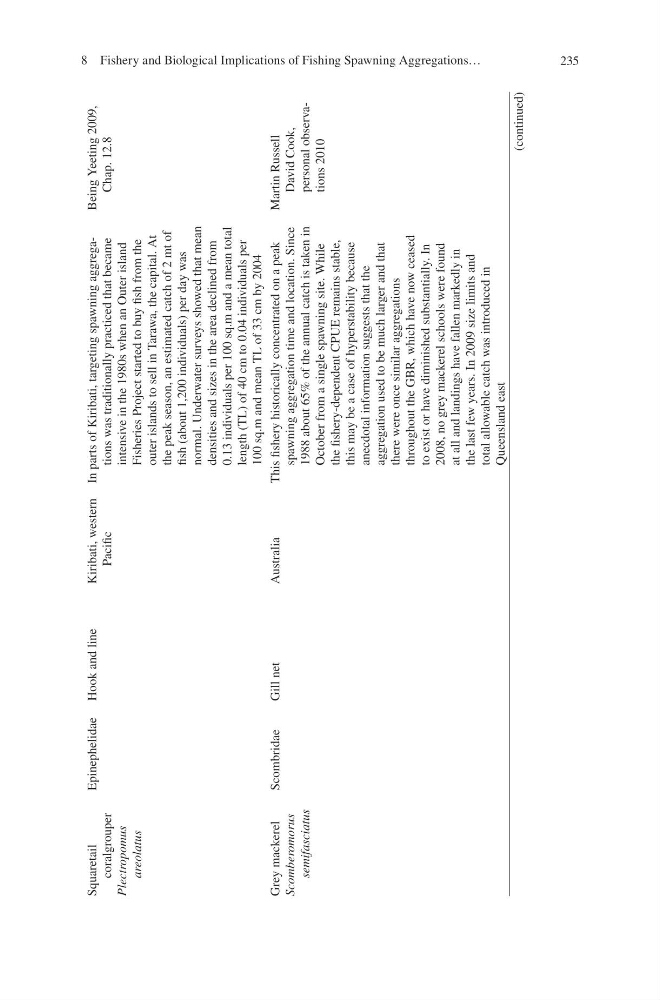
In parts of Kiribati, targeting spawning aggregations was traditionally practiced that became
intensive in the 1980s when an Outer island
Fisheries Project started to buy fi sh from the
outer islands to sell in Tarawa, the capital. At
the peak season, an estimated catch of 2 mt of
fi sh (about 1,200 individuals) per day was
normal. Underwater surveys showed that mean
densities and sizes in the area declined from
0.13 individuals per 100 sq.m and a mean total
length (TL) of 40 cm to 0.04 individuals per
100 sq.m and mean TL of 33 cm by 2004
Being Yeeting 2009,
Chap. 12.8
Grey mackerel
Scomberomorus
semifasciatus
Scombridae
Gill net
Australia
This fi shery historically concentrated on a peak
spawning aggregation time and location. Since
1988 about 65% of the annual catch is taken in
October from a single spawning site. While
the fi shery-dependent CPUE remains stable,
this may be a case of hyperstability because
anecdotal information suggests that the
aggregation used to be much larger and that
there were once similar aggregations
throughout the GBR, which have now ceased
to exist or have diminished substantially. In
2008, no grey mackerel schools were found
at all and landings have fallen markedly in
the last few years. In 2009 size limits and
total allowable catch was introduced in
Queensland east
Martin Russell
David Cook,
personal observations 2010
8 Fishery and Biological Implications of Fishing Spawning Aggregations…
(continued)
Squaretail
coralgrouper
Plectropomus
areolatus
Epinephelidae Hook and line
Kiribati, western
Pacifi c
In parts of Kiribati, targeting spawning aggregations was traditionally practiced that became
intensive in the 1980s when an Outer island
Fisheries Project started to buy fi sh from the
outer islands to sell in Tarawa, the capital. At
the peak season, an estimated catch of 2 mt of
fi sh (about 1,200 individuals) per day was
normal. Underwater surveys showed that mean
densities and sizes in the area declined from
0.13 individuals per 100 sq.m and a mean total
length (TL) of 40 cm to 0.04 individuals per
100 sq.m and mean TL of 33 cm by 2004
Being Yeeting 2009,
Chap. 12.8
Grey mackerel
Scomberomorus
semifasciatus
Scombridae
Gill net
Australia
This fi shery historically concentrated on a peak
spawning aggregation time and location. Since
1988 about 65% of the annual catch is taken in
October from a single spawning site. While
the fi shery-dependent CPUE remains stable,
this may be a case of hyperstability because
anecdotal information suggests that the
aggregation used to be much larger and that
there were once similar aggregations
throughout the GBR, which have now ceased
to exist or have diminished substantially. In
2008, no grey mackerel schools were found
at all and landings have fallen markedly in
the last few years. In 2009 size limits and
total allowable catch was introduced in
Queensland east
Martin Russell
David Cook,
personal observations 2010