

212
P.L. Colin
found possible pulses of recruitment of some aggregation spawners (snappers) using
channel nets at Ningaloo Reef, Western Australia, but for other families where
pulses have been seen elsewhere, such as surgeonfi shes, few settlement stage larvae
were captured.
Relationships between spawning season and recruitment are known in other
groupers. Keener et al ( 1988 ) showed a clear connection between aggregation
spawning of the gag grouper, Mycteroperca microlepis , with appearance of juveniles over a few days in nets fi shed in a tidal inlet. Recruitment of some smaller
groupers may not necessarily be a result of aggregation spawning. The coney,
E. fulvus , spawns in small haremic groups without lunar timing during the winter in
the Bahamas and new recruits appear at appropriate times where their otolith
increments back-date to known spawning times (PLC unpublished data) so the
settlement is seasonal, but does not appear to be pulsed. For other western Atlantic
groupers believed to have limited spawning seasons there is a loose relationship
between the known months of spawning and the appearance of juveniles 1–2 months
later (PLC unpublished data)
The same is possibly true for some small IWP groupers. Dufour et al. ( 1996 )
found simultaneously large fl uxes of honeycomb grouper, Epinephelus merra , for a
few days across a number of seaward reef fl ats in Moorea after the new moon in
February and March. Letourneur et al. ( 1998 ) and Chabanet et al ( 2005 ) reported
massive recruitment of honeycomb grouper following storms at Reunion Island,
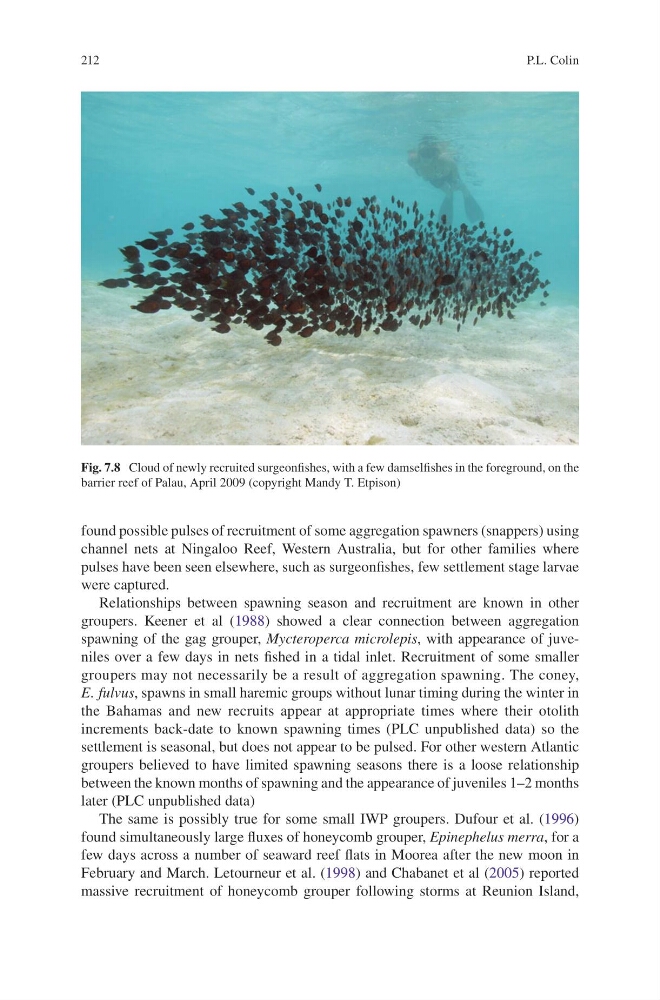
Fig. 7.8 Cloud of newly recruited surgeonfi shes, with a few damselfi shes in the foreground, on the
barrier reef of Palau, April 2009 (copyright Mandy T. Etpison)
P.L. Colin
found possible pulses of recruitment of some aggregation spawners (snappers) using
channel nets at Ningaloo Reef, Western Australia, but for other families where
pulses have been seen elsewhere, such as surgeonfi shes, few settlement stage larvae
were captured.
Relationships between spawning season and recruitment are known in other
groupers. Keener et al ( 1988 ) showed a clear connection between aggregation
spawning of the gag grouper, Mycteroperca microlepis , with appearance of juveniles over a few days in nets fi shed in a tidal inlet. Recruitment of some smaller
groupers may not necessarily be a result of aggregation spawning. The coney,
E. fulvus , spawns in small haremic groups without lunar timing during the winter in
the Bahamas and new recruits appear at appropriate times where their otolith
increments back-date to known spawning times (PLC unpublished data) so the
settlement is seasonal, but does not appear to be pulsed. For other western Atlantic
groupers believed to have limited spawning seasons there is a loose relationship
between the known months of spawning and the appearance of juveniles 1–2 months
later (PLC unpublished data)
The same is possibly true for some small IWP groupers. Dufour et al. ( 1996 )
found simultaneously large fl uxes of honeycomb grouper, Epinephelus merra , for a
few days across a number of seaward reef fl ats in Moorea after the new moon in
February and March. Letourneur et al. ( 1998 ) and Chabanet et al ( 2005 ) reported
massive recruitment of honeycomb grouper following storms at Reunion Island,
Fig. 7.8 Cloud of newly recruited surgeonfi shes, with a few damselfi shes in the foreground, on the
barrier reef of Palau, April 2009 (copyright Mandy T. Etpison)