

211
7 Aggregation Spawning: Biological Aspects of the Early Life History
elsewhere on the reef. Whether such large recruitment pulses originate from
spawning in Palau is not known, but some of the species do aggregate for spawning
in Palau. Other species can recruit directly into the reef in vast numbers, and may
be subject to predator pressures, but their disappearance is not so easily detected
(Fig. 7.8 ).
There are instances where recruitment occurrence is tied back to reproductive
seasons by inference from knowledge of spawning season and recruitment periods.
Such may occur for both aggregation and non-aggregating species, although in
many cases whether or not aggregation spawning occurs is not known. Spawning by
a large population of fi sh outside of aggregations over a short period of time, given
that oceanographic mechanisms may serve to concentrate eggs or larvae, may be
indistinguishable from aggregation spawning. Lunar effects may also be hard to
see in such cases, although it is possible to back-date otoliths to determine time
of spawning.
Pulse recruitment of the Nassau groupers in the Exuma Cays in the Bahamas,
directly tied to aggregation spawning, has been documented using channel nets for
a period of a few days about 1.5 months after spawning (Shenker et al. 1993 ; Colin
et al. 1997 ) . Additional recruitment may occur in areas other than those fed through
tidal channels, but is harder to quantify as such recruitment is not so easily monitored (Colin et al. 1997 ) . Doherty et al. ( 1994 ) documented pulse recruitment in the
squaretail coralgrouper on the Great Barrier Reef. Doherty and McIllwain ( 1996 )
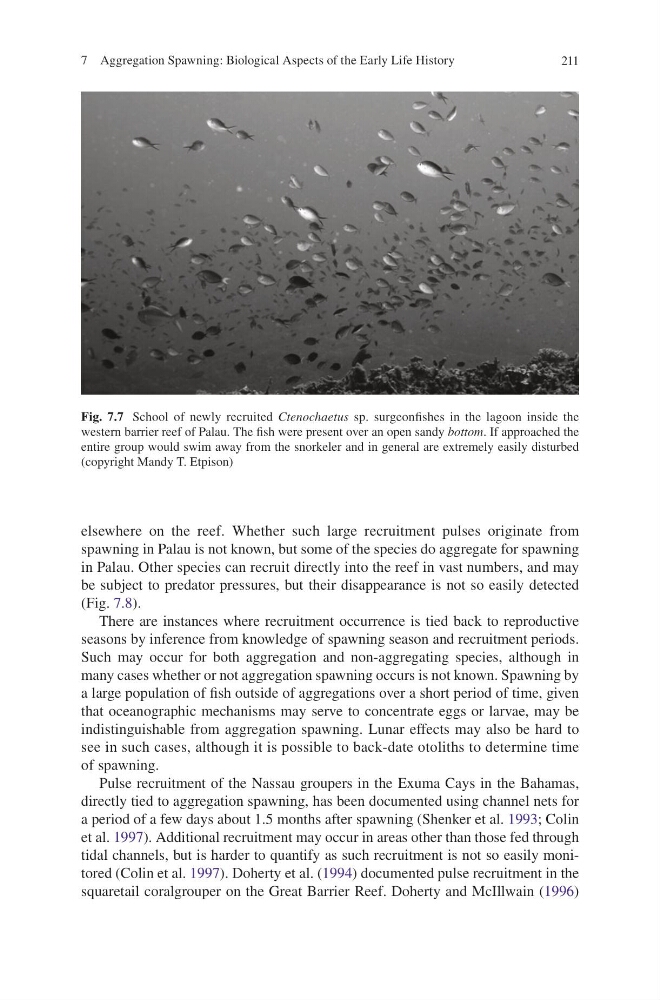
Fig. 7.7 School of newly recruited Ctenochaetus sp. surgeonfi shes in the lagoon inside the
western barrier reef of Palau. The fi sh were present over an open sandy bottom . If approached the
entire group would swim away from the snorkeler and in general are extremely easily disturbed
(copyright Mandy T. Etpison)
7 Aggregation Spawning: Biological Aspects of the Early Life History
elsewhere on the reef. Whether such large recruitment pulses originate from
spawning in Palau is not known, but some of the species do aggregate for spawning
in Palau. Other species can recruit directly into the reef in vast numbers, and may
be subject to predator pressures, but their disappearance is not so easily detected
(Fig. 7.8 ).
There are instances where recruitment occurrence is tied back to reproductive
seasons by inference from knowledge of spawning season and recruitment periods.
Such may occur for both aggregation and non-aggregating species, although in
many cases whether or not aggregation spawning occurs is not known. Spawning by
a large population of fi sh outside of aggregations over a short period of time, given
that oceanographic mechanisms may serve to concentrate eggs or larvae, may be
indistinguishable from aggregation spawning. Lunar effects may also be hard to
see in such cases, although it is possible to back-date otoliths to determine time
of spawning.
Pulse recruitment of the Nassau groupers in the Exuma Cays in the Bahamas,
directly tied to aggregation spawning, has been documented using channel nets for
a period of a few days about 1.5 months after spawning (Shenker et al. 1993 ; Colin
et al. 1997 ) . Additional recruitment may occur in areas other than those fed through
tidal channels, but is harder to quantify as such recruitment is not so easily monitored (Colin et al. 1997 ) . Doherty et al. ( 1994 ) documented pulse recruitment in the
squaretail coralgrouper on the Great Barrier Reef. Doherty and McIllwain ( 1996 )
Fig. 7.7 School of newly recruited Ctenochaetus sp. surgeonfi shes in the lagoon inside the
western barrier reef of Palau. The fi sh were present over an open sandy bottom . If approached the
entire group would swim away from the snorkeler and in general are extremely easily disturbed
(copyright Mandy T. Etpison)