

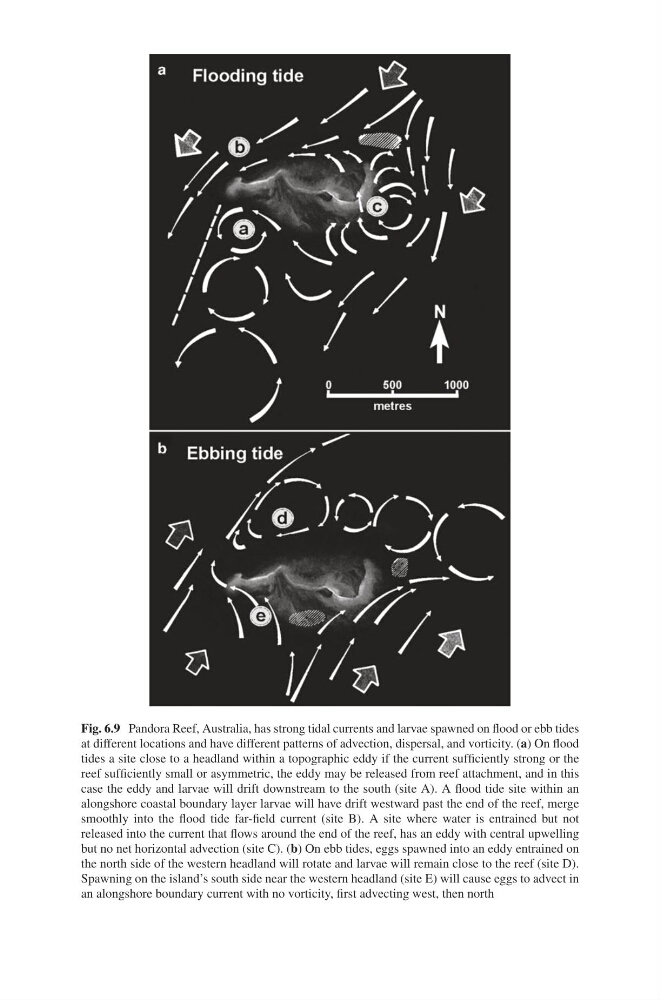
Fig. 6.9 Pandora Reef, Australia, has strong tidal currents and larvae spawned on fl ood or ebb tides
at different locations and have different patterns of advection, dispersal, and vorticity. ( a ) On fl ood
tides a site close to a headland within a topographic eddy if the current suffi ciently strong or the
reef suffi ciently small or asymmetric, the eddy may be released from reef attachment, and in this
case the eddy and larvae will drift downstream to the south (site A). A fl ood tide site within an
alongshore coastal boundary layer larvae will have drift westward past the end of the reef, merge
smoothly into the fl ood tide far-fi eld current (site B). A site where water is entrained but not
released into the current that fl ows around the end of the reef, has an eddy with central upwelling
but no net horizontal advection (site C). ( b ) On ebb tides, eggs spawned into an eddy entrained on
the north side of the western headland will rotate and larvae will remain close to the reef (site D).
Spawning on the island’s south side near the western headland (site E) will cause eggs to advect in
an alongshore boundary current with no vorticity, fi rst advecting west, then north
at different locations and have different patterns of advection, dispersal, and vorticity. ( a ) On fl ood
tides a site close to a headland within a topographic eddy if the current suffi ciently strong or the
reef suffi ciently small or asymmetric, the eddy may be released from reef attachment, and in this
case the eddy and larvae will drift downstream to the south (site A). A fl ood tide site within an
alongshore coastal boundary layer larvae will have drift westward past the end of the reef, merge
smoothly into the fl ood tide far-fi eld current (site B). A site where water is entrained but not
released into the current that fl ows around the end of the reef, has an eddy with central upwelling
but no net horizontal advection (site C). ( b ) On ebb tides, eggs spawned into an eddy entrained on
the north side of the western headland will rotate and larvae will remain close to the reef (site D).
Spawning on the island’s south side near the western headland (site E) will cause eggs to advect in
an alongshore boundary current with no vorticity, fi rst advecting west, then north