

179
6 Oceanography of the Planktonic Stages of Aggregation Spawning Reef Fishes
important for ground truth data on local fl ows. Current-following drifters are by far
the cheapest, quickest and easiest ways to measure local fl ow, and over the short
term (hours to a few days) they are believed to adequately mimic egg and larval
movements. Some methods to examine nearby fl ow patterns of water are included
in Chap. 9 .
Pandora Reef is a useful example of how clouds of eggs/larvae from potential
spawning sites near headlands can be transported from the reef into the open sea in
a smoothly fl owing CBL without vorticity or spawned into the vorticity of either an
entrained or free eddy fi eld (Hamner and Hauri 1981 ) . This reef (Fig. 6.9 ) is subject
to strong tidal currents within the Great Barrier Reef lagoon. Three different potential spawning sites on a fl ood tide are considered: one close to a headland within a
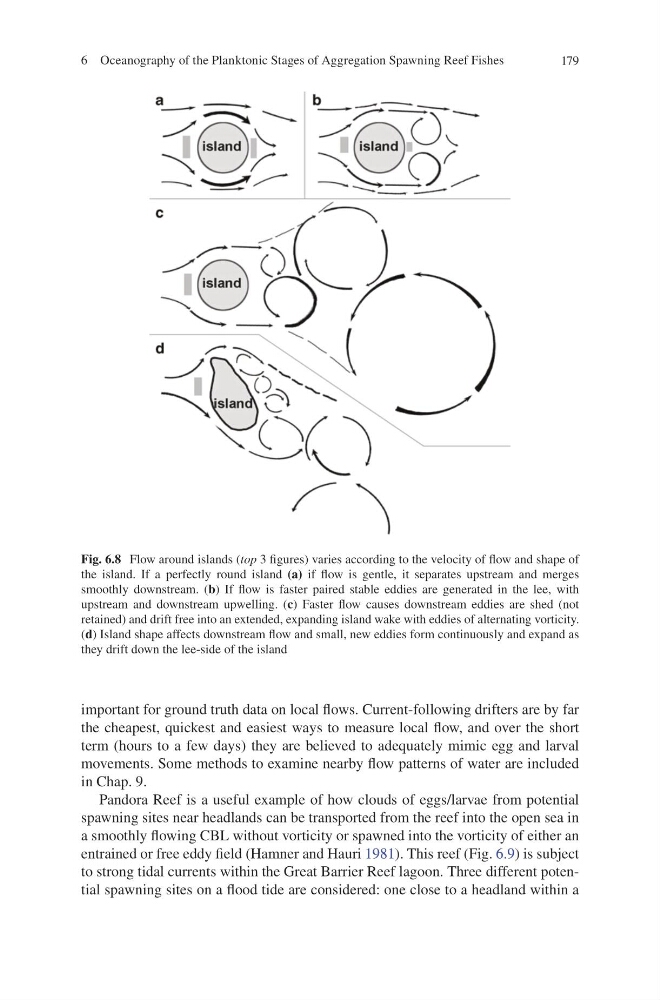
Fig. 6.8 Flow around islands ( top 3 fi gures) varies according to the velocity of fl ow and shape of
the island. If a perfectly round island (a) if fl ow is gentle, it separates upstream and merges
smoothly downstream. ( b ) If fl ow is faster paired stable eddies are generated in the lee, with
upstream and downstream upwelling. ( c ) Faster fl ow causes downstream eddies are shed (not
retained) and drift free into an extended, expanding island wake with eddies of alternating vorticity.
( d ) Island shape affects downstream fl ow and small, new eddies form continuously and expand as
they drift down the lee-side of the island
6 Oceanography of the Planktonic Stages of Aggregation Spawning Reef Fishes
important for ground truth data on local fl ows. Current-following drifters are by far
the cheapest, quickest and easiest ways to measure local fl ow, and over the short
term (hours to a few days) they are believed to adequately mimic egg and larval
movements. Some methods to examine nearby fl ow patterns of water are included
in Chap. 9 .
Pandora Reef is a useful example of how clouds of eggs/larvae from potential
spawning sites near headlands can be transported from the reef into the open sea in
a smoothly fl owing CBL without vorticity or spawned into the vorticity of either an
entrained or free eddy fi eld (Hamner and Hauri 1981 ) . This reef (Fig. 6.9 ) is subject
to strong tidal currents within the Great Barrier Reef lagoon. Three different potential spawning sites on a fl ood tide are considered: one close to a headland within a
Fig. 6.8 Flow around islands ( top 3 fi gures) varies according to the velocity of fl ow and shape of
the island. If a perfectly round island (a) if fl ow is gentle, it separates upstream and merges
smoothly downstream. ( b ) If fl ow is faster paired stable eddies are generated in the lee, with
upstream and downstream upwelling. ( c ) Faster fl ow causes downstream eddies are shed (not
retained) and drift free into an extended, expanding island wake with eddies of alternating vorticity.
( d ) Island shape affects downstream fl ow and small, new eddies form continuously and expand as
they drift down the lee-side of the island