

176
W.M. Hamner and J.L. Largier
It will be interesting in the future to learn how small herbivorous coral reef fi shes
manage to reproduce in situations other than as described above for Palau, on a barrier
reef subjected to strong tides and modest winds. Since small herbivorous fi shes
occur everywhere on all coral reefs, they undoubtedly will exhibit different patterns
of spawning elsewhere. For example, we do not know how these fi shes spawn on
windward reefs subjected to strong trade winds and continuous wave pounding. Nor
is it known how small herbivorous fi shes on small coral outcrops in the centre of
coral reef lagoons spawn, yet they must spawn into the surrounding lagoon because
small reef fi shes will not leave the shelter of the coral to swim alone over deep
water. If the reef fl at is exceptionally wide, will these small fi shes remain close to
their home range or will they migrate further to spawn? Clearly, more research is
needed on the behaviour of fi shes that form resident spawning aggregations and on
the fate and distribution of their eggs and larvae after becoming planktonic.
6.3.2 Transient Aggregation Spawning and Topographic Eddies
The fates of larvae spawned at the shelf edge by transient spawning aggregation
fi shes are often different from those spawned by resident aggregations. Transient
spawners are large, carnivorous fi shes that migrate considerable distances to
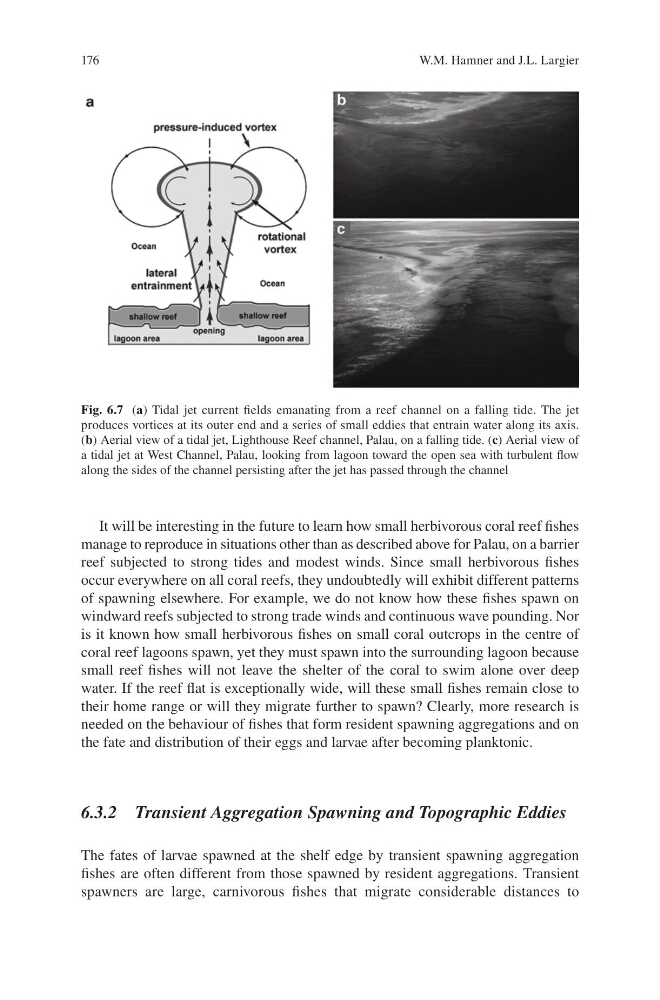
Fig. 6.7 ( a ) Tidal jet current fi elds emanating from a reef channel on a falling tide. The jet
produces vortices at its outer end and a series of small eddies that entrain water along its axis.
( b ) Aerial view of a tidal jet, Lighthouse Reef channel, Palau, on a falling tide. ( c ) Aerial view of
a tidal jet at West Channel, Palau, looking from lagoon toward the open sea with turbulent fl ow
along the sides of the channel persisting after the jet has passed through the channel
W.M. Hamner and J.L. Largier
It will be interesting in the future to learn how small herbivorous coral reef fi shes
manage to reproduce in situations other than as described above for Palau, on a barrier
reef subjected to strong tides and modest winds. Since small herbivorous fi shes
occur everywhere on all coral reefs, they undoubtedly will exhibit different patterns
of spawning elsewhere. For example, we do not know how these fi shes spawn on
windward reefs subjected to strong trade winds and continuous wave pounding. Nor
is it known how small herbivorous fi shes on small coral outcrops in the centre of
coral reef lagoons spawn, yet they must spawn into the surrounding lagoon because
small reef fi shes will not leave the shelter of the coral to swim alone over deep
water. If the reef fl at is exceptionally wide, will these small fi shes remain close to
their home range or will they migrate further to spawn? Clearly, more research is
needed on the behaviour of fi shes that form resident spawning aggregations and on
the fate and distribution of their eggs and larvae after becoming planktonic.
6.3.2 Transient Aggregation Spawning and Topographic Eddies
The fates of larvae spawned at the shelf edge by transient spawning aggregation
fi shes are often different from those spawned by resident aggregations. Transient
spawners are large, carnivorous fi shes that migrate considerable distances to
Fig. 6.7 ( a ) Tidal jet current fi elds emanating from a reef channel on a falling tide. The jet
produces vortices at its outer end and a series of small eddies that entrain water along its axis.
( b ) Aerial view of a tidal jet, Lighthouse Reef channel, Palau, on a falling tide. ( c ) Aerial view of
a tidal jet at West Channel, Palau, looking from lagoon toward the open sea with turbulent fl ow
along the sides of the channel persisting after the jet has passed through the channel