

175
6 Oceanography of the Planktonic Stages of Aggregation Spawning Reef Fishes
large, such as at the mouth of a large bay or river. Tidal jets through passes in
coral reefs are generally narrow, fast-fl owing features, typically ejected from narrow
passages or where fl ow separates from the shore (Wolanski and Hamner 1988 ) .
Many aggregations are believed to spawn eggs into tidal jets (see Figs. 2.6 and 5.13,
Chap. 12.10 ). Channels through the reef with associated tidal jets enhance offshore
fl ow during ebb tide and also augment fl ow back into the lagoon during fl ood tides,
often producing mid-channel axial convergent fronts during the return (Wolanski
and Hamner 1988 ) . Barrier reef channels in Palau are 15–70 m deep (Colin 2009 ) ,
they have strong fl ows up to about 10–12 m/s, and a number of species of fi shes
occur in transient spawning aggregations along the sides or bottoms of these channels.
Tidal jets in Palau (Fig. 6.7 ) move water from the CBL up to 2–3 km offshore during
ebb tides, but most drifters released into the eastern embayment during ebb tide
either returned toward the reef on fl ood tide or drifted along the reef in the CBL as
tidal currents slacked.
Thus, from the limited amount of information available (mostly from Palau), it
appears that resident spawning aggregations of coral reef fi shes release their spawn
at ebb tide each day into the nearest deep water, either a seaward facing reef front or
tidal channel. Associated with these topographic features is a tidal, coastal boundary
current that fl ows gently back and forth along the face of the reef. The length of the
reversing tidal excursion defi nes the temporal stability of the parcels of larvae-rich
water that move alongshore in the coastal boundary layer (i.e. early larvae of resident
aggregation spawning fi shes are entrained for several days or longer). The topography
of the fore-reef face, benthic rugosity, depth and linear sinuosity of the reef determine the shape of the embayments along the reef margin as well as the magnitude
of lateral trapping, sequestration, residence times and fl ushing rates of water,
plankton and fi sh larvae. Tidal jets clearly disrupt alongshore fl ow and enhance
cross-shore dispersion but generally these do not completely destroy the integrity of
the coastal boundary layer.
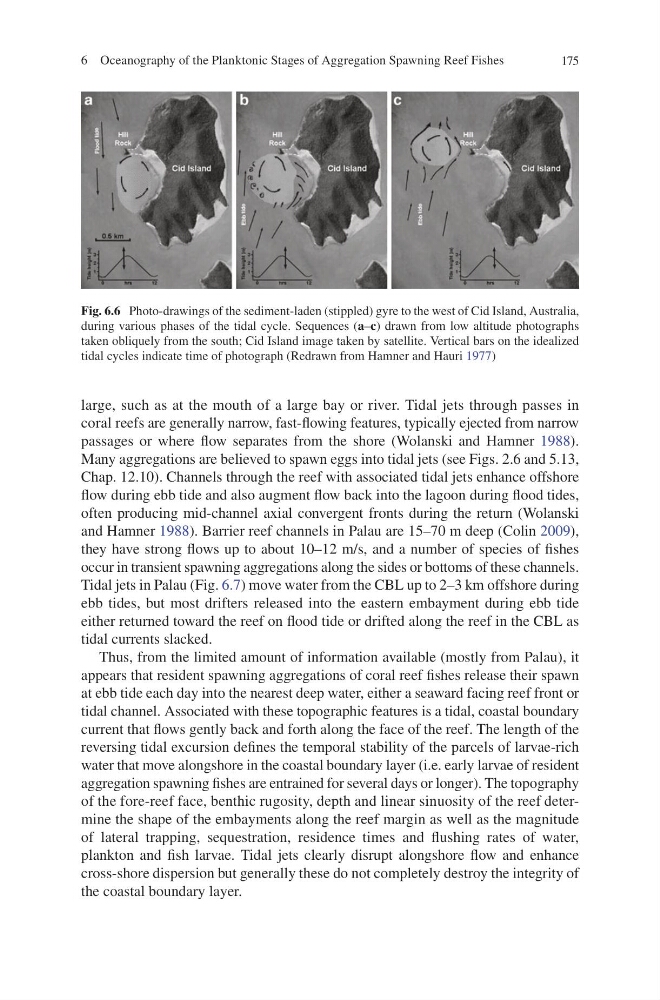
Fig. 6.6 Photo-drawings of the sediment-laden (stippled) gyre to the west of Cid Island, Australia,
during various phases of the tidal cycle. Sequences ( a – c ) drawn from low altitude photographs
taken obliquely from the south; Cid Island image taken by satellite. Vertical bars on the idealized
tidal cycles indicate time of photograph (Redrawn from Hamner and Hauri 1977 )
6 Oceanography of the Planktonic Stages of Aggregation Spawning Reef Fishes
large, such as at the mouth of a large bay or river. Tidal jets through passes in
coral reefs are generally narrow, fast-fl owing features, typically ejected from narrow
passages or where fl ow separates from the shore (Wolanski and Hamner 1988 ) .
Many aggregations are believed to spawn eggs into tidal jets (see Figs. 2.6 and 5.13,
Chap. 12.10 ). Channels through the reef with associated tidal jets enhance offshore
fl ow during ebb tide and also augment fl ow back into the lagoon during fl ood tides,
often producing mid-channel axial convergent fronts during the return (Wolanski
and Hamner 1988 ) . Barrier reef channels in Palau are 15–70 m deep (Colin 2009 ) ,
they have strong fl ows up to about 10–12 m/s, and a number of species of fi shes
occur in transient spawning aggregations along the sides or bottoms of these channels.
Tidal jets in Palau (Fig. 6.7 ) move water from the CBL up to 2–3 km offshore during
ebb tides, but most drifters released into the eastern embayment during ebb tide
either returned toward the reef on fl ood tide or drifted along the reef in the CBL as
tidal currents slacked.
Thus, from the limited amount of information available (mostly from Palau), it
appears that resident spawning aggregations of coral reef fi shes release their spawn
at ebb tide each day into the nearest deep water, either a seaward facing reef front or
tidal channel. Associated with these topographic features is a tidal, coastal boundary
current that fl ows gently back and forth along the face of the reef. The length of the
reversing tidal excursion defi nes the temporal stability of the parcels of larvae-rich
water that move alongshore in the coastal boundary layer (i.e. early larvae of resident
aggregation spawning fi shes are entrained for several days or longer). The topography
of the fore-reef face, benthic rugosity, depth and linear sinuosity of the reef determine the shape of the embayments along the reef margin as well as the magnitude
of lateral trapping, sequestration, residence times and fl ushing rates of water,
plankton and fi sh larvae. Tidal jets clearly disrupt alongshore fl ow and enhance
cross-shore dispersion but generally these do not completely destroy the integrity of
the coastal boundary layer.
Fig. 6.6 Photo-drawings of the sediment-laden (stippled) gyre to the west of Cid Island, Australia,
during various phases of the tidal cycle. Sequences ( a – c ) drawn from low altitude photographs
taken obliquely from the south; Cid Island image taken by satellite. Vertical bars on the idealized
tidal cycles indicate time of photograph (Redrawn from Hamner and Hauri 1977 )