

163
6 Oceanography of the Planktonic Stages of Aggregation Spawning Reef Fishes
time period (as discussed above). Determination of typical “recruitment pathways”
from an aggregation site requires consideration of many realizations and has most
often been theoretically examined through biophysical modelling (e.g. Paris et al.
2005 ) . While it is possible in principle to measure actual dispersal from an aggregation spawning site over a time period consistent with the entire pelagic stage of a
fi sh (Domeier 2004 ) , the method of determining such dispersal is subject to numerous unknowns which reduce the specifi city of the data and one would need to repeat
this study numerous times to obtain a typical recruitment pathway.
6.2.1 A Simple Model of Dispersion
Here we outline the scale of the initial dispersion of fertilized eggs, and relate it to
aggregation-spawning, with a view to better understanding the possible costs and
benefi ts of this reproductive strategy. Once released, planktonic eggs are carried by
the moving water and mixed outward as a dispersing cloud. Each egg is a “particle”
which follows an unpredictable path due to the infl uence of multiple fl ow features
on different scales and the ubiquitous presence of turbulence; however, there are
probable dispersion patterns related to the overall nature of the fl uid fl ow.
Given the stochastic nature of propagule dispersion, it is best to model the
process as a “random walk” (e.g. Siegel et al. 2008 ) , which allows the variability in
outcomes to be seen. However, this requires knowledge of the three-dimensional,
time-varying fl ow fi eld at the time of each spawning event. In reality, we have only
rudimentary knowledge of water fl ows during spawning and can only make limited
scale-estimates of the probable patterns of dispersion. For this purpose, one averages
over multiple spawning events (in space and time) to develop an advection-diffusion
view of dispersion at the scale of the population. In this approach, the typical or
mean fl ow over the time and spatial scale of interest is estimated and referred to as
“advection” (in oceanography the horizontal movement of water) and the zeromean variability in fl ows during this time of interest is estimated and referred to as
“diffusion” – net outward movement of particles from an area of higher to lower
concentration (e.g. Largier 2003 ) . Note that in this simplifi ed approach “shear
dispersion” due to mixing across shear in the mean fl ow is subsumed in the alongfl ow diffusion term. Also, when referring specifi cally to the transport of those
propagules that successfully recruit in adult habitat, the process is called “dispersal”.
This advection-diffusion approach is not intended to provide single-burst predictions,
but rather to represent a probable outcome for numerous releases of eggs (or even
over repeated spawning by the same population cohort) for a given spawning
location and time period.
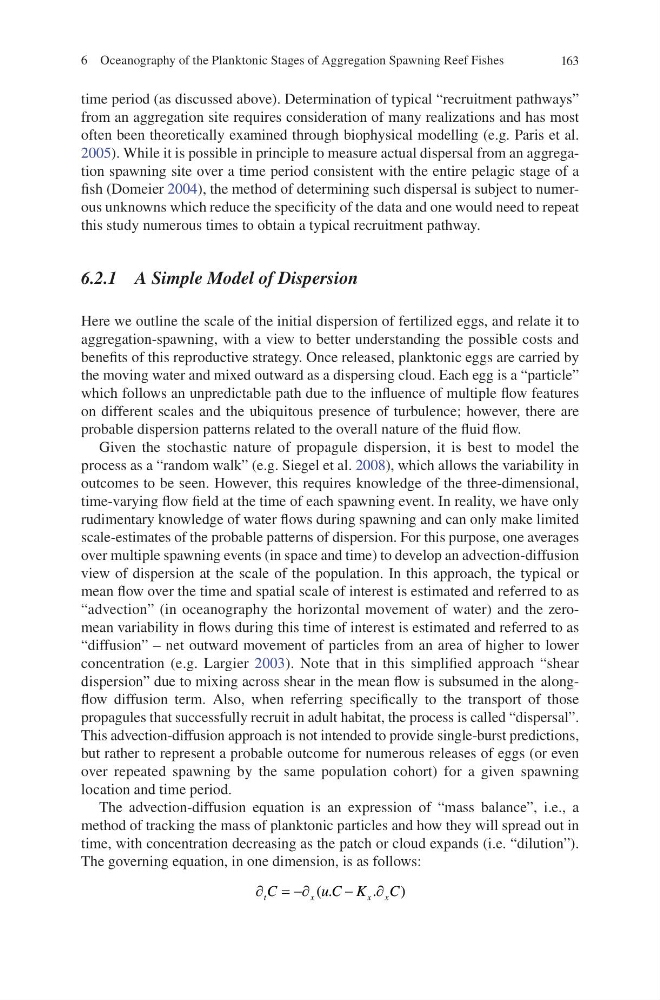
The advection-diffusion equation is an expression of “mass balance”, i.e., a
method of tracking the mass of planktonic particles and how they will spread out in
time, with concentration decreasing as the patch or cloud expands (i.e. “dilution”).
The governing equation, in one dimension, is as follows:
¶ = -
-

( .
.
)
t
x
x
x
C
uC K
C
6 Oceanography of the Planktonic Stages of Aggregation Spawning Reef Fishes
time period (as discussed above). Determination of typical “recruitment pathways”
from an aggregation site requires consideration of many realizations and has most
often been theoretically examined through biophysical modelling (e.g. Paris et al.
2005 ) . While it is possible in principle to measure actual dispersal from an aggregation spawning site over a time period consistent with the entire pelagic stage of a
fi sh (Domeier 2004 ) , the method of determining such dispersal is subject to numerous unknowns which reduce the specifi city of the data and one would need to repeat
this study numerous times to obtain a typical recruitment pathway.
6.2.1 A Simple Model of Dispersion
Here we outline the scale of the initial dispersion of fertilized eggs, and relate it to
aggregation-spawning, with a view to better understanding the possible costs and
benefi ts of this reproductive strategy. Once released, planktonic eggs are carried by
the moving water and mixed outward as a dispersing cloud. Each egg is a “particle”
which follows an unpredictable path due to the infl uence of multiple fl ow features
on different scales and the ubiquitous presence of turbulence; however, there are
probable dispersion patterns related to the overall nature of the fl uid fl ow.
Given the stochastic nature of propagule dispersion, it is best to model the
process as a “random walk” (e.g. Siegel et al. 2008 ) , which allows the variability in
outcomes to be seen. However, this requires knowledge of the three-dimensional,
time-varying fl ow fi eld at the time of each spawning event. In reality, we have only
rudimentary knowledge of water fl ows during spawning and can only make limited
scale-estimates of the probable patterns of dispersion. For this purpose, one averages
over multiple spawning events (in space and time) to develop an advection-diffusion
view of dispersion at the scale of the population. In this approach, the typical or
mean fl ow over the time and spatial scale of interest is estimated and referred to as
“advection” (in oceanography the horizontal movement of water) and the zeromean variability in fl ows during this time of interest is estimated and referred to as
“diffusion” – net outward movement of particles from an area of higher to lower
concentration (e.g. Largier 2003 ) . Note that in this simplifi ed approach “shear
dispersion” due to mixing across shear in the mean fl ow is subsumed in the alongfl ow diffusion term. Also, when referring specifi cally to the transport of those
propagules that successfully recruit in adult habitat, the process is called “dispersal”.
This advection-diffusion approach is not intended to provide single-burst predictions,
but rather to represent a probable outcome for numerous releases of eggs (or even
over repeated spawning by the same population cohort) for a given spawning
location and time period.
The advection-diffusion equation is an expression of “mass balance”, i.e., a
method of tracking the mass of planktonic particles and how they will spread out in
time, with concentration decreasing as the patch or cloud expands (i.e. “dilution”).
The governing equation, in one dimension, is as follows:
¶ = -
-

( .
.
)
t
x
x
x
C
uC K
C