

162
W.M. Hamner and J.L. Largier
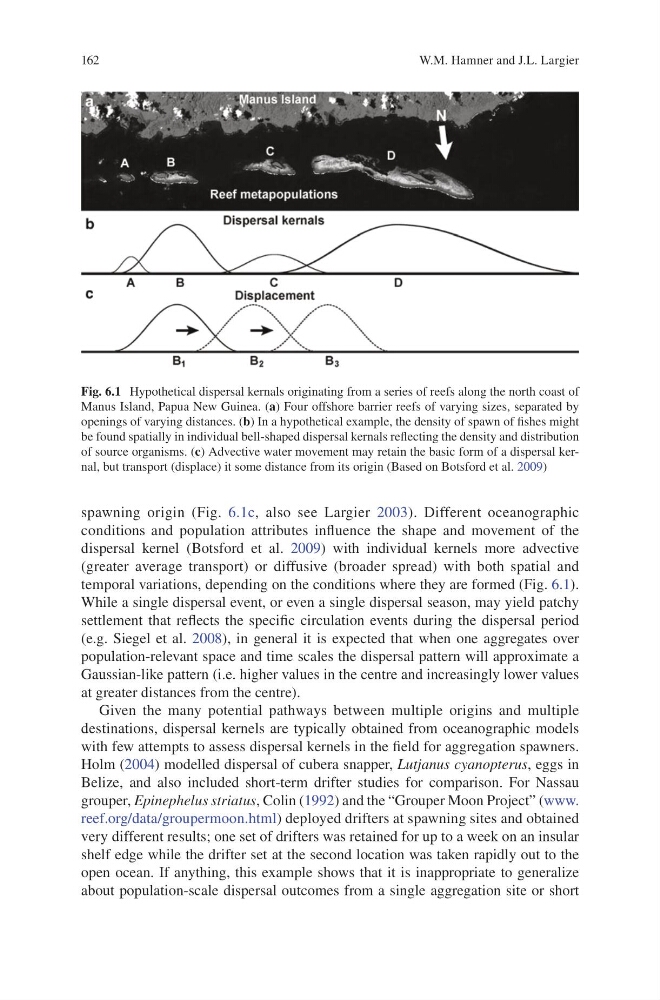
spawning origin (Fig. 6.1c , also see Largier 2003 ) . Different oceanographic
conditions and population attributes infl uence the shape and movement of the
dispersal kernel (Botsford et al. 2009 ) with individual kernels more advective
(greater average transport) or diffusive (broader spread) with both spatial and
temporal variations, depending on the conditions where they are formed (Fig. 6.1 ).
While a single dispersal event, or even a single dispersal season, may yield patchy
settlement that refl ects the specifi c circulation events during the dispersal period
(e.g. Siegel et al. 2008 ) , in general it is expected that when one aggregates over
population-relevant space and time scales the dispersal pattern will approximate a
Gaussian-like pattern (i.e. higher values in the centre and increasingly lower values
at greater distances from the centre).
Given the many potential pathways between multiple origins and multiple
destinations, dispersal kernels are typically obtained from oceanographic models
with few attempts to assess dispersal kernels in the fi eld for aggregation spawners.
Holm ( 2004 ) modelled dispersal of cubera snapper, Lutjanus cyanopterus , eggs in
Belize, and also included short-term drifter studies for comparison. For Nassau
grouper, Epinephelus striatus , Colin ( 1992 ) and the “Grouper Moon Project” ( www.
reef.org/data/groupermoon.html ) deployed drifters at spawning sites and obtained
very different results; one set of drifters was retained for up to a week on an insular
shelf edge while the drifter set at the second location was taken rapidly out to the
open ocean. If anything, this example shows that it is inappropriate to generalize
about population-scale dispersal outcomes from a single aggregation site or short
Fig. 6.1 Hypothetical dispersal kernals originating from a series of reefs along the north coast of
Manus Island, Papua New Guinea. ( a ) Four offshore barrier reefs of varying sizes, separated by
openings of varying distances. ( b ) In a hypothetical example, the density of spawn of fi shes might
be found spatially in individual bell-shaped dispersal kernals refl ecting the density and distribution
of source organisms. ( c ) Advective water movement may retain the basic form of a dispersal kernal, but transport (displace) it some distance from its origin (Based on Botsford et al. 2009 )
W.M. Hamner and J.L. Largier
spawning origin (Fig. 6.1c , also see Largier 2003 ) . Different oceanographic
conditions and population attributes infl uence the shape and movement of the
dispersal kernel (Botsford et al. 2009 ) with individual kernels more advective
(greater average transport) or diffusive (broader spread) with both spatial and
temporal variations, depending on the conditions where they are formed (Fig. 6.1 ).
While a single dispersal event, or even a single dispersal season, may yield patchy
settlement that refl ects the specifi c circulation events during the dispersal period
(e.g. Siegel et al. 2008 ) , in general it is expected that when one aggregates over
population-relevant space and time scales the dispersal pattern will approximate a
Gaussian-like pattern (i.e. higher values in the centre and increasingly lower values
at greater distances from the centre).
Given the many potential pathways between multiple origins and multiple
destinations, dispersal kernels are typically obtained from oceanographic models
with few attempts to assess dispersal kernels in the fi eld for aggregation spawners.
Holm ( 2004 ) modelled dispersal of cubera snapper, Lutjanus cyanopterus , eggs in
Belize, and also included short-term drifter studies for comparison. For Nassau
grouper, Epinephelus striatus , Colin ( 1992 ) and the “Grouper Moon Project” ( www.
reef.org/data/groupermoon.html ) deployed drifters at spawning sites and obtained
very different results; one set of drifters was retained for up to a week on an insular
shelf edge while the drifter set at the second location was taken rapidly out to the
open ocean. If anything, this example shows that it is inappropriate to generalize
about population-scale dispersal outcomes from a single aggregation site or short
Fig. 6.1 Hypothetical dispersal kernals originating from a series of reefs along the north coast of
Manus Island, Papua New Guinea. ( a ) Four offshore barrier reefs of varying sizes, separated by
openings of varying distances. ( b ) In a hypothetical example, the density of spawn of fi shes might
be found spatially in individual bell-shaped dispersal kernals refl ecting the density and distribution
of source organisms. ( c ) Advective water movement may retain the basic form of a dispersal kernal, but transport (displace) it some distance from its origin (Based on Botsford et al. 2009 )