

125
5 Timing and Location of Aggregation and Spawning in Reef Fishes
greater than 90° are considered to represent “corners” or if greatly rounded “bends”.
When a promontory is a large-scale feature, it may appear acute (less than 90°) in a
satellite or aerial image, but when viewed from the water’s surface or underwater it
appears to be a gently rounded feature (Promontory “A” in Fig. 5.3 ).
The grouping of reef projections at different scale levels is somewhat arbitrary,
but is a useful starting point for comparative purposes. Large-scale promontories
project a kilometre or more from the general reef profi le or form the terminal end of
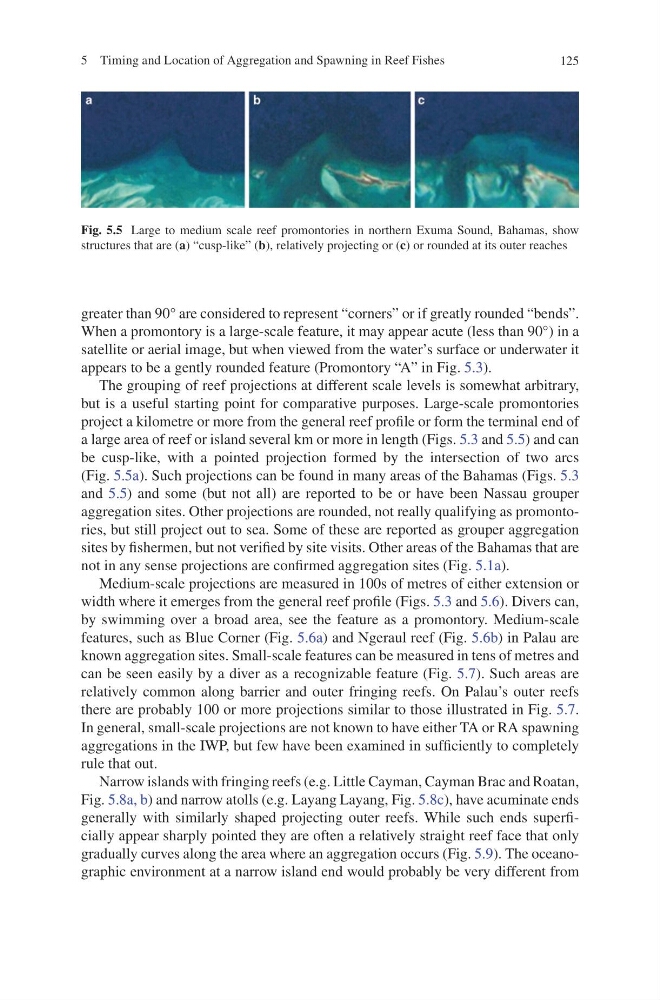
a large area of reef or island several km or more in length (Figs. 5.3 and 5.5 ) and can
be cusp-like, with a pointed projection formed by the intersection of two arcs
(Fig. 5.5a ). Such projections can be found in many areas of the Bahamas (Figs. 5.3
and 5.5 ) and some (but not all) are reported to be or have been Nassau grouper
aggregation sites. Other projections are rounded, not really qualifying as promontories, but still project out to sea. Some of these are reported as grouper aggregation
sites by fi shermen, but not verifi ed by site visits. Other areas of the Bahamas that are
not in any sense projections are confi rmed aggregation sites (Fig . 5.1a ).
Medium-scale projections are measured in 100s of metres of either extension or
width where it emerges from the general reef profi le (Figs. 5.3 and 5.6 ). Divers can,
by swimming over a broad area, see the feature as a promontory. Medium-scale
features, such as Blue Corner (Fig. 5.6a ) and Ngeraul reef (Fig. 5.6b ) in Palau are
known aggregation sites. Small-scale features can be measured in tens of metres and
can be seen easily by a diver as a recognizable feature (Fig. 5.7 ). Such areas are
relatively common along barrier and outer fringing reefs. On Palau’s outer reefs
there are probably 100 or more projections similar to those illustrated in Fig. 5.7 .
In general, small-scale projections are not known to have either TA or RA spawning
aggregations in the IWP, but few have been examined in suffi ciently to completely
rule that out.
Narrow islands with fringing reefs (e.g. Little Cayman, Cayman Brac and Roatan,
Fig. 5.8a, b ) and narrow atolls (e.g. Layang Layang, Fig. 5.8c ), have acuminate ends
generally with similarly shaped projecting outer reefs. While such ends superfi -
cially appear sharply pointed they are often a relatively straight reef face that only
gradually curves along the area where an aggregation occurs (Fig. 5.9 ). The oceanographic environment at a narrow island end would probably be very different from
Fig. 5.5 Large to medium scale reef promontories in northern Exuma Sound, Bahamas, show
structures that are ( a ) “cusp-like” ( b ), relatively projecting or ( c ) or rounded at its outer reaches
5 Timing and Location of Aggregation and Spawning in Reef Fishes
greater than 90° are considered to represent “corners” or if greatly rounded “bends”.
When a promontory is a large-scale feature, it may appear acute (less than 90°) in a
satellite or aerial image, but when viewed from the water’s surface or underwater it
appears to be a gently rounded feature (Promontory “A” in Fig. 5.3 ).
The grouping of reef projections at different scale levels is somewhat arbitrary,
but is a useful starting point for comparative purposes. Large-scale promontories
project a kilometre or more from the general reef profi le or form the terminal end of
a large area of reef or island several km or more in length (Figs. 5.3 and 5.5 ) and can
be cusp-like, with a pointed projection formed by the intersection of two arcs
(Fig. 5.5a ). Such projections can be found in many areas of the Bahamas (Figs. 5.3
and 5.5 ) and some (but not all) are reported to be or have been Nassau grouper
aggregation sites. Other projections are rounded, not really qualifying as promontories, but still project out to sea. Some of these are reported as grouper aggregation
sites by fi shermen, but not verifi ed by site visits. Other areas of the Bahamas that are
not in any sense projections are confi rmed aggregation sites (Fig . 5.1a ).
Medium-scale projections are measured in 100s of metres of either extension or
width where it emerges from the general reef profi le (Figs. 5.3 and 5.6 ). Divers can,
by swimming over a broad area, see the feature as a promontory. Medium-scale
features, such as Blue Corner (Fig. 5.6a ) and Ngeraul reef (Fig. 5.6b ) in Palau are
known aggregation sites. Small-scale features can be measured in tens of metres and
can be seen easily by a diver as a recognizable feature (Fig. 5.7 ). Such areas are
relatively common along barrier and outer fringing reefs. On Palau’s outer reefs
there are probably 100 or more projections similar to those illustrated in Fig. 5.7 .
In general, small-scale projections are not known to have either TA or RA spawning
aggregations in the IWP, but few have been examined in suffi ciently to completely
rule that out.
Narrow islands with fringing reefs (e.g. Little Cayman, Cayman Brac and Roatan,
Fig. 5.8a, b ) and narrow atolls (e.g. Layang Layang, Fig. 5.8c ), have acuminate ends
generally with similarly shaped projecting outer reefs. While such ends superfi -
cially appear sharply pointed they are often a relatively straight reef face that only
gradually curves along the area where an aggregation occurs (Fig. 5.9 ). The oceanographic environment at a narrow island end would probably be very different from
Fig. 5.5 Large to medium scale reef promontories in northern Exuma Sound, Bahamas, show
structures that are ( a ) “cusp-like” ( b ), relatively projecting or ( c ) or rounded at its outer reaches