

124
P.L. Colin
portions of reefs may not have the same profi le; a linear section of shallow reef may
have deeper projections or incised areas with steep faces. Features, such as projections, can be large, medium or small scale and often the same terms have been
applied to features at all scales (Fig. 5.3 ). Promontory is a term often used (and
misused) to describe a projection of reef relative to spawning aggregations, including
redundant terms for a promontory, such as “salient promontory” (Heyman and
Kjerfve 2008 ) and “a prominent reef promontory” (Rhodes 2003 ) . Promontory has
not been defi ned or characterized by most researchers. Features termed promontories
range from major reef structures several km across to small submerged projections
on a reef, about two orders of magnitude different in scale. The general defi nition of
a promontory as “a high point of land or rock projecting into a body of water” is
applicable in some cases (Heyman et al. 2005 ) . Others features, such as a bend in
the reef, have also been called promontories (Fig. 5.1b ).
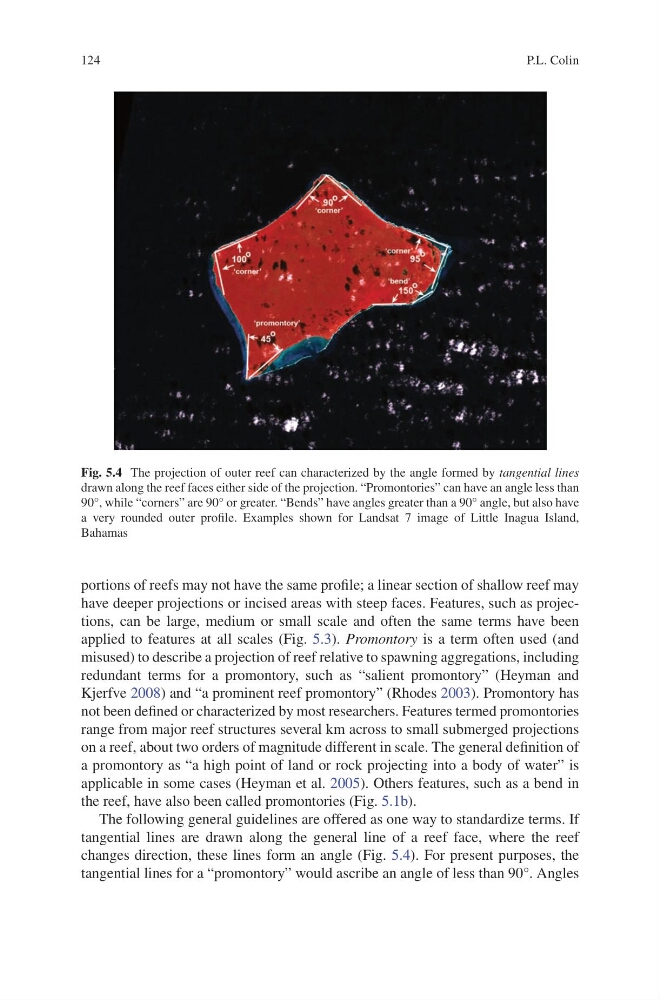
The following general guidelines are offered as one way to standardize terms. If
tangential lines are drawn along the general line of a reef face, where the reef
changes direction, these lines form an angle (Fig. 5.4 ). For present purposes, the
tangential lines for a “promontory” would ascribe an angle of less than 90°. Angles
Fig. 5.4 The projection of outer reef can characterized by the angle formed by tangential lines
drawn along the reef faces either side of the projection. “Promontories” can have an angle less than
90°, while “corners” are 90° or greater. “Bends” have angles greater than a 90° angle, but also have
a very rounded outer profi le. Examples shown for Landsat 7 image of Little Inagua Island,
Bahamas
P.L. Colin
portions of reefs may not have the same profi le; a linear section of shallow reef may
have deeper projections or incised areas with steep faces. Features, such as projections, can be large, medium or small scale and often the same terms have been
applied to features at all scales (Fig. 5.3 ). Promontory is a term often used (and
misused) to describe a projection of reef relative to spawning aggregations, including
redundant terms for a promontory, such as “salient promontory” (Heyman and
Kjerfve 2008 ) and “a prominent reef promontory” (Rhodes 2003 ) . Promontory has
not been defi ned or characterized by most researchers. Features termed promontories
range from major reef structures several km across to small submerged projections
on a reef, about two orders of magnitude different in scale. The general defi nition of
a promontory as “a high point of land or rock projecting into a body of water” is
applicable in some cases (Heyman et al. 2005 ) . Others features, such as a bend in
the reef, have also been called promontories (Fig. 5.1b ).
The following general guidelines are offered as one way to standardize terms. If
tangential lines are drawn along the general line of a reef face, where the reef
changes direction, these lines form an angle (Fig. 5.4 ). For present purposes, the
tangential lines for a “promontory” would ascribe an angle of less than 90°. Angles
Fig. 5.4 The projection of outer reef can characterized by the angle formed by tangential lines
drawn along the reef faces either side of the projection. “Promontories” can have an angle less than
90°, while “corners” are 90° or greater. “Bends” have angles greater than a 90° angle, but also have
a very rounded outer profi le. Examples shown for Landsat 7 image of Little Inagua Island,
Bahamas