

87
4 Spawning Aggregations in Reef Fishes; Ecological and Evolutionary Processes
life history features this implies that the formation of spawning aggregations is
based on very general biological processes such as those that enhance the reproductive
success of individuals or result in reductions in juvenile mortality. If so, this suggests
that growth rates, longevity or sexual ontogeny have little infl uence on how aggregations form. This question will be a primary consideration in the development of
this chapter.
The material for the study of aggregations, especially that relating to commercially
important species is listed in the SCRFA database (SCRFA 2009 www.SCRFA.org )
and is summarized in the initial chapters of this book (Chap. 1 , Appendix). These
record the number of species in which spawning aggregations have been proposed
either on the basis of direct evidence (spawning observation, presence of hydrated
eggs) or indirectly (seasonal peaks in reproductive activity, aggregating behaviour),
and provide a basis for assessing the ecological and evolutionary variety within the
different spawning modes, resident and transient. The record to date demonstrates
that aggregations are dominated by relatively few lineages of reef-associated fi shes.
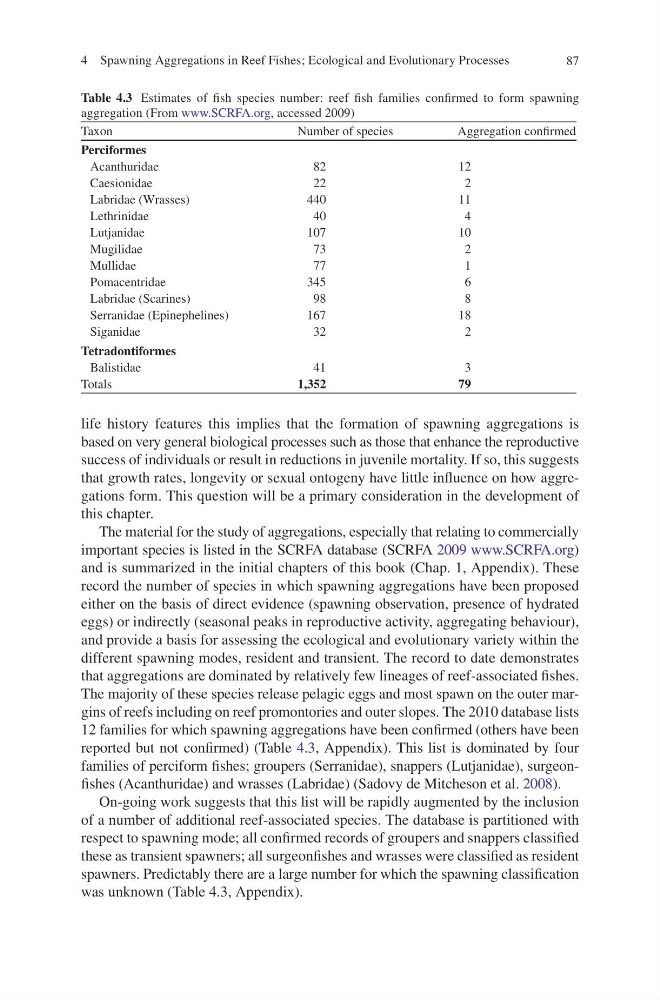
The majority of these species release pelagic eggs and most spawn on the outer margins of reefs including on reef promontories and outer slopes. The 2010 database lists
12 families for which spawning aggregations have been confi rmed ( others have been
reported but not confi rmed) (Table 4.3 , Appendix ). This list is dominated by four
families of perciform fi shes; groupers (Serranidae), snappers (Lutjanidae), surgeonfi shes (Acanthuridae) and wrasses (Labridae) (Sadovy de Mitcheson et al. 2008 ) .
On-going work suggests that this list will be rapidly augmented by the inclusion
of a number of additional reef-associated species. The database is partitioned with
respect to spawning mode; all confi rmed records of groupers and snappers classifi ed
these as transient spawners; all surgeonfi shes and wrasses were classifi ed as resident
spawners. Predictably there are a large number for which the spawning classifi cation
was unknown (Table 4.3, Appendix).
Table 4.3 Estimates of fi sh species number: reef fi sh families confi rmed to form spawning
aggregation (From www.SCRFA.org , accessed 2009)
Taxon
Number of species
Aggregation confi rmed
Perciformes
Acanthuridae
82
12
Caesionidae
22
2
Labridae (Wrasses)
440
11
Lethrinidae
40
4
Lutjanidae
107
10
Mugilidae
73
2
Mullidae
77
1
Pomacentridae
345
6
Labridae (Scarines)
98
8
Serranidae (Epinephelines)
167
18
Siganidae
32
2
Tetradontiformes
Balistidae
41
3
Totals
1,352
79
4 Spawning Aggregations in Reef Fishes; Ecological and Evolutionary Processes
life history features this implies that the formation of spawning aggregations is
based on very general biological processes such as those that enhance the reproductive
success of individuals or result in reductions in juvenile mortality. If so, this suggests
that growth rates, longevity or sexual ontogeny have little infl uence on how aggregations form. This question will be a primary consideration in the development of
this chapter.
The material for the study of aggregations, especially that relating to commercially
important species is listed in the SCRFA database (SCRFA 2009 www.SCRFA.org )
and is summarized in the initial chapters of this book (Chap. 1 , Appendix). These
record the number of species in which spawning aggregations have been proposed
either on the basis of direct evidence (spawning observation, presence of hydrated
eggs) or indirectly (seasonal peaks in reproductive activity, aggregating behaviour),
and provide a basis for assessing the ecological and evolutionary variety within the
different spawning modes, resident and transient. The record to date demonstrates
that aggregations are dominated by relatively few lineages of reef-associated fi shes.
The majority of these species release pelagic eggs and most spawn on the outer margins of reefs including on reef promontories and outer slopes. The 2010 database lists
12 families for which spawning aggregations have been confi rmed ( others have been
reported but not confi rmed) (Table 4.3 , Appendix ). This list is dominated by four
families of perciform fi shes; groupers (Serranidae), snappers (Lutjanidae), surgeonfi shes (Acanthuridae) and wrasses (Labridae) (Sadovy de Mitcheson et al. 2008 ) .
On-going work suggests that this list will be rapidly augmented by the inclusion
of a number of additional reef-associated species. The database is partitioned with
respect to spawning mode; all confi rmed records of groupers and snappers classifi ed
these as transient spawners; all surgeonfi shes and wrasses were classifi ed as resident
spawners. Predictably there are a large number for which the spawning classifi cation
was unknown (Table 4.3, Appendix).
Table 4.3 Estimates of fi sh species number: reef fi sh families confi rmed to form spawning
aggregation (From www.SCRFA.org , accessed 2009)
Taxon
Number of species
Aggregation confi rmed
Perciformes
Acanthuridae
82
12
Caesionidae
22
2
Labridae (Wrasses)
440
11
Lethrinidae
40
4
Lutjanidae
107
10
Mugilidae
73
2
Mullidae
77
1
Pomacentridae
345
6
Labridae (Scarines)
98
8
Serranidae (Epinephelines)
167
18
Siganidae
32
2
Tetradontiformes
Balistidae
41
3
Totals
1,352
79