

437
23 Octopus vulgaris. Paralarval Culture
planktonic stage have increased considerably in the past decades, successful juvenile settlement is still very difficult to achieve.
23.4.1 Paralarvae Collection and Transfer
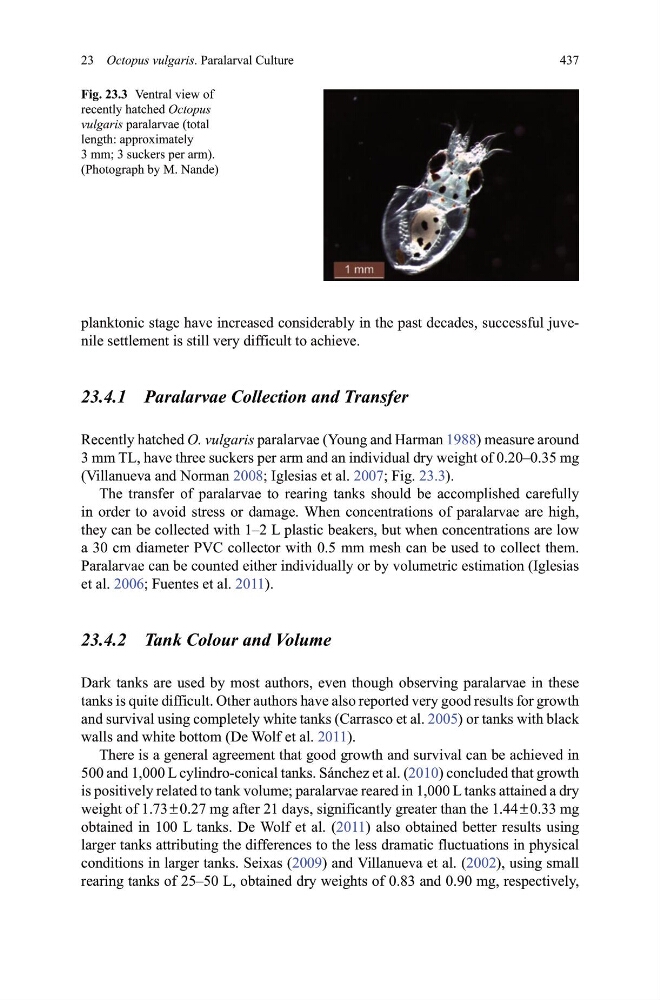
Recently hatched O� vulgaris paralarvae (Young and Harman 1988) measure around
3 mm TL, have three suckers per arm and an individual dry weight of 0.20–0.35 mg
(Villanueva and Norman 2008; Iglesias et al. 2007; Fig. 23.3).
The transfer of paralarvae to rearing tanks should be accomplished carefully
in order to avoid stress or damage. When concentrations of paralarvae are high,
they can be collected with 1–2 L plastic beakers, but when concentrations are low
a 30 cm diameter PVC collector with 0.5 mm mesh can be used to collect them.
Paralarvae can be counted either individually or by volumetric estimation (Iglesias
et al. 2006; Fuentes et al. 2011).
23.4.2 Tank Colour and Volume
Dark tanks are used by most authors, even though observing paralarvae in these
tanks is quite difficult. Other authors have also reported very good results for growth
and survival using completely white tanks (Carrasco et al. 2005) or tanks with black
walls and white bottom (De Wolf et al. 2011).
There is a general agreement that good growth and survival can be achieved in
500 and 1,000 L cylindro-conical tanks. Sánchez et al. (2010) concluded that growth
is positively related to tank volume; paralarvae reared in 1,000 L tanks attained a dry
weight of 1.73 ± 0.27 mg after 21 days, significantly greater than the 1.44 ± 0.33 mg
obtained in 100 L tanks. De Wolf et al. (2011) also obtained better results using
larger tanks attributing the differences to the less dramatic fluctuations in physical
conditions in larger tanks. Seixas (2009) and Villanueva et al. (2002), using small
rearing tanks of 25–50 L, obtained dry weights of 0.83 and 0.90 mg, respectively,
Fig. 23.3 Ventral view of
recently hatched Octopus
vulgaris paralarvae (total
length: approximately
3 mm; 3 suckers per arm).
(Photograph by M. Nande)
23 Octopus vulgaris. Paralarval Culture
planktonic stage have increased considerably in the past decades, successful juvenile settlement is still very difficult to achieve.
23.4.1 Paralarvae Collection and Transfer
Recently hatched O� vulgaris paralarvae (Young and Harman 1988) measure around
3 mm TL, have three suckers per arm and an individual dry weight of 0.20–0.35 mg
(Villanueva and Norman 2008; Iglesias et al. 2007; Fig. 23.3).
The transfer of paralarvae to rearing tanks should be accomplished carefully
in order to avoid stress or damage. When concentrations of paralarvae are high,
they can be collected with 1–2 L plastic beakers, but when concentrations are low
a 30 cm diameter PVC collector with 0.5 mm mesh can be used to collect them.
Paralarvae can be counted either individually or by volumetric estimation (Iglesias
et al. 2006; Fuentes et al. 2011).
23.4.2 Tank Colour and Volume
Dark tanks are used by most authors, even though observing paralarvae in these
tanks is quite difficult. Other authors have also reported very good results for growth
and survival using completely white tanks (Carrasco et al. 2005) or tanks with black
walls and white bottom (De Wolf et al. 2011).
There is a general agreement that good growth and survival can be achieved in
500 and 1,000 L cylindro-conical tanks. Sánchez et al. (2010) concluded that growth
is positively related to tank volume; paralarvae reared in 1,000 L tanks attained a dry
weight of 1.73 ± 0.27 mg after 21 days, significantly greater than the 1.44 ± 0.33 mg
obtained in 100 L tanks. De Wolf et al. (2011) also obtained better results using
larger tanks attributing the differences to the less dramatic fluctuations in physical
conditions in larger tanks. Seixas (2009) and Villanueva et al. (2002), using small
rearing tanks of 25–50 L, obtained dry weights of 0.83 and 0.90 mg, respectively,
Fig. 23.3 Ventral view of
recently hatched Octopus
vulgaris paralarvae (total
length: approximately
3 mm; 3 suckers per arm).
(Photograph by M. Nande)