

422
X. D. Zheng et al.
the same time, fresh and frozen feeds become acceptable substitutes for live ones.
Small pieces of fresh muscles of R� philippinarum are well accepted as an inert diet.
Generally, the feeding period of juveniles is within 2 h after being fed at night. The
leftover food must be cleaned the next morning in order to maintain good water
quality. The juvenile density gradually decreases to 30–40 individuals m
-3
after 2
months of growth.
Based on the experiments of 2010–2012, the sex of 115-day-old octopus could
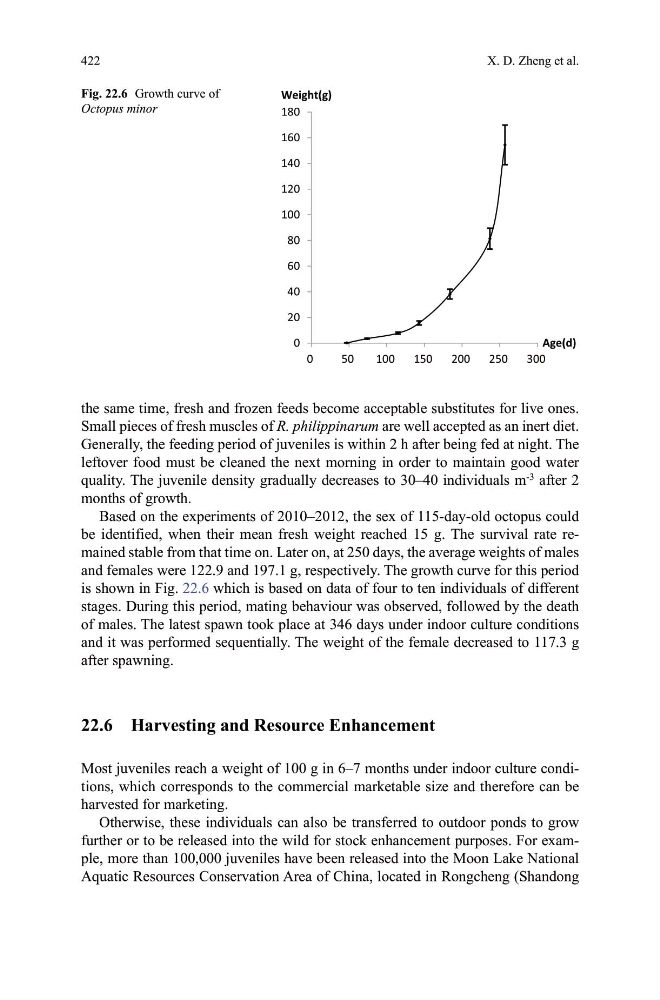
be identified, when their mean fresh weight reached 15 g. The survival rate remained stable from that time on. Later on, at 250 days, the average weights of males
and females were 122.9 and 197.1 g, respectively. The growth curve for this period
is shown in Fig. 22.6 which is based on data of four to ten individuals of different
stages. During this period, mating behaviour was observed, followed by the death
of males. The latest spawn took place at 346 days under indoor culture conditions
and it was performed sequentially. The weight of the female decreased to 117.3 g
after spawning.
22.6 Harvesting and Resource Enhancement
Most juveniles reach a weight of 100 g in 6–7 months under indoor culture conditions, which corresponds to the commercial marketable size and therefore can be
harvested for marketing.
Otherwise, these individuals can also be transferred to outdoor ponds to grow
further or to be released into the wild for stock enhancement purposes. For example, more than 100,000 juveniles have been released into the Moon Lake National
Aquatic Resources Conservation Area of China, located in Rongcheng (Shandong
0
20
40
60
80
100
120
140
160
180
0
50
100
150
200
250
300
Weight(g)
Age(d)
Fig. 22.6 Growth curve of
Octopus minor
X. D. Zheng et al.
the same time, fresh and frozen feeds become acceptable substitutes for live ones.
Small pieces of fresh muscles of R� philippinarum are well accepted as an inert diet.
Generally, the feeding period of juveniles is within 2 h after being fed at night. The
leftover food must be cleaned the next morning in order to maintain good water
quality. The juvenile density gradually decreases to 30–40 individuals m
-3
after 2
months of growth.
Based on the experiments of 2010–2012, the sex of 115-day-old octopus could
be identified, when their mean fresh weight reached 15 g. The survival rate remained stable from that time on. Later on, at 250 days, the average weights of males
and females were 122.9 and 197.1 g, respectively. The growth curve for this period
is shown in Fig. 22.6 which is based on data of four to ten individuals of different
stages. During this period, mating behaviour was observed, followed by the death
of males. The latest spawn took place at 346 days under indoor culture conditions
and it was performed sequentially. The weight of the female decreased to 117.3 g
after spawning.
22.6 Harvesting and Resource Enhancement
Most juveniles reach a weight of 100 g in 6–7 months under indoor culture conditions, which corresponds to the commercial marketable size and therefore can be
harvested for marketing.
Otherwise, these individuals can also be transferred to outdoor ponds to grow
further or to be released into the wild for stock enhancement purposes. For example, more than 100,000 juveniles have been released into the Moon Lake National
Aquatic Resources Conservation Area of China, located in Rongcheng (Shandong
0
20
40
60
80
100
120
140
160
180
0
50
100
150
200
250
300
Weight(g)
Age(d)
Fig. 22.6 Growth curve of
Octopus minor