

21 Octopus mimus
403
sumed that food intake in females induces hypertrophy and atrophy of the microvilli
due to fasting conditions. No cilia have been seen in digestive cells of O� mimus as
described on Pteroctopus tetracirrhus (Morales 1973; Zamora and Olivares 2004).
The energetic costs for growth and development of the ovary imply the storage of
282.5 kcal g
−1
of mostly proteins (47.6 %), carbohydrates (45.1 %) and few lipids
(4 %). Approximately 90 % of the energy is deposited in the eggs and derived to
sustain the development of the embryos (Zamora and Olivares 2004).
O� mimus fecundity is estimated between 60,000 and 400,000 eggs (Warnke
1999; Castro et al. 2002), similarly to other octopus species with planktonic larvae
(Joll 1983; van Heukelem 1983), higher than species with larger eggs and direct
development (Forsythe et al. 1983; Boletzky 1975; Solís-Ramírez 1967) and lower
than squids with no parental care that destine more energy to produce a major quantity of eggs for ensuring reproductive success (Hixon 1983; Ikeda et al. 1993).
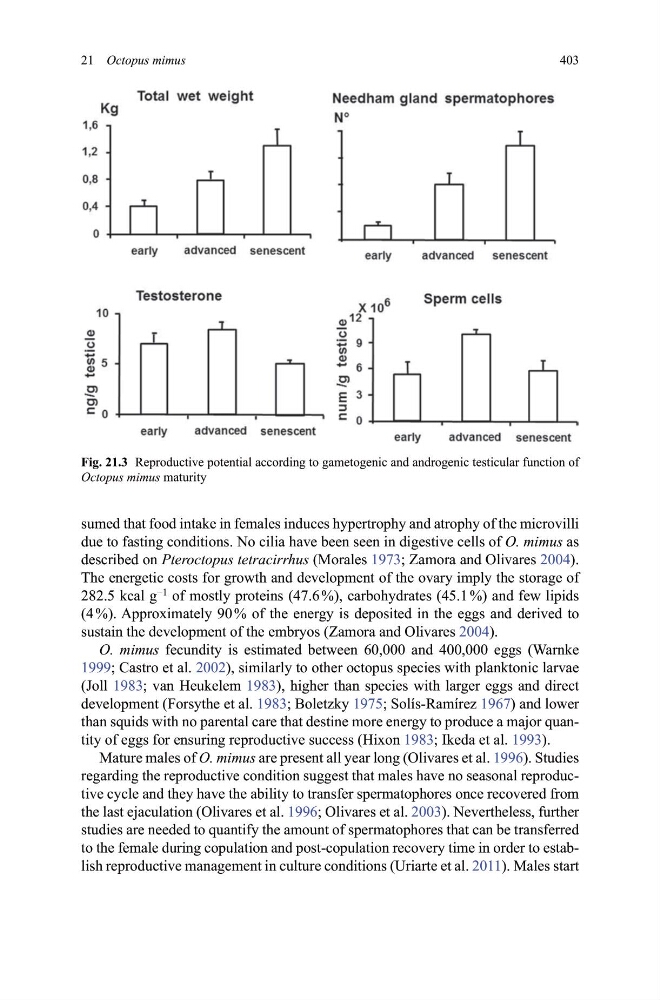
Mature males of O� mimus are present all year long (Olivares et al. 1996). Studies
regarding the reproductive condition suggest that males have no seasonal reproductive cycle and they have the ability to transfer spermatophores once recovered from
the last ejaculation (Olivares et al. 1996; Olivares et al. 2003). Nevertheless, further
studies are needed to quantify the amount of spermatophores that can be transferred
to the female during copulation and post-copulation recovery time in order to establish reproductive management in culture conditions (Uriarte et al. 2011). Males start
Fig. 21.3 Reproductive potential according to gametogenic and androgenic testicular function of
Octopus mimus maturity
403
sumed that food intake in females induces hypertrophy and atrophy of the microvilli
due to fasting conditions. No cilia have been seen in digestive cells of O� mimus as
described on Pteroctopus tetracirrhus (Morales 1973; Zamora and Olivares 2004).
The energetic costs for growth and development of the ovary imply the storage of
282.5 kcal g
−1
of mostly proteins (47.6 %), carbohydrates (45.1 %) and few lipids
(4 %). Approximately 90 % of the energy is deposited in the eggs and derived to
sustain the development of the embryos (Zamora and Olivares 2004).
O� mimus fecundity is estimated between 60,000 and 400,000 eggs (Warnke
1999; Castro et al. 2002), similarly to other octopus species with planktonic larvae
(Joll 1983; van Heukelem 1983), higher than species with larger eggs and direct
development (Forsythe et al. 1983; Boletzky 1975; Solís-Ramírez 1967) and lower
than squids with no parental care that destine more energy to produce a major quantity of eggs for ensuring reproductive success (Hixon 1983; Ikeda et al. 1993).
Mature males of O� mimus are present all year long (Olivares et al. 1996). Studies
regarding the reproductive condition suggest that males have no seasonal reproductive cycle and they have the ability to transfer spermatophores once recovered from
the last ejaculation (Olivares et al. 1996; Olivares et al. 2003). Nevertheless, further
studies are needed to quantify the amount of spermatophores that can be transferred
to the female during copulation and post-copulation recovery time in order to establish reproductive management in culture conditions (Uriarte et al. 2011). Males start
Fig. 21.3 Reproductive potential according to gametogenic and androgenic testicular function of
Octopus mimus maturity