

388
C. Rosas et al.
Laboratory trials have demonstrated that this system is as effective as when
females care for the eggs, with the advantage that the artificial incubation system
involves less space, less water and allows removing the females and selling them as
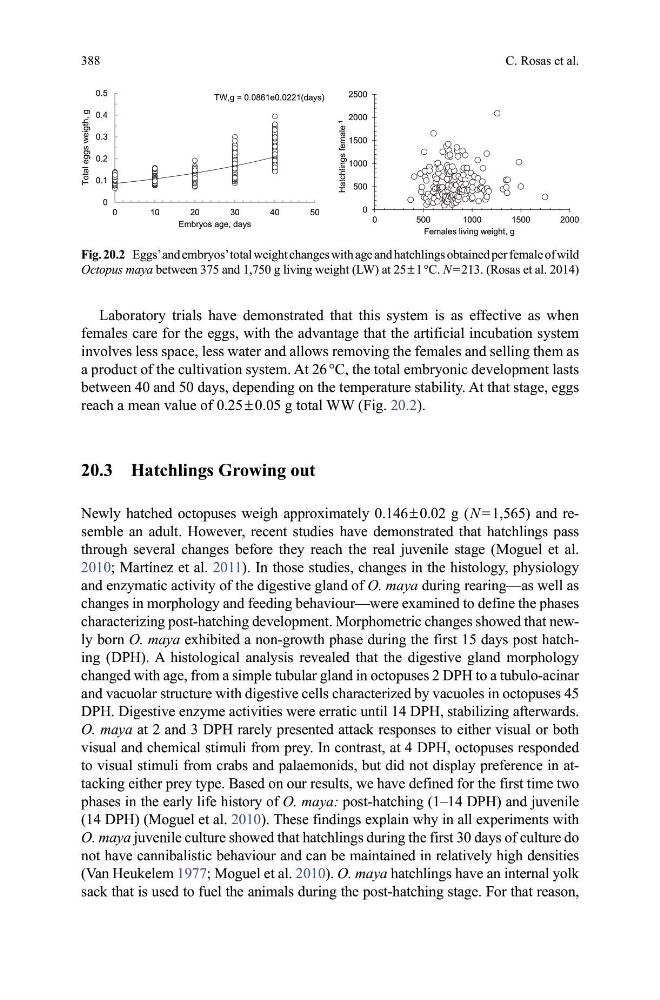
a product of the cultivation system. At 26 °C, the total embryonic development lasts
between 40 and 50 days, depending on the temperature stability. At that stage, eggs
reach a mean value of 0.25 ± 0.05 g total WW (Fig. 20.2).
20.3 Hatchlings Growing out
Newly hatched octopuses weigh approximately 0.146 ± 0.02 g ( N = 1,565) and resemble an adult. However, recent studies have demonstrated that hatchlings pass
through several changes before they reach the real juvenile stage (Moguel et al.
2010; Martínez et al. 2011). In those studies, changes in the histology, physiology
and enzymatic activity of the digestive gland of O� maya during rearing—as well as
changes in morphology and feeding behaviour—were examined to define the phases
characterizing post-hatching development. Morphometric changes showed that newly born O� maya exhibited a non-growth phase during the first 15 days post hatching (DPH). A histological analysis revealed that the digestive gland morphology
changed with age, from a simple tubular gland in octopuses 2 DPH to a tubulo-acinar
and vacuolar structure with digestive cells characterized by vacuoles in octopuses 45
DPH. Digestive enzyme activities were erratic until 14 DPH, stabilizing afterwards.
O� maya at 2 and 3 DPH rarely presented attack responses to either visual or both
visual and chemical stimuli from prey. In contrast, at 4 DPH, octopuses responded
to visual stimuli from crabs and palaemonids, but did not display preference in attacking either prey type. Based on our results, we have defined for the first time two
phases in the early life history of O� maya: post-hatching (1–14 DPH) and juvenile
(14 DPH) (Moguel et al. 2010). These findings explain why in all experiments with
O� maya juvenile culture showed that hatchlings during the first 30 days of culture do
not have cannibalistic behaviour and can be maintained in relatively high densities
(Van Heukelem 1977; Moguel et al. 2010). O� maya hatchlings have an internal yolk
sack that is used to fuel the animals during the post-hatching stage. For that reason,
7:J HGD\V
7RWDOHJJVZHLJWKJ
(PEU\RVDJHGD\V
+DWFKOLQJVIHPDOH
)HPDOHVOLYLQJZHLJKWJ
Fig. 20.2 Eggs’ and embryos’ total weight changes with age and hatchlings obtained per female of wild
Octopus maya between 375 and 1,750 g living weight (LW) at 25 ± 1 °C. N = 213. (Rosas et al. 2014)
C. Rosas et al.
Laboratory trials have demonstrated that this system is as effective as when
females care for the eggs, with the advantage that the artificial incubation system
involves less space, less water and allows removing the females and selling them as
a product of the cultivation system. At 26 °C, the total embryonic development lasts
between 40 and 50 days, depending on the temperature stability. At that stage, eggs
reach a mean value of 0.25 ± 0.05 g total WW (Fig. 20.2).
20.3 Hatchlings Growing out
Newly hatched octopuses weigh approximately 0.146 ± 0.02 g ( N = 1,565) and resemble an adult. However, recent studies have demonstrated that hatchlings pass
through several changes before they reach the real juvenile stage (Moguel et al.
2010; Martínez et al. 2011). In those studies, changes in the histology, physiology
and enzymatic activity of the digestive gland of O� maya during rearing—as well as
changes in morphology and feeding behaviour—were examined to define the phases
characterizing post-hatching development. Morphometric changes showed that newly born O� maya exhibited a non-growth phase during the first 15 days post hatching (DPH). A histological analysis revealed that the digestive gland morphology
changed with age, from a simple tubular gland in octopuses 2 DPH to a tubulo-acinar
and vacuolar structure with digestive cells characterized by vacuoles in octopuses 45
DPH. Digestive enzyme activities were erratic until 14 DPH, stabilizing afterwards.
O� maya at 2 and 3 DPH rarely presented attack responses to either visual or both
visual and chemical stimuli from prey. In contrast, at 4 DPH, octopuses responded
to visual stimuli from crabs and palaemonids, but did not display preference in attacking either prey type. Based on our results, we have defined for the first time two
phases in the early life history of O� maya: post-hatching (1–14 DPH) and juvenile
(14 DPH) (Moguel et al. 2010). These findings explain why in all experiments with
O� maya juvenile culture showed that hatchlings during the first 30 days of culture do
not have cannibalistic behaviour and can be maintained in relatively high densities
(Van Heukelem 1977; Moguel et al. 2010). O� maya hatchlings have an internal yolk
sack that is used to fuel the animals during the post-hatching stage. For that reason,
7:J HGD\V
7RWDOHJJVZHLJWKJ
(PEU\RVDJHGD\V
+DWFKOLQJVIHPDOH
)HPDOHVOLYLQJZHLJKWJ
Fig. 20.2 Eggs’ and embryos’ total weight changes with age and hatchlings obtained per female of wild
Octopus maya between 375 and 1,750 g living weight (LW) at 25 ± 1 °C. N = 213. (Rosas et al. 2014)