

387
20 Octopus maya
crabs ( Callinectes spp.; 70 %) and mussels ( Mytilus spp.; 30 %) at 15 % WW ration.
Presently, a mixed diet composed of fish, squid and shrimp is used as a broodstock
diet for O� maya-cultivated females. Wild and cultivated females normally spawn
37 ± 23 days after entrance into the maturation facilities. Spawning takes at least
5 days to complete, during which the females can eat. Hence, it is important to feed
females with half of the daily ration during this period. There is no relationship
between hatchlings per female production and LW of O� maya females suggesting
that egg production depends on each female characteristic, independently of the age
and/or LW (Fig. 20.2).
O� maya is a semelparous species; females reproduce once and then die (Van
Heukelem 1976). Considering this biological characteristic, a massive hatchling
production system for O� maya was designed, permitting large-scale management
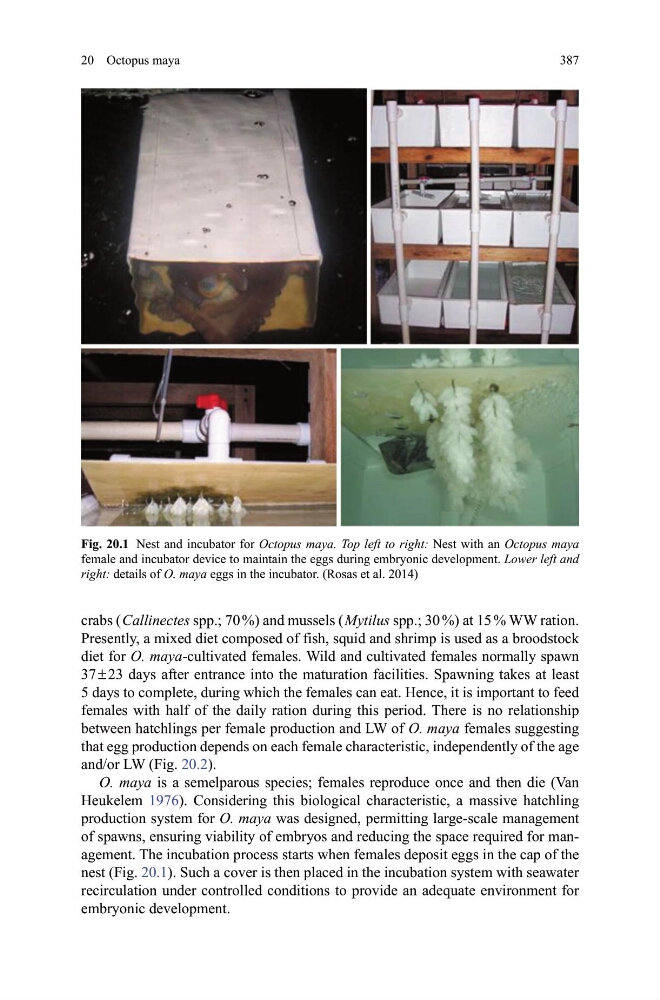
of spawns, ensuring viability of embryos and reducing the space required for management. The incubation process starts when females deposit eggs in the cap of the
nest (Fig. 20.1). Such a cover is then placed in the incubation system with seawater
recirculation under controlled conditions to provide an adequate environment for
embryonic development.
Fig. 20.1 Nest and incubator for Octopus maya� Top left to right: Nest with an Octopus maya
female and incubator device to maintain the eggs during embryonic development. Lower left and
right: details of O� maya eggs in the incubator. (Rosas et al. 2014)
20 Octopus maya
crabs ( Callinectes spp.; 70 %) and mussels ( Mytilus spp.; 30 %) at 15 % WW ration.
Presently, a mixed diet composed of fish, squid and shrimp is used as a broodstock
diet for O� maya-cultivated females. Wild and cultivated females normally spawn
37 ± 23 days after entrance into the maturation facilities. Spawning takes at least
5 days to complete, during which the females can eat. Hence, it is important to feed
females with half of the daily ration during this period. There is no relationship
between hatchlings per female production and LW of O� maya females suggesting
that egg production depends on each female characteristic, independently of the age
and/or LW (Fig. 20.2).
O� maya is a semelparous species; females reproduce once and then die (Van
Heukelem 1976). Considering this biological characteristic, a massive hatchling
production system for O� maya was designed, permitting large-scale management
of spawns, ensuring viability of embryos and reducing the space required for management. The incubation process starts when females deposit eggs in the cap of the
nest (Fig. 20.1). Such a cover is then placed in the incubation system with seawater
recirculation under controlled conditions to provide an adequate environment for
embryonic development.
Fig. 20.1 Nest and incubator for Octopus maya� Top left to right: Nest with an Octopus maya
female and incubator device to maintain the eggs during embryonic development. Lower left and
right: details of O� maya eggs in the incubator. (Rosas et al. 2014)