

340
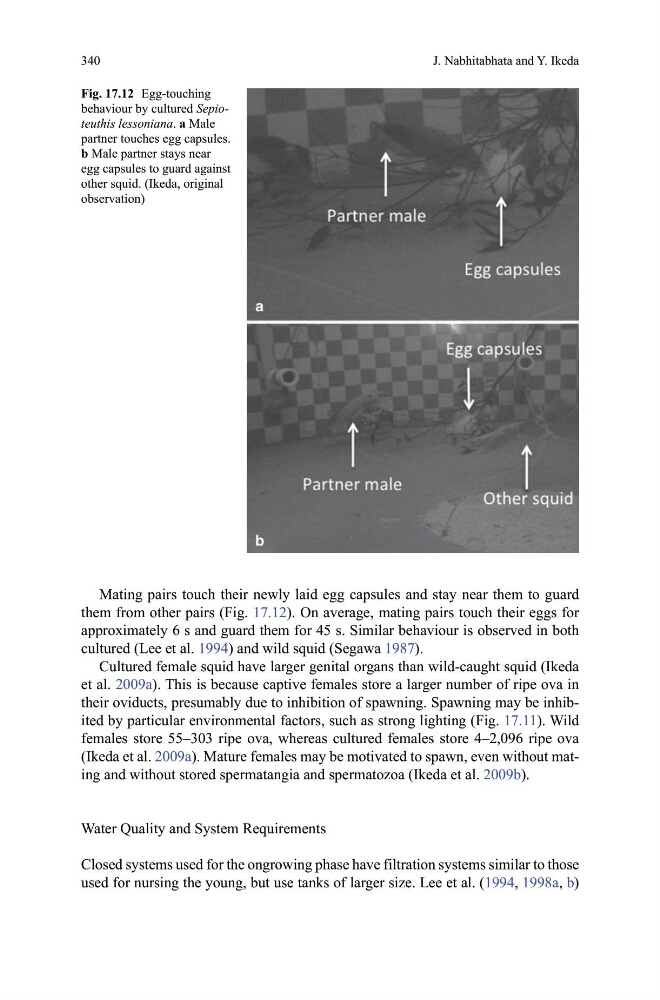
Mating pairs touch their newly laid egg capsules and stay near them to guard
them from other pairs (Fig. 17.12). On average, mating pairs touch their eggs for
approximately 6 s and guard them for 45 s. Similar behaviour is observed in both
cultured (Lee et al. 1994) and wild squid (Segawa 1987).
Cultured female squid have larger genital organs than wild-caught squid (Ikeda
et al. 2009a). This is because captive females store a larger number of ripe ova in
their oviducts, presumably due to inhibition of spawning. Spawning may be inhibited by particular environmental factors, such as strong lighting (Fig. 17.11). Wild
females store 55–303 ripe ova, whereas cultured females store 4–2,096 ripe ova
(Ikeda et al. 2009a). Mature females may be motivated to spawn, even without mating and without stored spermatangia and spermatozoa (Ikeda et al. 2009b).
Water Quality and System Requirements
Closed systems used for the ongrowing phase have filtration systems similar to those
used for nursing the young, but use tanks of larger size. Lee et al. (1994, 1998a, b)
Fig. 17.12 Egg-touching
behaviour by cultured Sepioteuthis lessoniana. a Male
partner touches egg capsules.
b Male partner stays near
egg capsules to guard against
other squid. (Ikeda, original
observation)
J. Nabhitabhata and Y. Ikeda
Mating pairs touch their newly laid egg capsules and stay near them to guard
them from other pairs (Fig. 17.12). On average, mating pairs touch their eggs for
approximately 6 s and guard them for 45 s. Similar behaviour is observed in both
cultured (Lee et al. 1994) and wild squid (Segawa 1987).
Cultured female squid have larger genital organs than wild-caught squid (Ikeda
et al. 2009a). This is because captive females store a larger number of ripe ova in
their oviducts, presumably due to inhibition of spawning. Spawning may be inhibited by particular environmental factors, such as strong lighting (Fig. 17.11). Wild
females store 55–303 ripe ova, whereas cultured females store 4–2,096 ripe ova
(Ikeda et al. 2009a). Mature females may be motivated to spawn, even without mating and without stored spermatangia and spermatozoa (Ikeda et al. 2009b).
Water Quality and System Requirements
Closed systems used for the ongrowing phase have filtration systems similar to those
used for nursing the young, but use tanks of larger size. Lee et al. (1994, 1998a, b)
Fig. 17.12 Egg-touching
behaviour by cultured Sepioteuthis lessoniana. a Male
partner touches egg capsules.
b Male partner stays near
egg capsules to guard against
other squid. (Ikeda, original
observation)
J. Nabhitabhata and Y. Ikeda