

333
The number of ova contained in a single S� lessoniana egg capsule varies in
temperate waters. For example, egg capsules are reported to contain the following number of ova: 2–8 (average 3.0 and 5.8) at Iriomote Island of the Ryukyu
Archipelago (Tsuchiya 1981), 2 and 4–8 (mode 6) at Ishigaki Island of the Ryukyu
Archipelago (Segawa et al. 1993b), 0–9 (mean 3.5–6.4) at Kominato of Chiba
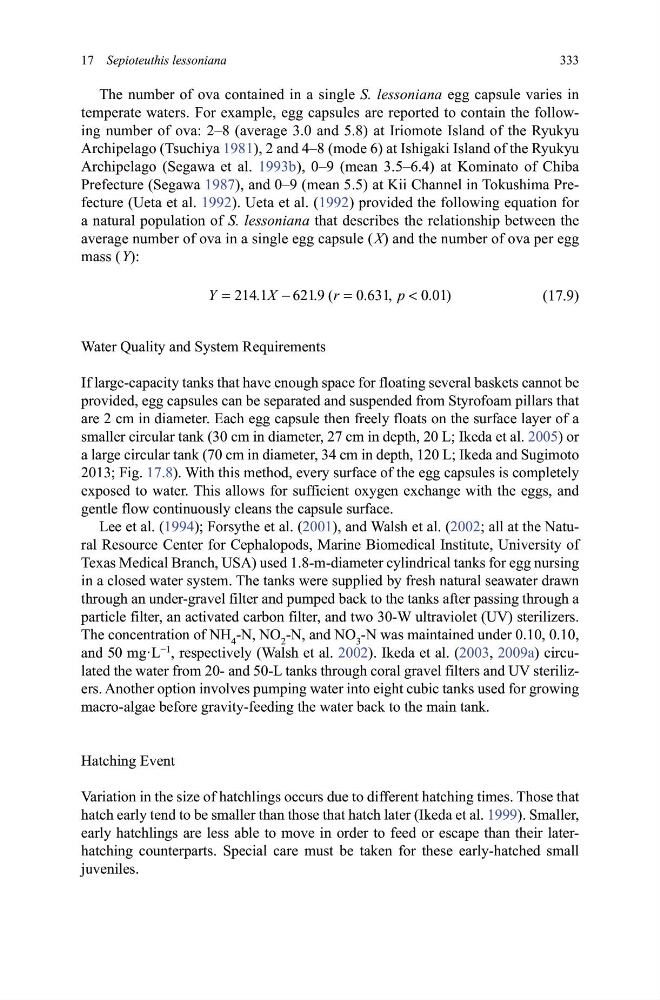
Prefecture (Segawa 1987), and 0–9 (mean 5.5) at Kii Channel in Tokushima Prefecture (Ueta et al. 1992). Ueta et al. (1992) provided the following equation for
a natural population of S� lessoniana that describes the relationship between the
average number of ova in a single egg capsule ( X) and the number of ova per egg
mass ( Y):
(17.9)
Water Quality and System Requirements
If large-capacity tanks that have enough space for floating several baskets cannot be
provided, egg capsules can be separated and suspended from Styrofoam pillars that
are 2 cm in diameter. Each egg capsule then freely floats on the surface layer of a
smaller circular tank (30 cm in diameter, 27 cm in depth, 20 L; Ikeda et al. 2005) or
a large circular tank (70 cm in diameter, 34 cm in depth, 120 L; Ikeda and Sugimoto
2013; Fig. 17.8). With this method, every surface of the egg capsules is completely
exposed to water. This allows for sufficient oxygen exchange with the eggs, and
gentle flow continuously cleans the capsule surface.
Lee et al. (1994); Forsythe et al. (2001), and Walsh et al. (2002; all at the Natural Resource Center for Cephalopods, Marine Biomedical Institute, University of
Texas Medical Branch, USA) used 1.8-m-diameter cylindrical tanks for egg nursing
in a closed water system. The tanks were supplied by fresh natural seawater drawn
through an under-gravel filter and pumped back to the tanks after passing through a
particle filter, an activated carbon filter, and two 30-W ultraviolet (UV) sterilizers.
The concentration of NH 4 -N, NO 2 -N, and NO 3 -N was maintained under 0.10, 0.10,
and 50 mg·L
−1
, respectively (Walsh et al. 2002). Ikeda et al. (2003, 2009a) circulated the water from 20- and 50-L tanks through coral gravel filters and UV sterilizers. Another option involves pumping water into eight cubic tanks used for growing
macro-algae before gravity-feeding the water back to the main tank.
Hatching Event
Variation in the size of hatchlings occurs due to different hatching times. Those that
hatch early tend to be smaller than those that hatch later (Ikeda et al. 1999). Smaller,
early hatchlings are less able to move in order to feed or escape than their laterhatching counterparts. Special care must be taken for these early-hatched small
juveniles.
214.1
621.9 (
0.631,
0.01)
Y
X
r
p
=
−
=
<
17 Sepioteuthis lessoniana
The number of ova contained in a single S� lessoniana egg capsule varies in
temperate waters. For example, egg capsules are reported to contain the following number of ova: 2–8 (average 3.0 and 5.8) at Iriomote Island of the Ryukyu
Archipelago (Tsuchiya 1981), 2 and 4–8 (mode 6) at Ishigaki Island of the Ryukyu
Archipelago (Segawa et al. 1993b), 0–9 (mean 3.5–6.4) at Kominato of Chiba
Prefecture (Segawa 1987), and 0–9 (mean 5.5) at Kii Channel in Tokushima Prefecture (Ueta et al. 1992). Ueta et al. (1992) provided the following equation for
a natural population of S� lessoniana that describes the relationship between the
average number of ova in a single egg capsule ( X) and the number of ova per egg
mass ( Y):
(17.9)
Water Quality and System Requirements
If large-capacity tanks that have enough space for floating several baskets cannot be
provided, egg capsules can be separated and suspended from Styrofoam pillars that
are 2 cm in diameter. Each egg capsule then freely floats on the surface layer of a
smaller circular tank (30 cm in diameter, 27 cm in depth, 20 L; Ikeda et al. 2005) or
a large circular tank (70 cm in diameter, 34 cm in depth, 120 L; Ikeda and Sugimoto
2013; Fig. 17.8). With this method, every surface of the egg capsules is completely
exposed to water. This allows for sufficient oxygen exchange with the eggs, and
gentle flow continuously cleans the capsule surface.
Lee et al. (1994); Forsythe et al. (2001), and Walsh et al. (2002; all at the Natural Resource Center for Cephalopods, Marine Biomedical Institute, University of
Texas Medical Branch, USA) used 1.8-m-diameter cylindrical tanks for egg nursing
in a closed water system. The tanks were supplied by fresh natural seawater drawn
through an under-gravel filter and pumped back to the tanks after passing through a
particle filter, an activated carbon filter, and two 30-W ultraviolet (UV) sterilizers.
The concentration of NH 4 -N, NO 2 -N, and NO 3 -N was maintained under 0.10, 0.10,
and 50 mg·L
−1
, respectively (Walsh et al. 2002). Ikeda et al. (2003, 2009a) circulated the water from 20- and 50-L tanks through coral gravel filters and UV sterilizers. Another option involves pumping water into eight cubic tanks used for growing
macro-algae before gravity-feeding the water back to the main tank.
Hatching Event
Variation in the size of hatchlings occurs due to different hatching times. Those that
hatch early tend to be smaller than those that hatch later (Ikeda et al. 1999). Smaller,
early hatchlings are less able to move in order to feed or escape than their laterhatching counterparts. Special care must be taken for these early-hatched small
juveniles.
214.1
621.9 (
0.631,
0.01)
Y
X
r
p
=
−
=
<
17 Sepioteuthis lessoniana