

332
have not yet been established for loliginid squid. These squid have relatively large
ova that are wrapped in a thick gelatinous layer (i.e. egg capsule) during embryonic
development. Artificial insemination of the ommastrephid squid Todarodes pacificus is successfully performed by the addition of oviducal gland jelly at, and after,
insemination of ova from the oviduct with spermatozoa from the seminal receptacle
(Ikeda et al. 1993). The gelatinous substance of oviducal gland origin is necessary
for formation of the perivitelline space that allows embryonic development to proceed normally. Oviducal gland jelly would act similarly in S� lessoniana.
17.3.2.2 Nursing of Egg Capsules
Egg-Capsule Characteristics
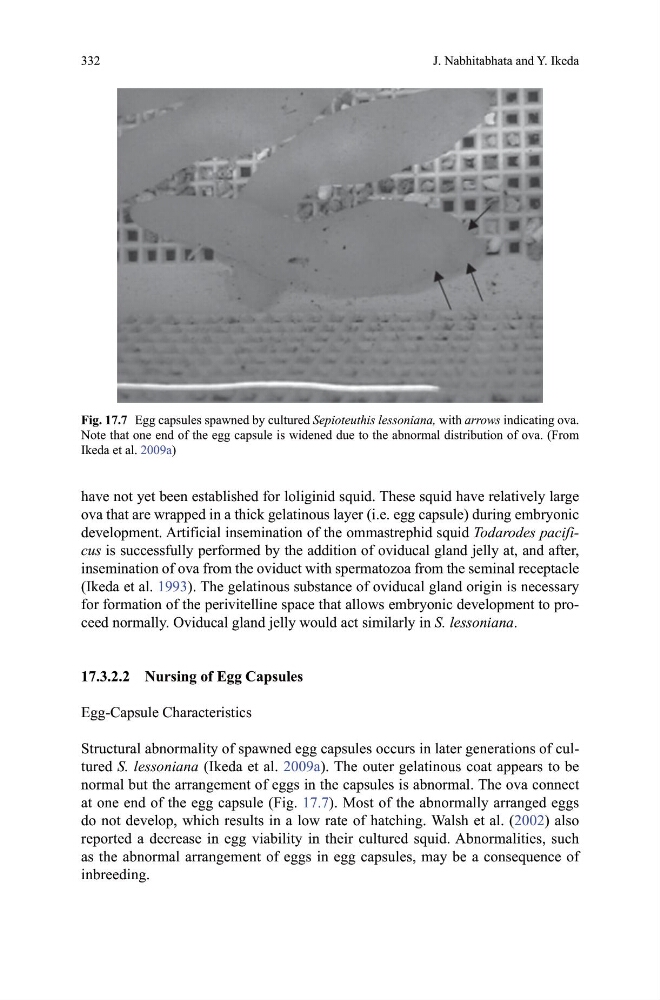
Structural abnormality of spawned egg capsules occurs in later generations of cultured S� lessoniana (Ikeda et al. 2009a). The outer gelatinous coat appears to be
normal but the arrangement of eggs in the capsules is abnormal. The ova connect
at one end of the egg capsule (Fig. 17.7). Most of the abnormally arranged eggs
do not develop, which results in a low rate of hatching. Walsh et al. (2002) also
reported a decrease in egg viability in their cultured squid. Abnormalities, such
as the abnormal arrangement of eggs in egg capsules, may be a consequence of
inbreeding.
Fig. 17.7 Egg capsules spawned by cultured Sepioteuthis lessoniana, with arrows indicating ova.
Note that one end of the egg capsule is widened due to the abnormal distribution of ova. (From
Ikeda et al. 2009a)
J. Nabhitabhata and Y. Ikeda
have not yet been established for loliginid squid. These squid have relatively large
ova that are wrapped in a thick gelatinous layer (i.e. egg capsule) during embryonic
development. Artificial insemination of the ommastrephid squid Todarodes pacificus is successfully performed by the addition of oviducal gland jelly at, and after,
insemination of ova from the oviduct with spermatozoa from the seminal receptacle
(Ikeda et al. 1993). The gelatinous substance of oviducal gland origin is necessary
for formation of the perivitelline space that allows embryonic development to proceed normally. Oviducal gland jelly would act similarly in S� lessoniana.
17.3.2.2 Nursing of Egg Capsules
Egg-Capsule Characteristics
Structural abnormality of spawned egg capsules occurs in later generations of cultured S� lessoniana (Ikeda et al. 2009a). The outer gelatinous coat appears to be
normal but the arrangement of eggs in the capsules is abnormal. The ova connect
at one end of the egg capsule (Fig. 17.7). Most of the abnormally arranged eggs
do not develop, which results in a low rate of hatching. Walsh et al. (2002) also
reported a decrease in egg viability in their cultured squid. Abnormalities, such
as the abnormal arrangement of eggs in egg capsules, may be a consequence of
inbreeding.
Fig. 17.7 Egg capsules spawned by cultured Sepioteuthis lessoniana, with arrows indicating ova.
Note that one end of the egg capsule is widened due to the abnormal distribution of ova. (From
Ikeda et al. 2009a)
J. Nabhitabhata and Y. Ikeda