

321
hatchery with a camouflage net that reduces light efficiency by 80 % (Nabhitabhata
et al. 2005).
Hatching Event
The hatching rate depends on the biotic and abiotic history during incubation, and
embryonic development. The average embryonic period is 20 days (a range of 17–23
days) at about 28 °C (Nabhitabhata 1978, 1996; Nabhitabhata and Kbinrum 1981) and
is longer at lower temperatures. The hatching period, from the hatching of the first
egg to the hatching of the last eggs in the same cluster of the same spawning, is 3–7
days. More than 50 % of the hatching occurs at night after 2400 h on the second and
third day from the first hatching. The hatching rate is generally more than 90 % but
may vary depending on the embryonic stage at the time of collection from the wild.
Hatching rates of eggs spawned in captivity are low due to a larger percentage of
unfertilized eggs and abnormally developed embryos than are found in eggs collected
from the wild. The hatchlings pass through the basket mesh into the nursing tank.
When the optimum density of hatchlings in the tank is achieved, the egg baskets are
transferred to another tank containing (previously prepared) water of similar quality.
Egg baskets are transferred between tanks to control the hatchling density in tanks
and to grade the size of hatchlings. Egg-capsule-nursing tanks are then used to nurse
the young. Hatchlings may be handled if extreme caution is used to avoid skin damage that could subsequently cause mortality. Transfer of hatchlings is better avoided,
and it is much more appropriate to transfer egg capsules sometime before hatching.
17.3.1.4 Nursing of Young
Characters and Habits of Young
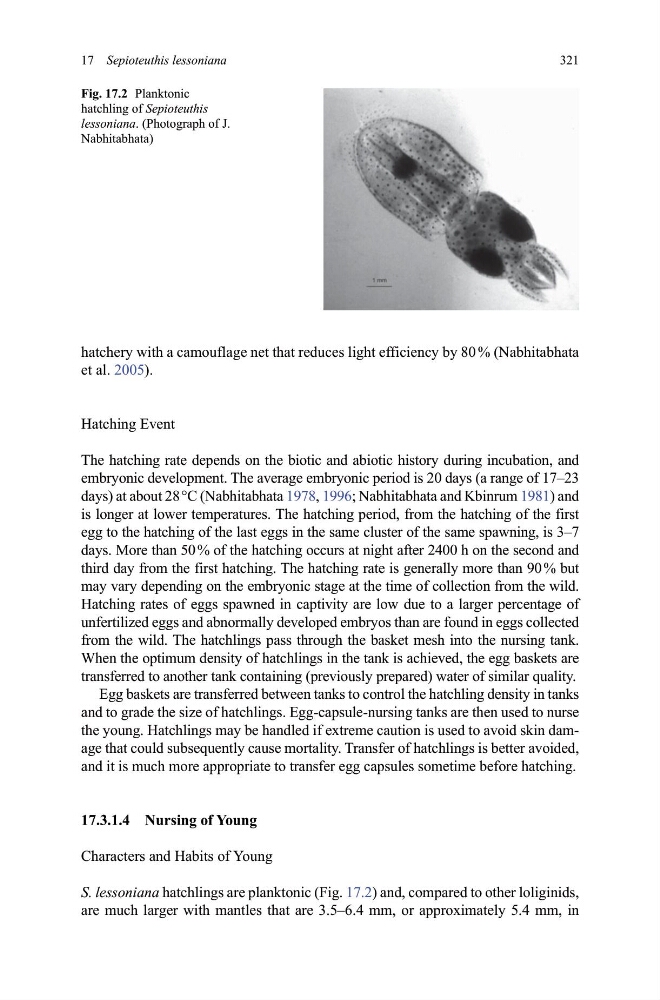
S� lessoniana hatchlings are planktonic (Fig. 17.2) and, compared to other loliginids,
are much larger with mantles that are 3.5–6.4 mm, or approximately 5.4 mm, in
Fig. 17.2 Planktonic
hatchling of Sepioteuthis
lessoniana. (Photograph of J.
Nabhitabhata)
17 Sepioteuthis lessoniana
hatchery with a camouflage net that reduces light efficiency by 80 % (Nabhitabhata
et al. 2005).
Hatching Event
The hatching rate depends on the biotic and abiotic history during incubation, and
embryonic development. The average embryonic period is 20 days (a range of 17–23
days) at about 28 °C (Nabhitabhata 1978, 1996; Nabhitabhata and Kbinrum 1981) and
is longer at lower temperatures. The hatching period, from the hatching of the first
egg to the hatching of the last eggs in the same cluster of the same spawning, is 3–7
days. More than 50 % of the hatching occurs at night after 2400 h on the second and
third day from the first hatching. The hatching rate is generally more than 90 % but
may vary depending on the embryonic stage at the time of collection from the wild.
Hatching rates of eggs spawned in captivity are low due to a larger percentage of
unfertilized eggs and abnormally developed embryos than are found in eggs collected
from the wild. The hatchlings pass through the basket mesh into the nursing tank.
When the optimum density of hatchlings in the tank is achieved, the egg baskets are
transferred to another tank containing (previously prepared) water of similar quality.
Egg baskets are transferred between tanks to control the hatchling density in tanks
and to grade the size of hatchlings. Egg-capsule-nursing tanks are then used to nurse
the young. Hatchlings may be handled if extreme caution is used to avoid skin damage that could subsequently cause mortality. Transfer of hatchlings is better avoided,
and it is much more appropriate to transfer egg capsules sometime before hatching.
17.3.1.4 Nursing of Young
Characters and Habits of Young
S� lessoniana hatchlings are planktonic (Fig. 17.2) and, compared to other loliginids,
are much larger with mantles that are 3.5–6.4 mm, or approximately 5.4 mm, in
Fig. 17.2 Planktonic
hatchling of Sepioteuthis
lessoniana. (Photograph of J.
Nabhitabhata)
17 Sepioteuthis lessoniana