

320
Water Quality and System Requirements
Egg capsules that contain many eggs require efficient aeration. There must be
enough space between egg capsules to allow a sufficient water current to carry
enough oxygen to the capsules. Also, with regard to sanitation, elimination of unfertilized eggs and empty egg capsules is conveniently carried out in plastic baskets that float in concrete tanks until the eggs hatch (Nabhitabhata 1978, 1996;
Nabhitabhata and Kbinrum 1981; Chindamaikul et al. 1994b). Before spreading in
plastic baskets, the capsules must be separated from their clusters.
Nursing of egg capsules can continue under controlled conditions in the tanks previously used for acclimatization in hatcheries. In an open system, changes in physical
and chemical parameters should be minimized. Egg capsules are visually checked every day, and those that die, containing abnormally developed embryos, or are empty
are discarded in order to prevent infection of others or decomposition and reduction
of water quality. Mechanical stimuli and brief changes in temperature or salinity can
cause premature hatching. A water flow-through method is used to exchange tank water and to minimize temperature fluctuation in open systems, and flow is maintained
at a rate of 1 L min
−1
. Fresh seawater is pumped through a carbon filter and stored in
a concrete tank before it is gravity-fed to the hatchery. Using this system, the water in
nursing tanks can be maintained at an average temperature of 28 °C, salinity of 30–33
psu, and pH of 6.0–8.0 (Nabhitabhata et al. 2005). The salinity required to achieve a
hatching rate of at least 50 % is 22–37 psu (Nabhitabhata et al. 1991b, 2001c).
Other important physical conditions include turbidity, or suspended solids, and
light. Turbidity should be kept as low as possible (Nabhitabhata 1993) through
filtration and/or prior sedimentation, particularly in open systems. High levels of
suspended solids or high turbidity are critical detrimental parameters. The use of
lighting and unnatural daily light–dark periods should be avoided. The growth of
algae and fungi on the surface of the egg capsules due to excess light reduces the
hatching rate by blocking oxygen supply to the embryos. The attachment of algae
can also initiate fungal growth on the capsule membrane and lead to infection of
the embryo. The most convenient way to reduce incident light is by curtaining the
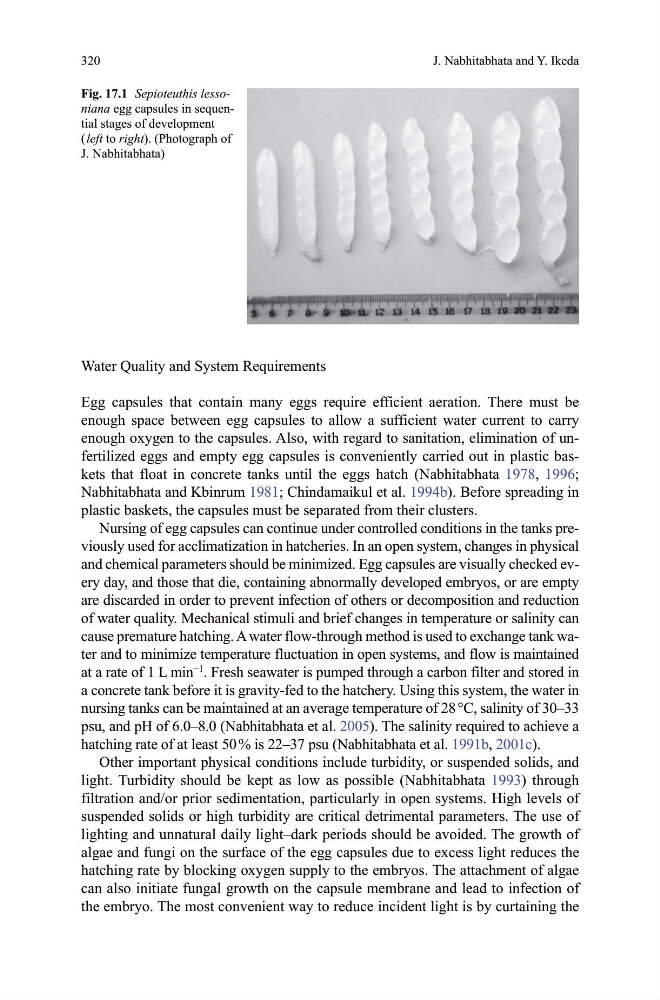
Fig. 17.1 Sepioteuthis lessoniana egg capsules in sequential stages of development
( left to right). (Photograph of
J. Nabhitabhata)
J. Nabhitabhata and Y. Ikeda
Water Quality and System Requirements
Egg capsules that contain many eggs require efficient aeration. There must be
enough space between egg capsules to allow a sufficient water current to carry
enough oxygen to the capsules. Also, with regard to sanitation, elimination of unfertilized eggs and empty egg capsules is conveniently carried out in plastic baskets that float in concrete tanks until the eggs hatch (Nabhitabhata 1978, 1996;
Nabhitabhata and Kbinrum 1981; Chindamaikul et al. 1994b). Before spreading in
plastic baskets, the capsules must be separated from their clusters.
Nursing of egg capsules can continue under controlled conditions in the tanks previously used for acclimatization in hatcheries. In an open system, changes in physical
and chemical parameters should be minimized. Egg capsules are visually checked every day, and those that die, containing abnormally developed embryos, or are empty
are discarded in order to prevent infection of others or decomposition and reduction
of water quality. Mechanical stimuli and brief changes in temperature or salinity can
cause premature hatching. A water flow-through method is used to exchange tank water and to minimize temperature fluctuation in open systems, and flow is maintained
at a rate of 1 L min
−1
. Fresh seawater is pumped through a carbon filter and stored in
a concrete tank before it is gravity-fed to the hatchery. Using this system, the water in
nursing tanks can be maintained at an average temperature of 28 °C, salinity of 30–33
psu, and pH of 6.0–8.0 (Nabhitabhata et al. 2005). The salinity required to achieve a
hatching rate of at least 50 % is 22–37 psu (Nabhitabhata et al. 1991b, 2001c).
Other important physical conditions include turbidity, or suspended solids, and
light. Turbidity should be kept as low as possible (Nabhitabhata 1993) through
filtration and/or prior sedimentation, particularly in open systems. High levels of
suspended solids or high turbidity are critical detrimental parameters. The use of
lighting and unnatural daily light–dark periods should be avoided. The growth of
algae and fungi on the surface of the egg capsules due to excess light reduces the
hatching rate by blocking oxygen supply to the embryos. The attachment of algae
can also initiate fungal growth on the capsule membrane and lead to infection of
the embryo. The most convenient way to reduce incident light is by curtaining the
Fig. 17.1 Sepioteuthis lessoniana egg capsules in sequential stages of development
( left to right). (Photograph of
J. Nabhitabhata)
J. Nabhitabhata and Y. Ikeda