

284
E. A. G. Vidal and S. von Boletzky
For L. vulgaris, incubation times at extreme temperatures were recorded for 70
days at 10 °C (Boletzky 1987) and between 13 and 19 days at 24 °C (Sen 2005a).
While for D. opalescens, incubation times varied between 93 days at 7.2 °C and 19
days at 24.4 °C (Zeidberg et al. 2011). Incubation time is inversely proportional to
temperature and egg size in cephalopods (Boletzky 1974a, 1987). Therefore, differences in incubation time suggest that more attention should be given to the exact
range of variation in the respective sizes of ova in both species as well as to the
exact relationship between the rates of embryonic development at different temperatures and the individual size of ova.
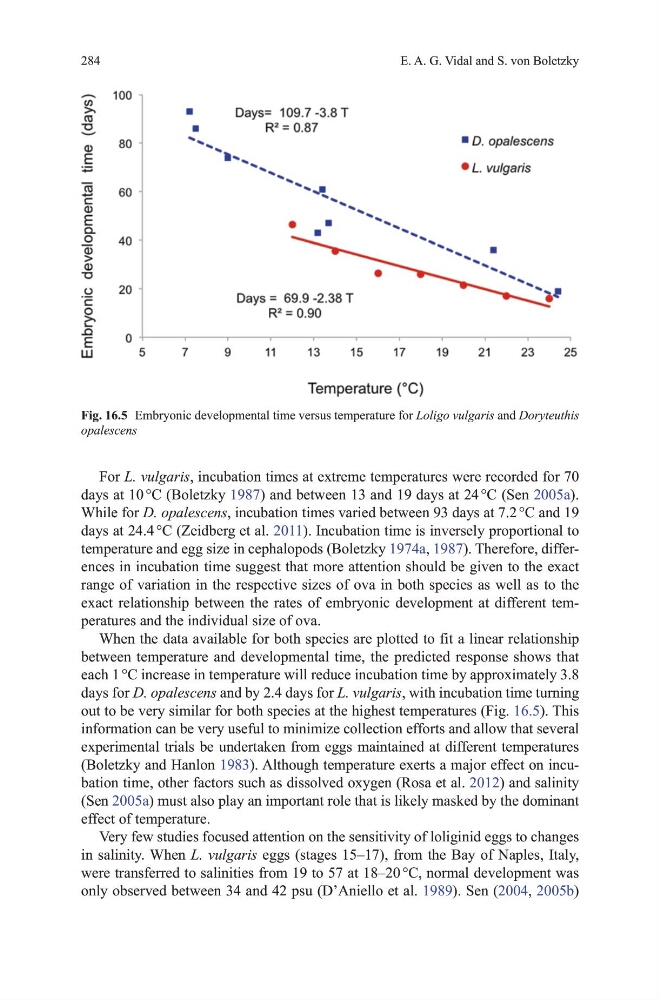
When the data available for both species are plotted to fit a linear relationship
between temperature and developmental time, the predicted response shows that
each 1 °C increase in temperature will reduce incubation time by approximately 3.8
days for D. opalescens and by 2.4 days for L. vulgaris, with incubation time turning
out to be very similar for both species at the highest temperatures (Fig. 16.5). This
information can be very useful to minimize collection efforts and allow that several
experimental trials be undertaken from eggs maintained at different temperatures
(Boletzky and Hanlon 1983). Although temperature exerts a major effect on incubation time, other factors such as dissolved oxygen (Rosa et al. 2012) and salinity
(Sen 2005a) must also play an important role that is likely masked by the dominant
effect of temperature.
Very few studies focused attention on the sensitivity of loliginid eggs to changes
in salinity. When L. vulgaris eggs (stages 15–17), from the Bay of Naples, Italy,
were transferred to salinities from 19 to 57 at 18–20 °C, normal development was
only observed between 34 and 42 psu (D’Aniello et al. 1989). Sen (2004, 2005b)
Fig. 16.5 Embryonic developmental time versus temperature for Loligo vulgaris and Doryteuthis
opalescens
E. A. G. Vidal and S. von Boletzky
For L. vulgaris, incubation times at extreme temperatures were recorded for 70
days at 10 °C (Boletzky 1987) and between 13 and 19 days at 24 °C (Sen 2005a).
While for D. opalescens, incubation times varied between 93 days at 7.2 °C and 19
days at 24.4 °C (Zeidberg et al. 2011). Incubation time is inversely proportional to
temperature and egg size in cephalopods (Boletzky 1974a, 1987). Therefore, differences in incubation time suggest that more attention should be given to the exact
range of variation in the respective sizes of ova in both species as well as to the
exact relationship between the rates of embryonic development at different temperatures and the individual size of ova.
When the data available for both species are plotted to fit a linear relationship
between temperature and developmental time, the predicted response shows that
each 1 °C increase in temperature will reduce incubation time by approximately 3.8
days for D. opalescens and by 2.4 days for L. vulgaris, with incubation time turning
out to be very similar for both species at the highest temperatures (Fig. 16.5). This
information can be very useful to minimize collection efforts and allow that several
experimental trials be undertaken from eggs maintained at different temperatures
(Boletzky and Hanlon 1983). Although temperature exerts a major effect on incubation time, other factors such as dissolved oxygen (Rosa et al. 2012) and salinity
(Sen 2005a) must also play an important role that is likely masked by the dominant
effect of temperature.
Very few studies focused attention on the sensitivity of loliginid eggs to changes
in salinity. When L. vulgaris eggs (stages 15–17), from the Bay of Naples, Italy,
were transferred to salinities from 19 to 57 at 18–20 °C, normal development was
only observed between 34 and 42 psu (D’Aniello et al. 1989). Sen (2004, 2005b)
Fig. 16.5 Embryonic developmental time versus temperature for Loligo vulgaris and Doryteuthis
opalescens