

283
16 Loligo vulgaris and Doryteuthis opalescens
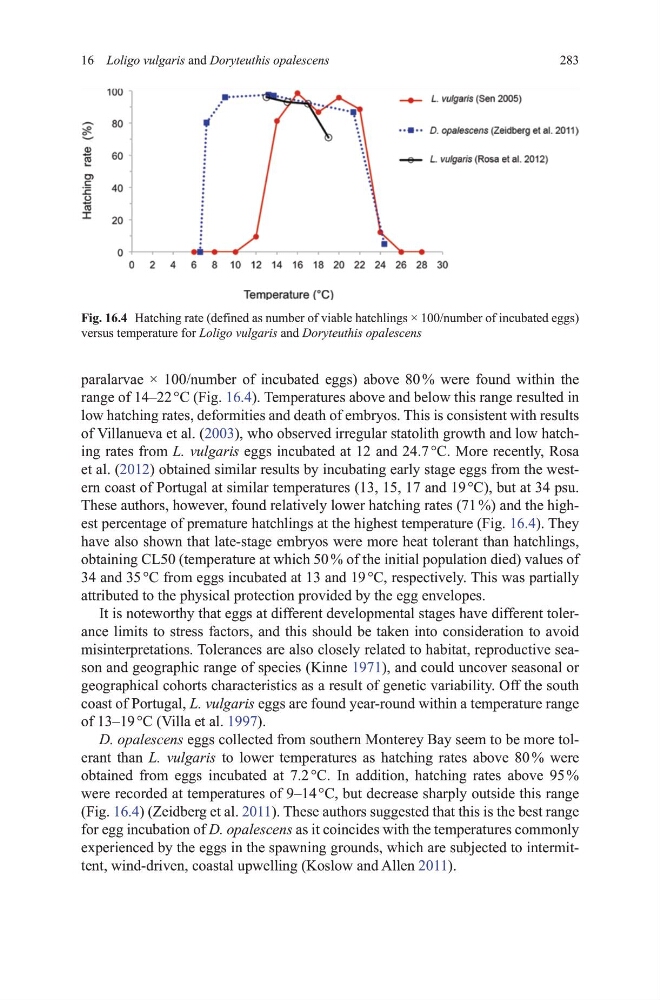
paralarvae × 100/number of incubated eggs) above 80 % were found within the
range of 14–22 °C (Fig. 16.4). Temperatures above and below this range resulted in
low hatching rates, deformities and death of embryos. This is consistent with results
of Villanueva et al. (2003), who observed irregular statolith growth and low hatching rates from L. vulgaris eggs incubated at 12 and 24.7 °C. More recently, Rosa
et al. (2012) obtained similar results by incubating early stage eggs from the western coast of Portugal at similar temperatures (13, 15, 17 and 19 °C), but at 34 psu.
These authors, however, found relatively lower hatching rates (71 %) and the highest percentage of premature hatchlings at the highest temperature (Fig. 16.4). They
have also shown that late-stage embryos were more heat tolerant than hatchlings,
obtaining CL50 (temperature at which 50 % of the initial population died) values of
34 and 35 °C from eggs incubated at 13 and 19 °C, respectively. This was partially
attributed to the physical protection provided by the egg envelopes.
It is noteworthy that eggs at different developmental stages have different tolerance limits to stress factors, and this should be taken into consideration to avoid
misinterpretations. Tolerances are also closely related to habitat, reproductive season and geographic range of species (Kinne 1971), and could uncover seasonal or
geographical cohorts characteristics as a result of genetic variability. Off the south
coast of Portugal, L. vulgaris eggs are found year-round within a temperature range
of 13–19 °C (Villa et al. 1997).
D. opalescens eggs collected from southern Monterey Bay seem to be more tolerant than L. vulgaris to lower temperatures as hatching rates above 80 % were
obtained from eggs incubated at 7.2 °C. In addition, hatching rates above 95 %
were recorded at temperatures of 9–14 °C, but decrease sharply outside this range
(Fig. 16.4) (Zeidberg et al. 2011). These authors suggested that this is the best range
for egg incubation of D. opalescens as it coincides with the temperatures commonly
experienced by the eggs in the spawning grounds, which are subjected to intermittent, wind-driven, coastal upwelling (Koslow and Allen 2011).
Fig. 16.4 Hatching rate (defined as number of viable hatchlings × 100/number of incubated eggs)
versus temperature for Loligo vulgaris and Doryteuthis opalescens
16 Loligo vulgaris and Doryteuthis opalescens
paralarvae × 100/number of incubated eggs) above 80 % were found within the
range of 14–22 °C (Fig. 16.4). Temperatures above and below this range resulted in
low hatching rates, deformities and death of embryos. This is consistent with results
of Villanueva et al. (2003), who observed irregular statolith growth and low hatching rates from L. vulgaris eggs incubated at 12 and 24.7 °C. More recently, Rosa
et al. (2012) obtained similar results by incubating early stage eggs from the western coast of Portugal at similar temperatures (13, 15, 17 and 19 °C), but at 34 psu.
These authors, however, found relatively lower hatching rates (71 %) and the highest percentage of premature hatchlings at the highest temperature (Fig. 16.4). They
have also shown that late-stage embryos were more heat tolerant than hatchlings,
obtaining CL50 (temperature at which 50 % of the initial population died) values of
34 and 35 °C from eggs incubated at 13 and 19 °C, respectively. This was partially
attributed to the physical protection provided by the egg envelopes.
It is noteworthy that eggs at different developmental stages have different tolerance limits to stress factors, and this should be taken into consideration to avoid
misinterpretations. Tolerances are also closely related to habitat, reproductive season and geographic range of species (Kinne 1971), and could uncover seasonal or
geographical cohorts characteristics as a result of genetic variability. Off the south
coast of Portugal, L. vulgaris eggs are found year-round within a temperature range
of 13–19 °C (Villa et al. 1997).
D. opalescens eggs collected from southern Monterey Bay seem to be more tolerant than L. vulgaris to lower temperatures as hatching rates above 80 % were
obtained from eggs incubated at 7.2 °C. In addition, hatching rates above 95 %
were recorded at temperatures of 9–14 °C, but decrease sharply outside this range
(Fig. 16.4) (Zeidberg et al. 2011). These authors suggested that this is the best range
for egg incubation of D. opalescens as it coincides with the temperatures commonly
experienced by the eggs in the spawning grounds, which are subjected to intermittent, wind-driven, coastal upwelling (Koslow and Allen 2011).
Fig. 16.4 Hatching rate (defined as number of viable hatchlings × 100/number of incubated eggs)
versus temperature for Loligo vulgaris and Doryteuthis opalescens