

272
E. A. G. Vidal and S. von Boletzky
multi-species bottom and pelagic trawl fisheries. Major fishing grounds are located
off Portugal, on the West African Banks and in the western Mediterranean, where
the species is caught in the international fisheries with otter trawls and purse seines
in daytime and occasionally at night with light attraction’.
The California market squid (Fig. 16.2) was recently renamed from Loligo opalescens to Doryteuthis opalescens, based upon the molecular phylogeny (Anderson
2000). This key forage species lives in the nearshore pelagic environment and is endemic to the California Current region, being found from British Columbia, Canada
to the southern tip of Baja California, Mexico (from 50°N to 25°N).
The fishery is focused entirely on adults aggregated for spawning over the shelf,
which occurs from April to July in Monterey during the upwelling season and from
November to March in southern California during the productive storm season.
Fisheries shifted from Monterey to southern California (Channel Islands) from
1970 to 2000. Landings grew in the past 20 years to become the largest US squid
fishery in terms of tonnage and ex-vessel value (Jereb and Roper 2010, p. 64). The
fishery is managed with weekend closures and an annual limit of 118,000 t with
yields of ~US$ 26 million. However, since 2003, a record year, landings in Monterey have dropped off to zero in 2008, and fishing in southern California has gone
from a winter activity to a year-round venture (Jackson and Domeier 2003). ‘They
typically are harvested on shallow nearshore spawning grounds; specialized light
boats shine high intensity lights on the water to attract and congregate the squids
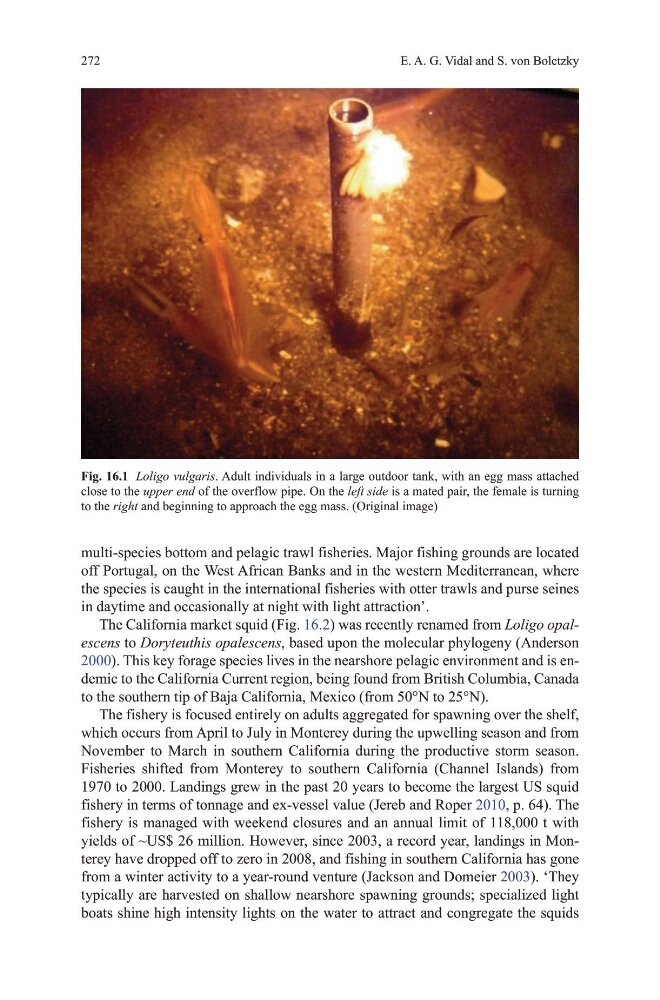
Fig. 16.1 Loligo vulgaris. Adult individuals in a large outdoor tank, with an egg mass attached
close to the upper end of the overflow pipe. On the left side is a mated pair, the female is turning
to the right and beginning to approach the egg mass. (Original image)
E. A. G. Vidal and S. von Boletzky
multi-species bottom and pelagic trawl fisheries. Major fishing grounds are located
off Portugal, on the West African Banks and in the western Mediterranean, where
the species is caught in the international fisheries with otter trawls and purse seines
in daytime and occasionally at night with light attraction’.
The California market squid (Fig. 16.2) was recently renamed from Loligo opalescens to Doryteuthis opalescens, based upon the molecular phylogeny (Anderson
2000). This key forage species lives in the nearshore pelagic environment and is endemic to the California Current region, being found from British Columbia, Canada
to the southern tip of Baja California, Mexico (from 50°N to 25°N).
The fishery is focused entirely on adults aggregated for spawning over the shelf,
which occurs from April to July in Monterey during the upwelling season and from
November to March in southern California during the productive storm season.
Fisheries shifted from Monterey to southern California (Channel Islands) from
1970 to 2000. Landings grew in the past 20 years to become the largest US squid
fishery in terms of tonnage and ex-vessel value (Jereb and Roper 2010, p. 64). The
fishery is managed with weekend closures and an annual limit of 118,000 t with
yields of ~US$ 26 million. However, since 2003, a record year, landings in Monterey have dropped off to zero in 2008, and fishing in southern California has gone
from a winter activity to a year-round venture (Jackson and Domeier 2003). ‘They
typically are harvested on shallow nearshore spawning grounds; specialized light
boats shine high intensity lights on the water to attract and congregate the squids
Fig. 16.1 Loligo vulgaris. Adult individuals in a large outdoor tank, with an egg mass attached
close to the upper end of the overflow pipe. On the left side is a mated pair, the female is turning
to the right and beginning to approach the egg mass. (Original image)