

266
15.6.3 Euprymna tasmanica Growth
Detailed studies on growth of E� tasmanica are scarce. Growth rate of E� tasmanica
is rapid, with hatchlings reaching adult size in 2 months at 18 °C. E� tasmanica can
grow from a ML of approximately 1.7 mm and a weight of 0.012 g at hatching
(Steer et al. 2004) to 0.06 g at 21 days and to 6.8 g at 112 days (Sinn et al. 2008).
The daily growth rate from day 21 to 63 is 7–9 %, from 63 to 84 days decreases to
2–4 % and from 84–112 days 1–2 % at 18 °C (Sinn 2005).
The relationships between weight and age are exponential from 7 to 44 days after
hatching and linear from 58 to 140 days (Moltschaniwskyj and Carter 2010) which
can be expressed as:
(15.7)
(15.8)
15.7 Trends in Research and Industry
The main purpose of culture Euprymna is obviously not for human consumption.
Present research in the fields of marine pharmacology, biotechnology and mimetic
engineering requires small and “easy to culture” squids. Rapidly growing demand
InW
A
=
−
0 069
4 06
.
.
W
A
=
−
0 07
328
.
. .
J. Nabhitabhata and M. K. Nishiguchi
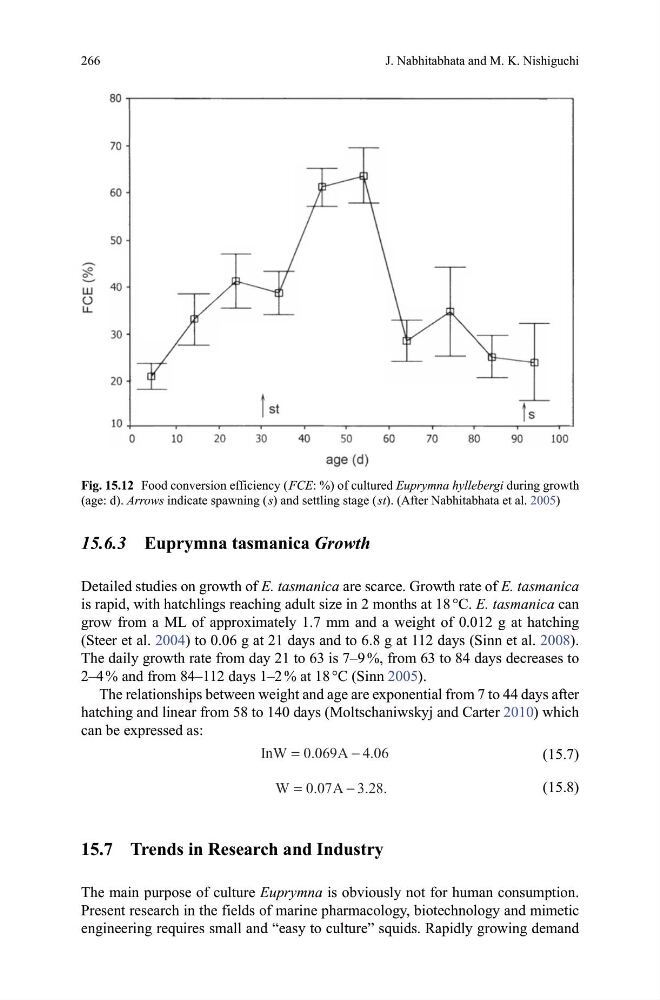
Fig. 15.12 Food conversion efficiency ( FCE: %) of cultured Euprymna hyllebergi during growth
(age: d). Arrows indicate spawning ( s) and settling stage ( st). (After Nabhitabhata et al. 2005)
15.6.3 Euprymna tasmanica Growth
Detailed studies on growth of E� tasmanica are scarce. Growth rate of E� tasmanica
is rapid, with hatchlings reaching adult size in 2 months at 18 °C. E� tasmanica can
grow from a ML of approximately 1.7 mm and a weight of 0.012 g at hatching
(Steer et al. 2004) to 0.06 g at 21 days and to 6.8 g at 112 days (Sinn et al. 2008).
The daily growth rate from day 21 to 63 is 7–9 %, from 63 to 84 days decreases to
2–4 % and from 84–112 days 1–2 % at 18 °C (Sinn 2005).
The relationships between weight and age are exponential from 7 to 44 days after
hatching and linear from 58 to 140 days (Moltschaniwskyj and Carter 2010) which
can be expressed as:
(15.7)
(15.8)
15.7 Trends in Research and Industry
The main purpose of culture Euprymna is obviously not for human consumption.
Present research in the fields of marine pharmacology, biotechnology and mimetic
engineering requires small and “easy to culture” squids. Rapidly growing demand
InW
A
=
−
0 069
4 06
.
.
W
A
=
−
0 07
328
.
. .
J. Nabhitabhata and M. K. Nishiguchi
Fig. 15.12 Food conversion efficiency ( FCE: %) of cultured Euprymna hyllebergi during growth
(age: d). Arrows indicate spawning ( s) and settling stage ( st). (After Nabhitabhata et al. 2005)