

246
X.-D. Zheng et al.
The juveniles start their demersal life when the ML reaches 8–10 mm. As for
above 10 mm ML juveniles, shrimp (e.g. Neomysis awatschensis) or crab (e.g. Portunus trituberculatus) larvae can be used as feed. The feed density is up to 0.3–0.5
individuals L
−1
. When the ML of the juveniles reaches 12–15 mm, dried shrimp
( Acetes sp.) or crushed fish ( Pseudorasbora parva) at a body length of 10 mm
can be used as supplement, and gradually, be used as the only diet, at the rate of
10–20 % of the body weight.
14.4.2 Water Quality, Illumination, Aeration and Nursing
Density
The suitable temperature for juveniles is 19–30 °C, with 23–26 °C being the best
range (Zheng et al. 2010). Within this range, the warmer the water is, the faster
the hatchlings grow. The standards regarding the water quality are: pH 7.6–8.6,
DO ≥ 5 mg L
−1
and ammonia nitrogen ≤ 0.2 mg L
−1
. These conditions should remain
stable. The juveniles have good adaptability to low salinity, so long as it is above
20 psu, with 25–32 psu being the best.
The juvenile cuttlefishes prefer dim light and excessive illumination can reduce
their ingestion, which has a negative impact on the growth and survival rate. Bright
light may cause them to eject ink. The nursing pools should be covered with black
cloth sheeting, and dim light (≤ 500 Lx) should be maintained during the entire
nursing period. Oxygen demand by the juveniles increases along with their growth.
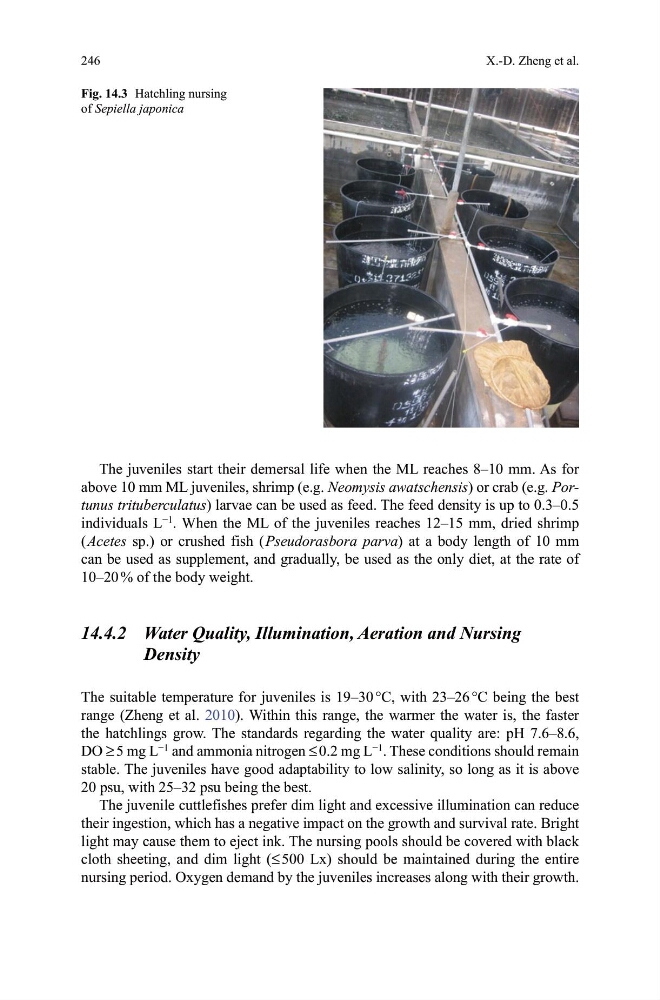
Fig. 14.3 Hatchling nursing
of Sepiella japonica
X.-D. Zheng et al.
The juveniles start their demersal life when the ML reaches 8–10 mm. As for
above 10 mm ML juveniles, shrimp (e.g. Neomysis awatschensis) or crab (e.g. Portunus trituberculatus) larvae can be used as feed. The feed density is up to 0.3–0.5
individuals L
−1
. When the ML of the juveniles reaches 12–15 mm, dried shrimp
( Acetes sp.) or crushed fish ( Pseudorasbora parva) at a body length of 10 mm
can be used as supplement, and gradually, be used as the only diet, at the rate of
10–20 % of the body weight.
14.4.2 Water Quality, Illumination, Aeration and Nursing
Density
The suitable temperature for juveniles is 19–30 °C, with 23–26 °C being the best
range (Zheng et al. 2010). Within this range, the warmer the water is, the faster
the hatchlings grow. The standards regarding the water quality are: pH 7.6–8.6,
DO ≥ 5 mg L
−1
and ammonia nitrogen ≤ 0.2 mg L
−1
. These conditions should remain
stable. The juveniles have good adaptability to low salinity, so long as it is above
20 psu, with 25–32 psu being the best.
The juvenile cuttlefishes prefer dim light and excessive illumination can reduce
their ingestion, which has a negative impact on the growth and survival rate. Bright
light may cause them to eject ink. The nursing pools should be covered with black
cloth sheeting, and dim light (≤ 500 Lx) should be maintained during the entire
nursing period. Oxygen demand by the juveniles increases along with their growth.
Fig. 14.3 Hatchling nursing
of Sepiella japonica