

178
Paulij et al. 1990). The use of IP67-electric-certified equipment and material (e.g.
illumination) is mandatory if these are installed near the tank.
The use of semi-open or closed systems should comprise a scaled filtration based
on the basic setup described by Hanlon (1990) to assure that protein load in the
water (resulting from feeding and eventual inking due to reproductive behaviour
or stress response) is kept low and spikes or build-up of nitrogenous compounds
is avoided. Upgrades on the equipment used in these types of systems are advised
to help reduce the area occupied and to attain increased efficiency. The build-up of
anoxic areas in the tank, due to low water circulation, should be prevented while
designing the system setup.
Airlifts and outflow pipes should be covered with plastic nets of appropriate
mesh size to prevent animals and eggs from escaping or being washed out. While
designing the seawater system, it should be considered that sharp objects or rough
surfaces must not exist inside the tank since they may cause skin damage to the
animals. If needed, a wall foam protection system similar to that described by Hanley et al. (1999) should be used. Following a good welfare practice regarding enriched environments and considering the animal’s ability to camouflage; this tank
should be under low light intensities of 200 Lx or less (measured at the water-air
interface of the tank) and under a normal photoperiod that should replicate natural
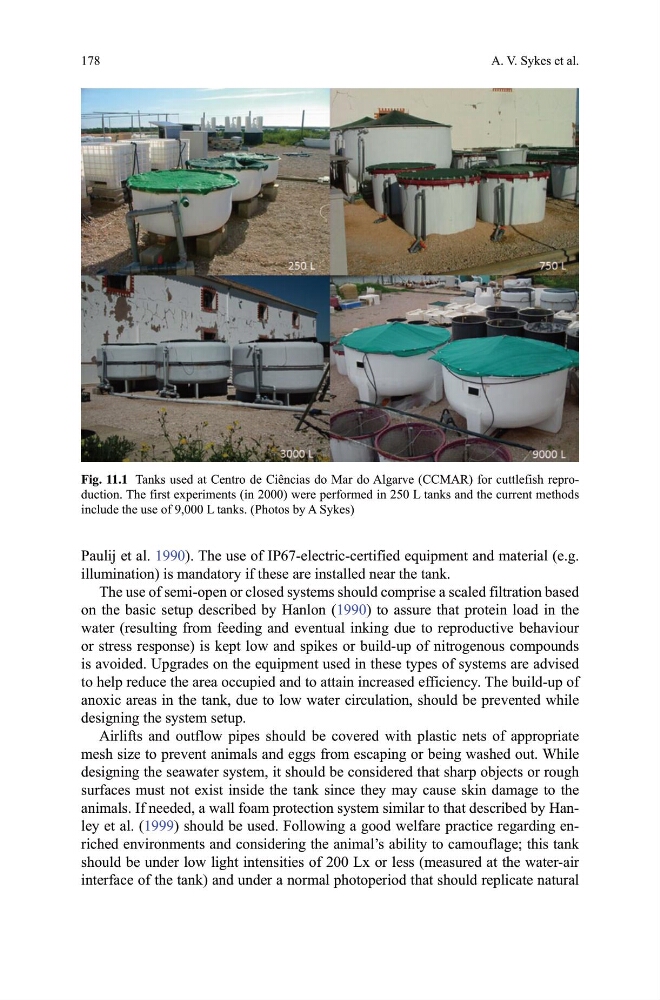
Fig. 11.1 Tanks used at Centro de Ciências do Mar do Algarve (CCMAR) for cuttlefish reproduction. The first experiments (in 2000) were performed in 250 L tanks and the current methods
include the use of 9,000 L tanks. (Photos by A Sykes)
A. V. Sykes et al.
Paulij et al. 1990). The use of IP67-electric-certified equipment and material (e.g.
illumination) is mandatory if these are installed near the tank.
The use of semi-open or closed systems should comprise a scaled filtration based
on the basic setup described by Hanlon (1990) to assure that protein load in the
water (resulting from feeding and eventual inking due to reproductive behaviour
or stress response) is kept low and spikes or build-up of nitrogenous compounds
is avoided. Upgrades on the equipment used in these types of systems are advised
to help reduce the area occupied and to attain increased efficiency. The build-up of
anoxic areas in the tank, due to low water circulation, should be prevented while
designing the system setup.
Airlifts and outflow pipes should be covered with plastic nets of appropriate
mesh size to prevent animals and eggs from escaping or being washed out. While
designing the seawater system, it should be considered that sharp objects or rough
surfaces must not exist inside the tank since they may cause skin damage to the
animals. If needed, a wall foam protection system similar to that described by Hanley et al. (1999) should be used. Following a good welfare practice regarding enriched environments and considering the animal’s ability to camouflage; this tank
should be under low light intensities of 200 Lx or less (measured at the water-air
interface of the tank) and under a normal photoperiod that should replicate natural
Fig. 11.1 Tanks used at Centro de Ciências do Mar do Algarve (CCMAR) for cuttlefish reproduction. The first experiments (in 2000) were performed in 250 L tanks and the current methods
include the use of 9,000 L tanks. (Photos by A Sykes)
A. V. Sykes et al.