

156
J. G. García et al.
1,100 kg, a truck crane and facilities on land, as well as auxiliary equipment. The
ongrowing period consists of two fattening cycles a year, starting with subadults of
800 g, which achieve 2.5–3 kg (size T3) at the end of the process. Feeding is fundamentally based on trawling ship discards comprising of crabs ( Polybius henslowii),
black squat lobster ( Galathea squamifera), horse mackerel ( Trachurus trachurus),
blue whiting ( Micromesistius poutassou), etc. The average CI during the ongrowing
process is 5.80 and 78 % of final survival is attained.
The total production cost in the year 2004 was of 5.80 € kg
−1
. If we update it to
2011 considering an average inflation of 3.5 %, a mean updated cost of 7.38 € kg
−1
would result. This work calculates the break-even point, which is the minimum operational size for costs to equal revenue. The minimum size is 43 cages, providing
an annual production of 38.7 t with an average cost of 5.80 € and a maximum acquisition price of subadults and food of 4.58 and 0.155 € kg
−1
, respectively. The food
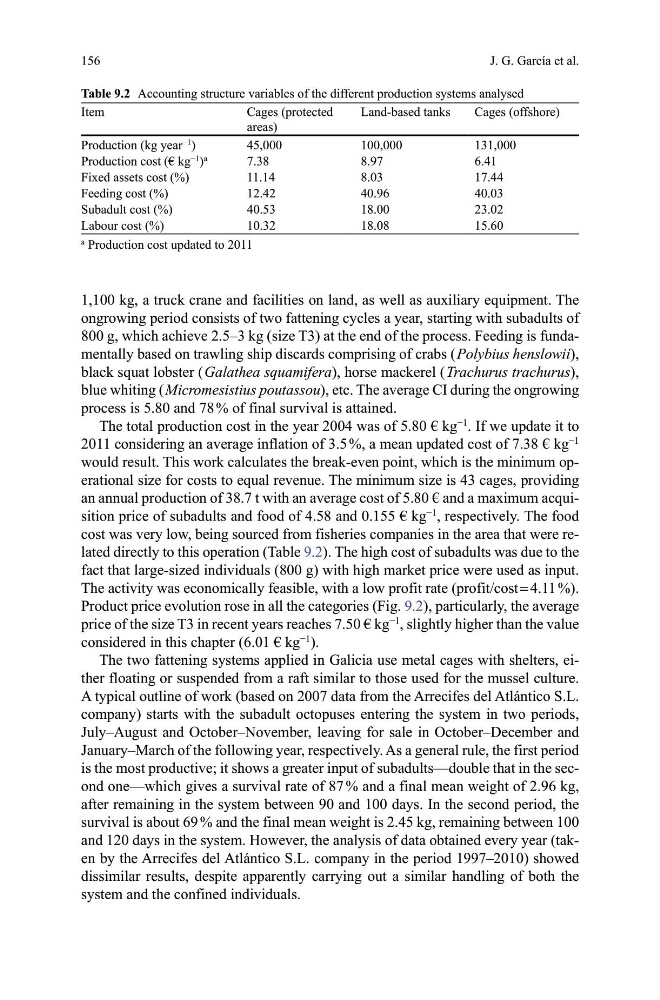
cost was very low, being sourced from fisheries companies in the area that were related directly to this operation (Table 9.2). The high cost of subadults was due to the
fact that large-sized individuals (800 g) with high market price were used as input.
The activity was economically feasible, with a low profit rate (profit/cost = 4.11 %).
Product price evolution rose in all the categories (Fig. 9.2), particularly, the average
price of the size T3 in recent years reaches 7.50 € kg
−1
, slightly higher than the value
considered in this chapter (6.01 € kg
−1
).
The two fattening systems applied in Galicia use metal cages with shelters, either floating or suspended from a raft similar to those used for the mussel culture.
A typical outline of work (based on 2007 data from the Arrecifes del Atlántico S.L.
company) starts with the subadult octopuses entering the system in two periods,
July–August and October–November, leaving for sale in October–December and
January–March of the following year, respectively. As a general rule, the first period
is the most productive; it shows a greater input of subadults—double that in the second one—which gives a survival rate of 87 % and a final mean weight of 2.96 kg,
after remaining in the system between 90 and 100 days. In the second period, the
survival is about 69 % and the final mean weight is 2.45 kg, remaining between 100
and 120 days in the system. However, the analysis of data obtained every year (taken by the Arrecifes del Atlántico S.L. company in the period 1997–2010) showed
dissimilar results, despite apparently carrying out a similar handling of both the
system and the confined individuals.
Table 9.2 Accounting structure variables of the different production systems analysed
Item
Cages (protected
areas)
Land-based tanks
Cages (offshore)
Production (kg year
−1
)
45,000
100,000
131,000
Production cost (€ kg
−1
)
a
7.38
8.97
6.41
Fixed assets cost (%)
11.14
8.03
17.44
Feeding cost (%)
12.42
40.96
40.03
Subadult cost (%)
40.53
18.00
23.02
Labour cost (%)
10.32
18.08
15.60
a
Production cost updated to 2011
J. G. García et al.
1,100 kg, a truck crane and facilities on land, as well as auxiliary equipment. The
ongrowing period consists of two fattening cycles a year, starting with subadults of
800 g, which achieve 2.5–3 kg (size T3) at the end of the process. Feeding is fundamentally based on trawling ship discards comprising of crabs ( Polybius henslowii),
black squat lobster ( Galathea squamifera), horse mackerel ( Trachurus trachurus),
blue whiting ( Micromesistius poutassou), etc. The average CI during the ongrowing
process is 5.80 and 78 % of final survival is attained.
The total production cost in the year 2004 was of 5.80 € kg
−1
. If we update it to
2011 considering an average inflation of 3.5 %, a mean updated cost of 7.38 € kg
−1
would result. This work calculates the break-even point, which is the minimum operational size for costs to equal revenue. The minimum size is 43 cages, providing
an annual production of 38.7 t with an average cost of 5.80 € and a maximum acquisition price of subadults and food of 4.58 and 0.155 € kg
−1
, respectively. The food
cost was very low, being sourced from fisheries companies in the area that were related directly to this operation (Table 9.2). The high cost of subadults was due to the
fact that large-sized individuals (800 g) with high market price were used as input.
The activity was economically feasible, with a low profit rate (profit/cost = 4.11 %).
Product price evolution rose in all the categories (Fig. 9.2), particularly, the average
price of the size T3 in recent years reaches 7.50 € kg
−1
, slightly higher than the value
considered in this chapter (6.01 € kg
−1
).
The two fattening systems applied in Galicia use metal cages with shelters, either floating or suspended from a raft similar to those used for the mussel culture.
A typical outline of work (based on 2007 data from the Arrecifes del Atlántico S.L.
company) starts with the subadult octopuses entering the system in two periods,
July–August and October–November, leaving for sale in October–December and
January–March of the following year, respectively. As a general rule, the first period
is the most productive; it shows a greater input of subadults—double that in the second one—which gives a survival rate of 87 % and a final mean weight of 2.96 kg,
after remaining in the system between 90 and 100 days. In the second period, the
survival is about 69 % and the final mean weight is 2.45 kg, remaining between 100
and 120 days in the system. However, the analysis of data obtained every year (taken by the Arrecifes del Atlántico S.L. company in the period 1997–2010) showed
dissimilar results, despite apparently carrying out a similar handling of both the
system and the confined individuals.
Table 9.2 Accounting structure variables of the different production systems analysed
Item
Cages (protected
areas)
Land-based tanks
Cages (offshore)
Production (kg year
−1
)
45,000
100,000
131,000
Production cost (€ kg
−1
)
a
7.38
8.97
6.41
Fixed assets cost (%)
11.14
8.03
17.44
Feeding cost (%)
12.42
40.96
40.03
Subadult cost (%)
40.53
18.00
23.02
Labour cost (%)
10.32
18.08
15.60
a
Production cost updated to 2011