

154
J. G. García et al.
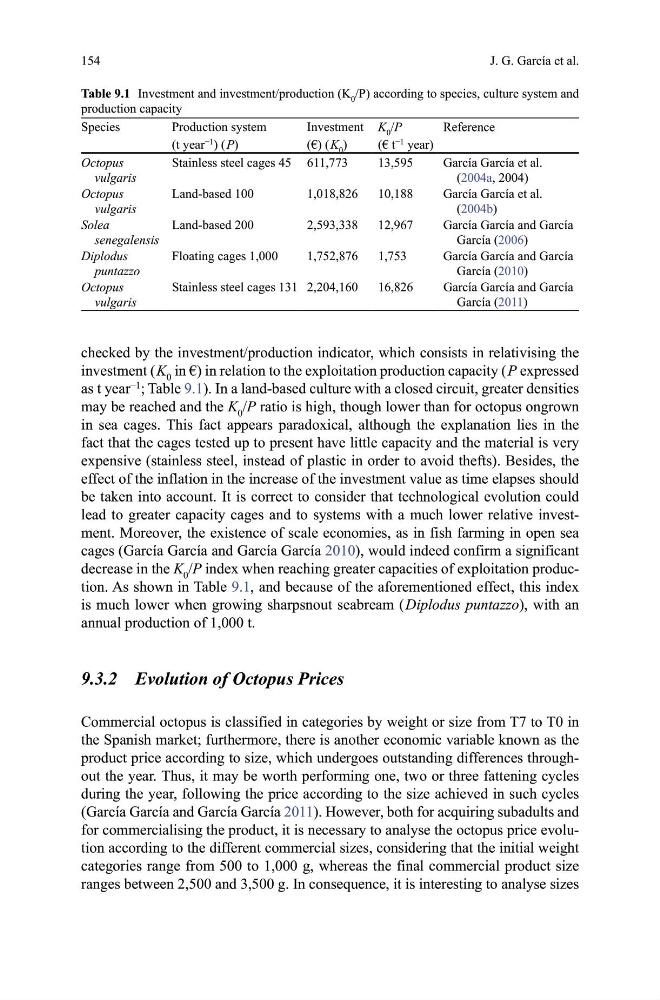
checked by the investment/production indicator, which consists in relativising the
investment ( K 0 in €) in relation to the exploitation production capacity ( P expressed
as t year
−1
; Table 9.1). In a land-based culture with a closed circuit, greater densities
may be reached and the K 0 /P ratio is high, though lower than for octopus ongrown
in sea cages. This fact appears paradoxical, although the explanation lies in the
fact that the cages tested up to present have little capacity and the material is very
expensive (stainless steel, instead of plastic in order to avoid thefts). Besides, the
effect of the inflation in the increase of the investment value as time elapses should
be taken into account. It is correct to consider that technological evolution could
lead to greater capacity cages and to systems with a much lower relative investment. Moreover, the existence of scale economies, as in fish farming in open sea
cages (García García and García García 2010), would indeed confirm a significant
decrease in the K 0 /P index when reaching greater capacities of exploitation production. As shown in Table 9.1, and because of the aforementioned effect, this index
is much lower when growing sharpsnout seabream ( Diplodus puntazzo), with an
annual production of 1,000 t.
9.3.2 Evolution of Octopus Prices
Commercial octopus is classified in categories by weight or size from T7 to T0 in
the Spanish market; furthermore, there is another economic variable known as the
product price according to size, which undergoes outstanding differences throughout the year. Thus, it may be worth performing one, two or three fattening cycles
during the year, following the price according to the size achieved in such cycles
(García García and García García 2011). However, both for acquiring subadults and
for commercialising the product, it is necessary to analyse the octopus price evolution according to the different commercial sizes, considering that the initial weight
categories range from 500 to 1,000 g, whereas the final commercial product size
ranges between 2,500 and 3,500 g. In consequence, it is interesting to analyse sizes
Table 9.1 Investment and investment/production (K 0 /P) according to species, culture system and
production capacity
Species
Production system
Investment K 0 /P
Reference
(t year
−1
) ( P)
(€) ( K 0 )
(€ t
−1
year)
Octopus
vulgaris
Stainless steel cages 45 611,773
13,595
García García et al.
(2004a, 2004)
Octopus
vulgaris
Land-based 100
1,018,826
10,188
García García et al.
(2004b)
Solea
senegalensis
Land-based 200
2,593,338
12,967
García García and García
García (2006)
Diplodus
puntazzo
Floating cages 1,000
1,752,876
1,753
García García and García
García (2010)
Octopus
vulgaris
Stainless steel cages 131 2,204,160
16,826
García García and García
García (2011)
J. G. García et al.
checked by the investment/production indicator, which consists in relativising the
investment ( K 0 in €) in relation to the exploitation production capacity ( P expressed
as t year
−1
; Table 9.1). In a land-based culture with a closed circuit, greater densities
may be reached and the K 0 /P ratio is high, though lower than for octopus ongrown
in sea cages. This fact appears paradoxical, although the explanation lies in the
fact that the cages tested up to present have little capacity and the material is very
expensive (stainless steel, instead of plastic in order to avoid thefts). Besides, the
effect of the inflation in the increase of the investment value as time elapses should
be taken into account. It is correct to consider that technological evolution could
lead to greater capacity cages and to systems with a much lower relative investment. Moreover, the existence of scale economies, as in fish farming in open sea
cages (García García and García García 2010), would indeed confirm a significant
decrease in the K 0 /P index when reaching greater capacities of exploitation production. As shown in Table 9.1, and because of the aforementioned effect, this index
is much lower when growing sharpsnout seabream ( Diplodus puntazzo), with an
annual production of 1,000 t.
9.3.2 Evolution of Octopus Prices
Commercial octopus is classified in categories by weight or size from T7 to T0 in
the Spanish market; furthermore, there is another economic variable known as the
product price according to size, which undergoes outstanding differences throughout the year. Thus, it may be worth performing one, two or three fattening cycles
during the year, following the price according to the size achieved in such cycles
(García García and García García 2011). However, both for acquiring subadults and
for commercialising the product, it is necessary to analyse the octopus price evolution according to the different commercial sizes, considering that the initial weight
categories range from 500 to 1,000 g, whereas the final commercial product size
ranges between 2,500 and 3,500 g. In consequence, it is interesting to analyse sizes
Table 9.1 Investment and investment/production (K 0 /P) according to species, culture system and
production capacity
Species
Production system
Investment K 0 /P
Reference
(t year
−1
) ( P)
(€) ( K 0 )
(€ t
−1
year)
Octopus
vulgaris
Stainless steel cages 45 611,773
13,595
García García et al.
(2004a, 2004)
Octopus
vulgaris
Land-based 100
1,018,826
10,188
García García et al.
(2004b)
Solea
senegalensis
Land-based 200
2,593,338
12,967
García García and García
García (2006)
Diplodus
puntazzo
Floating cages 1,000
1,752,876
1,753
García García and García
García (2010)
Octopus
vulgaris
Stainless steel cages 131 2,204,160
16,826
García García and García
García (2011)