

133
8 Applications, Uses and By-products from Cephalopods
studied the viscera oil composition of squid and explained that this oil contains 15–
25 % of EPA and DHA. Squid contains more DHA than EPA in its lipids (Liang and
Hwang 2000). The oil extracted from the viscera of cuttlefish ( Sepiella maindroni
de Rochebruns) was studied by Shen et al. (2007). Fatty acid composition, cholesterol content and volatile compound composition were analysed by these authors.
The composition of fatty acids was 50 % monounsaturated fatty acids (MUFAs), followed by 31 % PUFAs and finally 19 % saturated fatty acids (Shen et al. 2007). In
their study, Shen et al. (2007) revealed that cuttlefish oil from East China had an
unsaturated fatty acid content of 81 %. Cuttlefish oil is also suitable as a high-energy
feedstuff in aquaculture because of its fatty acid content and the strong fishy odour,
which is an attractant for fish or shrimp. Even the residual portion after the extraction
of PUFA and MUFA can be used for biodiesel production (Shen et al. 2007). Tavakoli
and Yoshida (2006) studied squid oil hydrolysis as a mechanism for the production
of Ω-3 PUFA and fatty acids for biodiesel. When using cuttlefish oil for functional
ingredients, the EPA and DHA yields can be optimized. Park et al. (2011) developed a refined oil from raw cuttlefish ( Todarodes pacificus) viscera and obtained
a significantly higher composition, 14.7 % of EPA and 28.6 % of DHA; this refined
product has a good stability. The cuttlefish digestive gland, which constitutes about
7–12 % of body weight, is also rich in EPA and DHA (Joseph et al. 2005). The study
of Joseph et al. (2005) has shown that the use of Ω-3 PUFA, from cuttlefish digestive
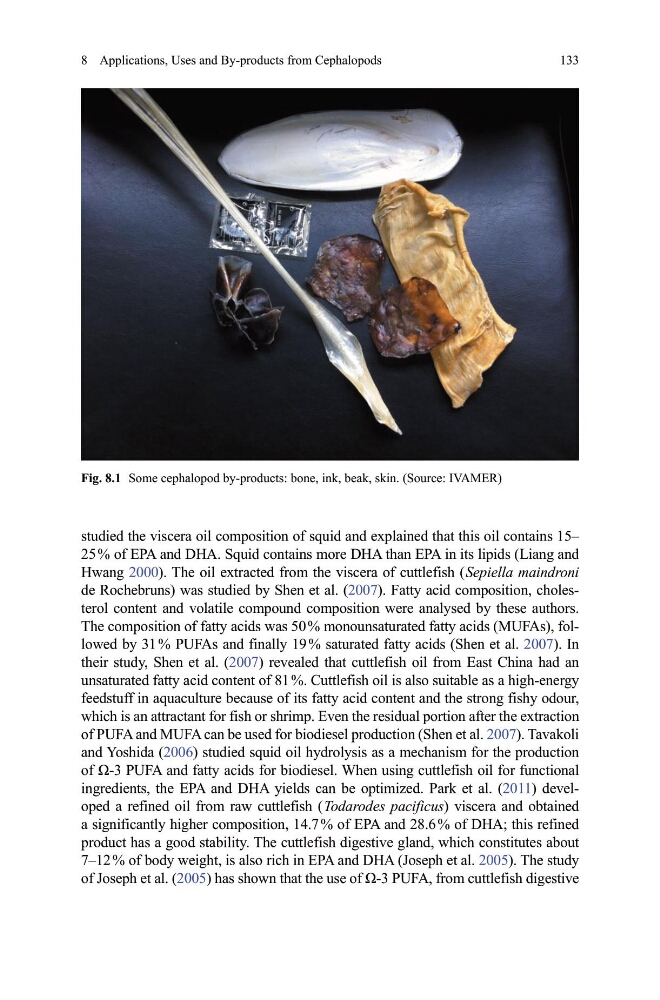
Fig. 8.1 Some cephalopod by-products: bone, ink, beak, skin. (Source: IVAMER)
8 Applications, Uses and By-products from Cephalopods
studied the viscera oil composition of squid and explained that this oil contains 15–
25 % of EPA and DHA. Squid contains more DHA than EPA in its lipids (Liang and
Hwang 2000). The oil extracted from the viscera of cuttlefish ( Sepiella maindroni
de Rochebruns) was studied by Shen et al. (2007). Fatty acid composition, cholesterol content and volatile compound composition were analysed by these authors.
The composition of fatty acids was 50 % monounsaturated fatty acids (MUFAs), followed by 31 % PUFAs and finally 19 % saturated fatty acids (Shen et al. 2007). In
their study, Shen et al. (2007) revealed that cuttlefish oil from East China had an
unsaturated fatty acid content of 81 %. Cuttlefish oil is also suitable as a high-energy
feedstuff in aquaculture because of its fatty acid content and the strong fishy odour,
which is an attractant for fish or shrimp. Even the residual portion after the extraction
of PUFA and MUFA can be used for biodiesel production (Shen et al. 2007). Tavakoli
and Yoshida (2006) studied squid oil hydrolysis as a mechanism for the production
of Ω-3 PUFA and fatty acids for biodiesel. When using cuttlefish oil for functional
ingredients, the EPA and DHA yields can be optimized. Park et al. (2011) developed a refined oil from raw cuttlefish ( Todarodes pacificus) viscera and obtained
a significantly higher composition, 14.7 % of EPA and 28.6 % of DHA; this refined
product has a good stability. The cuttlefish digestive gland, which constitutes about
7–12 % of body weight, is also rich in EPA and DHA (Joseph et al. 2005). The study
of Joseph et al. (2005) has shown that the use of Ω-3 PUFA, from cuttlefish digestive
Fig. 8.1 Some cephalopod by-products: bone, ink, beak, skin. (Source: IVAMER)