

121
7 Aquaculture to Restocking
with another female after her last spawning. Mating and spawning are observed in
the early morning and late afternoon.
Eggs are collected daily from the broodstock tanks and transferred to be nursed in
other tanks in the hatchery under controlled conditions. The capsules are collected
by hand each day after the females pause their spawning. The egg clusters are also
available from some squid traps.
Sepioteuthis lessoniana Broodstock Live bigfin squid can be collected using a similar method to that for cuttlefish, but the collection of only egg masses is an appropriate
current choice. Firstly, it is more economical and convenient because the percentage
of egg capsules attached to traps is more than 95 % in quantity compared to 5 % for the
cuttlefish. Secondly, most of the collected broodstock squid are not healthy enough to
produce healthy eggs due to their pelagic habit and high metabolic rate.
Primary Handling of Egg Capsules The egg capsules collected from the wild
occur in various sizes, hence differ in their embryonic stages, and have to be graded.
Squid egg capsules are graded into four stages according to their size and shape.
The first stage is the newly spawned egg capsule with a cylindrical shape and is at
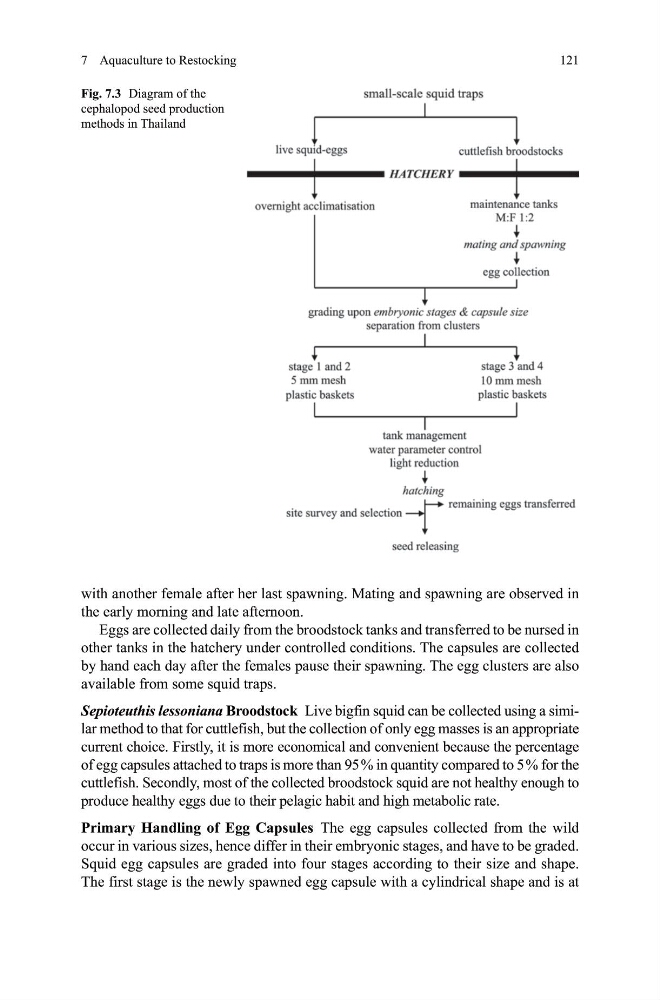
Fig. 7.3 Diagram of the
cephalopod seed production
methods in Thailand
7 Aquaculture to Restocking
with another female after her last spawning. Mating and spawning are observed in
the early morning and late afternoon.
Eggs are collected daily from the broodstock tanks and transferred to be nursed in
other tanks in the hatchery under controlled conditions. The capsules are collected
by hand each day after the females pause their spawning. The egg clusters are also
available from some squid traps.
Sepioteuthis lessoniana Broodstock Live bigfin squid can be collected using a similar method to that for cuttlefish, but the collection of only egg masses is an appropriate
current choice. Firstly, it is more economical and convenient because the percentage
of egg capsules attached to traps is more than 95 % in quantity compared to 5 % for the
cuttlefish. Secondly, most of the collected broodstock squid are not healthy enough to
produce healthy eggs due to their pelagic habit and high metabolic rate.
Primary Handling of Egg Capsules The egg capsules collected from the wild
occur in various sizes, hence differ in their embryonic stages, and have to be graded.
Squid egg capsules are graded into four stages according to their size and shape.
The first stage is the newly spawned egg capsule with a cylindrical shape and is at
Fig. 7.3 Diagram of the
cephalopod seed production
methods in Thailand