

119
7 Aquaculture to Restocking
and the fishing technique operates from the experience and understanding of squid
behaviour by local fishermen (see also Chap. 17 ‘Sepioteuthis lessoniana’). The
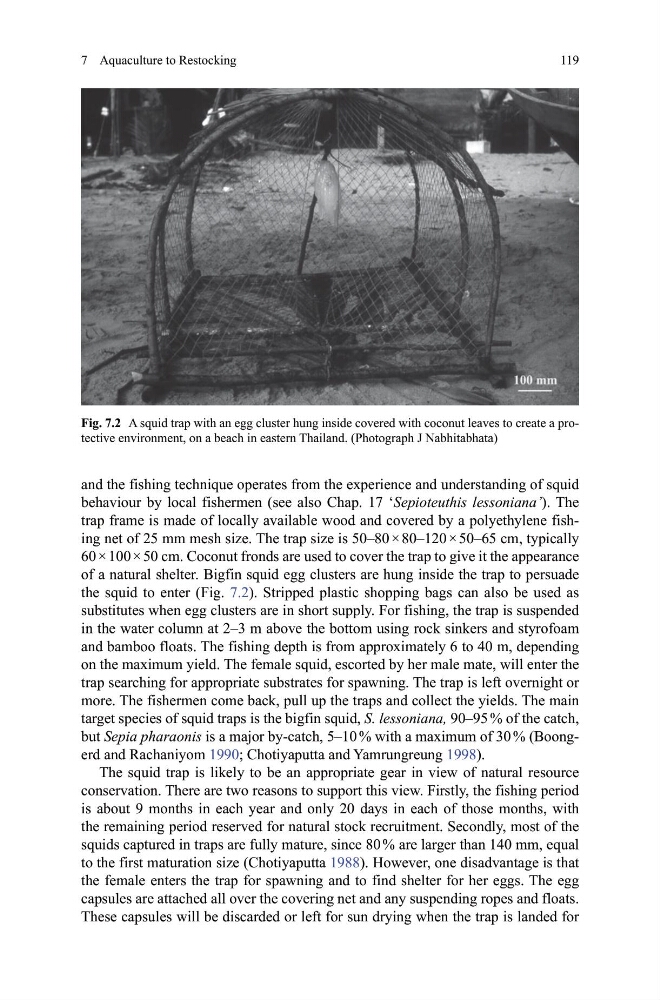
trap frame is made of locally available wood and covered by a polyethylene fishing net of 25 mm mesh size. The trap size is 50–80 × 80–120 × 50–65 cm, typically
60 × 100 × 50 cm. Coconut fronds are used to cover the trap to give it the appearance
of a natural shelter. Bigfin squid egg clusters are hung inside the trap to persuade
the squid to enter (Fig. 7.2). Stripped plastic shopping bags can also be used as
substitutes when egg clusters are in short supply. For fishing, the trap is suspended
in the water column at 2–3 m above the bottom using rock sinkers and styrofoam
and bamboo floats. The fishing depth is from approximately 6 to 40 m, depending
on the maximum yield. The female squid, escorted by her male mate, will enter the
trap searching for appropriate substrates for spawning. The trap is left overnight or
more. The fishermen come back, pull up the traps and collect the yields. The main
target species of squid traps is the bigfin squid, S� lessoniana, 90–95 % of the catch,
but Sepia pharaonis is a major by-catch, 5–10 % with a maximum of 30 % (Boongerd and Rachaniyom 1990; Chotiyaputta and Yamrungreung 1998).
The squid trap is likely to be an appropriate gear in view of natural resource
conservation. There are two reasons to support this view. Firstly, the fishing period
is about 9 months in each year and only 20 days in each of those months, with
the remaining period reserved for natural stock recruitment. Secondly, most of the
squids captured in traps are fully mature, since 80 % are larger than 140 mm, equal
to the first maturation size (Chotiyaputta 1988). However, one disadvantage is that
the female enters the trap for spawning and to find shelter for her eggs. The egg
capsules are attached all over the covering net and any suspending ropes and floats.
These capsules will be discarded or left for sun drying when the trap is landed for
Fig. 7.2 A squid trap with an egg cluster hung inside covered with coconut leaves to create a protective environment, on a beach in eastern Thailand. (Photograph J Nabhitabhata)
7 Aquaculture to Restocking
and the fishing technique operates from the experience and understanding of squid
behaviour by local fishermen (see also Chap. 17 ‘Sepioteuthis lessoniana’). The
trap frame is made of locally available wood and covered by a polyethylene fishing net of 25 mm mesh size. The trap size is 50–80 × 80–120 × 50–65 cm, typically
60 × 100 × 50 cm. Coconut fronds are used to cover the trap to give it the appearance
of a natural shelter. Bigfin squid egg clusters are hung inside the trap to persuade
the squid to enter (Fig. 7.2). Stripped plastic shopping bags can also be used as
substitutes when egg clusters are in short supply. For fishing, the trap is suspended
in the water column at 2–3 m above the bottom using rock sinkers and styrofoam
and bamboo floats. The fishing depth is from approximately 6 to 40 m, depending
on the maximum yield. The female squid, escorted by her male mate, will enter the
trap searching for appropriate substrates for spawning. The trap is left overnight or
more. The fishermen come back, pull up the traps and collect the yields. The main
target species of squid traps is the bigfin squid, S� lessoniana, 90–95 % of the catch,
but Sepia pharaonis is a major by-catch, 5–10 % with a maximum of 30 % (Boongerd and Rachaniyom 1990; Chotiyaputta and Yamrungreung 1998).
The squid trap is likely to be an appropriate gear in view of natural resource
conservation. There are two reasons to support this view. Firstly, the fishing period
is about 9 months in each year and only 20 days in each of those months, with
the remaining period reserved for natural stock recruitment. Secondly, most of the
squids captured in traps are fully mature, since 80 % are larger than 140 mm, equal
to the first maturation size (Chotiyaputta 1988). However, one disadvantage is that
the female enters the trap for spawning and to find shelter for her eggs. The egg
capsules are attached all over the covering net and any suspending ropes and floats.
These capsules will be discarded or left for sun drying when the trap is landed for
Fig. 7.2 A squid trap with an egg cluster hung inside covered with coconut leaves to create a protective environment, on a beach in eastern Thailand. (Photograph J Nabhitabhata)