

115
7 Aquaculture to Restocking
the release of hatchlings. In 1964, S� lessoniana hatchlings were reared up to 70 mm
in total length (TL) in 2 months and O� vulgaris from eggs to the paralarval stage with
14–15 suckers in 20–25 days (JASFA 2003). In 1982, JASFA succeeded in rearing O�
vulgaris to the stage of paralarval settlement (JASFA 2003). The targeted cephalopod
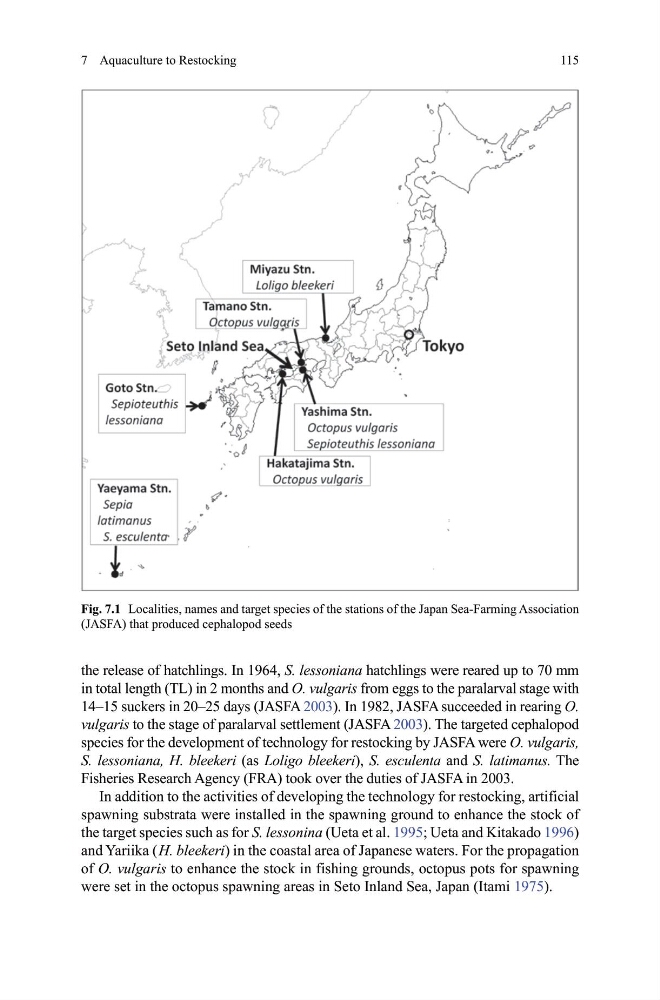
species for the development of technology for restocking by JASFA were O� vulgaris,
S� lessoniana, H� bleekeri (as Loligo bleekeri), S� esculenta and S� latimanus� The
Fisheries Research Agency (FRA) took over the duties of JASFA in 2003.
In addition to the activities of developing the technology for restocking, artificial
spawning substrata were installed in the spawning ground to enhance the stock of
the target species such as for S� lessonina (Ueta et al. 1995; Ueta and Kitakado 1996)
and Yariika ( H� bleekeri) in the coastal area of Japanese waters. For the propagation
of O� vulgaris to enhance the stock in fishing grounds, octopus pots for spawning
were set in the octopus spawning areas in Seto Inland Sea, Japan (Itami 1975).
Fig. 7.1 Localities, names and target species of the stations of the Japan Sea-Farming Association
(JASFA) that produced cephalopod seeds
7 Aquaculture to Restocking
the release of hatchlings. In 1964, S� lessoniana hatchlings were reared up to 70 mm
in total length (TL) in 2 months and O� vulgaris from eggs to the paralarval stage with
14–15 suckers in 20–25 days (JASFA 2003). In 1982, JASFA succeeded in rearing O�
vulgaris to the stage of paralarval settlement (JASFA 2003). The targeted cephalopod
species for the development of technology for restocking by JASFA were O� vulgaris,
S� lessoniana, H� bleekeri (as Loligo bleekeri), S� esculenta and S� latimanus� The
Fisheries Research Agency (FRA) took over the duties of JASFA in 2003.
In addition to the activities of developing the technology for restocking, artificial
spawning substrata were installed in the spawning ground to enhance the stock of
the target species such as for S� lessonina (Ueta et al. 1995; Ueta and Kitakado 1996)
and Yariika ( H� bleekeri) in the coastal area of Japanese waters. For the propagation
of O� vulgaris to enhance the stock in fishing grounds, octopus pots for spawning
were set in the octopus spawning areas in Seto Inland Sea, Japan (Itami 1975).
Fig. 7.1 Localities, names and target species of the stations of the Japan Sea-Farming Association
(JASFA) that produced cephalopod seeds