

103
congenital morphology, related alterations have ever been reported; they have been
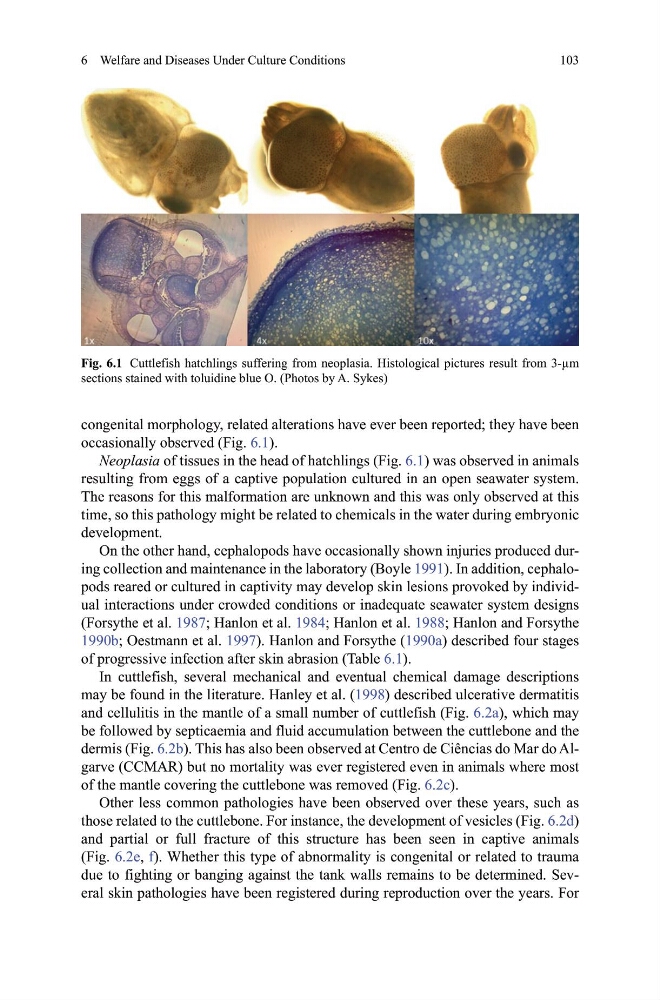
occasionally observed (Fig. 6.1).
Neoplasia of tissues in the head of hatchlings (Fig. 6.1) was observed in animals
resulting from eggs of a captive population cultured in an open seawater system.
The reasons for this malformation are unknown and this was only observed at this
time, so this pathology might be related to chemicals in the water during embryonic
development.
On the other hand, cephalopods have occasionally shown injuries produced during collection and maintenance in the laboratory (Boyle 1991). In addition, cephalopods reared or cultured in captivity may develop skin lesions provoked by individual interactions under crowded conditions or inadequate seawater system designs
(Forsythe et al. 1987; Hanlon et al. 1984; Hanlon et al. 1988; Hanlon and Forsythe
1990b; Oestmann et al. 1997). Hanlon and Forsythe (1990a) described four stages
of progressive infection after skin abrasion (Table 6.1).
In cuttlefish, several mechanical and eventual chemical damage descriptions
may be found in the literature. Hanley et al. (1998) described ulcerative dermatitis
and cellulitis in the mantle of a small number of cuttlefish (Fig. 6.2a), which may
be followed by septicaemia and fluid accumulation between the cuttlebone and the
dermis (Fig. 6.2b). This has also been observed at Centro de Ciências do Mar do Algarve (CCMAR) but no mortality was ever registered even in animals where most
of the mantle covering the cuttlebone was removed (Fig. 6.2c).
Other less common pathologies have been observed over these years, such as
those related to the cuttlebone. For instance, the development of vesicles (Fig. 6.2d)
and partial or full fracture of this structure has been seen in captive animals
(Fig. 6.2e, f). Whether this type of abnormality is congenital or related to trauma
due to fighting or banging against the tank walls remains to be determined. Several skin pathologies have been registered during reproduction over the years. For
Fig. 6.1 Cuttlefish hatchlings suffering from neoplasia. Histological pictures result from 3-µm
sections stained with toluidine blue O. (Photos by A. Sykes)
6 Welfare and Diseases Under Culture Conditions
congenital morphology, related alterations have ever been reported; they have been
occasionally observed (Fig. 6.1).
Neoplasia of tissues in the head of hatchlings (Fig. 6.1) was observed in animals
resulting from eggs of a captive population cultured in an open seawater system.
The reasons for this malformation are unknown and this was only observed at this
time, so this pathology might be related to chemicals in the water during embryonic
development.
On the other hand, cephalopods have occasionally shown injuries produced during collection and maintenance in the laboratory (Boyle 1991). In addition, cephalopods reared or cultured in captivity may develop skin lesions provoked by individual interactions under crowded conditions or inadequate seawater system designs
(Forsythe et al. 1987; Hanlon et al. 1984; Hanlon et al. 1988; Hanlon and Forsythe
1990b; Oestmann et al. 1997). Hanlon and Forsythe (1990a) described four stages
of progressive infection after skin abrasion (Table 6.1).
In cuttlefish, several mechanical and eventual chemical damage descriptions
may be found in the literature. Hanley et al. (1998) described ulcerative dermatitis
and cellulitis in the mantle of a small number of cuttlefish (Fig. 6.2a), which may
be followed by septicaemia and fluid accumulation between the cuttlebone and the
dermis (Fig. 6.2b). This has also been observed at Centro de Ciências do Mar do Algarve (CCMAR) but no mortality was ever registered even in animals where most
of the mantle covering the cuttlebone was removed (Fig. 6.2c).
Other less common pathologies have been observed over these years, such as
those related to the cuttlebone. For instance, the development of vesicles (Fig. 6.2d)
and partial or full fracture of this structure has been seen in captive animals
(Fig. 6.2e, f). Whether this type of abnormality is congenital or related to trauma
due to fighting or banging against the tank walls remains to be determined. Several skin pathologies have been registered during reproduction over the years. For
Fig. 6.1 Cuttlefish hatchlings suffering from neoplasia. Histological pictures result from 3-µm
sections stained with toluidine blue O. (Photos by A. Sykes)
6 Welfare and Diseases Under Culture Conditions