

337
18 Assessing Governability – What’s Next
presented in the book, we conclude with some re fl ections about what can be done
to improve governability in fi sheries and aquaculture.
Framework for Assessing Governability
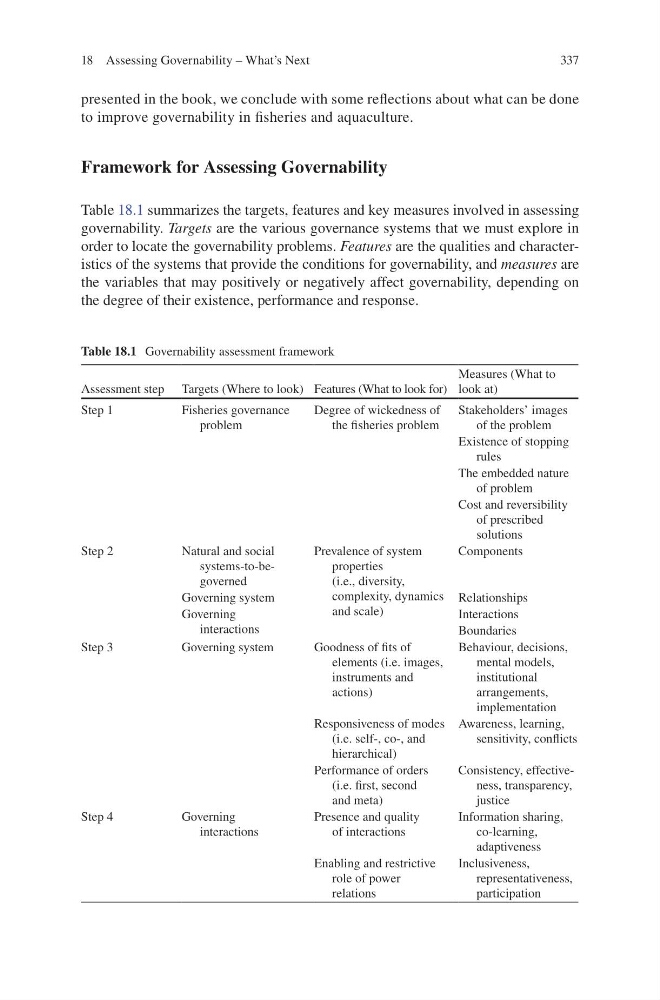
Table 18.1 summarizes the targets, features and key measures involved in assessing
governability. Targets are the various governance systems that we must explore in
order to locate the governability problems. Features are the qualities and characteristics of the systems that provide the conditions for governability, and measures are
the variables that may positively or negatively affect governability, depending on
the degree of their existence, performance and response.
Table 18.1 Governability assessment framework
Assessment step Targets (Where to look) Features (What to look for)
Measures (What to
look at)
Step 1
Fisheries governance
problem
Degree of wickedness of
the fi sheries problem
Stakeholders’ images
of the problem
Existence of stopping
rules
The embedded nature
of problem
Cost and reversibility
of prescribed
solutions
Step 2
Natural and social
systems-to-begoverned
Prevalence of system
properties
(i.e., diversity,
complexity, dynamics
and scale)
Components
Governing system
Relationships
Governing
interactions
Interactions
Boundaries
Step 3
Governing system
Goodness of fi ts of
elements (i.e. images,
instruments and
actions)
Responsiveness of modes
(i.e. self-, co-, and
hierarchical)
Performance of orders
(i.e. fi rst, second
and meta)
Behaviour, decisions,
mental models,
institutional
arrangements,
implementation
Awareness, learning,
sensitivity, con fl icts
Consistency, effectiveness, transparency,
justice
Step 4
Governing
interactions
Presence and quality
of interactions
Enabling and restrictive
role of power
relations
Information sharing,
co-learning,
adaptiveness
Inclusiveness,
representativeness,
participation
18 Assessing Governability – What’s Next
presented in the book, we conclude with some re fl ections about what can be done
to improve governability in fi sheries and aquaculture.
Framework for Assessing Governability
Table 18.1 summarizes the targets, features and key measures involved in assessing
governability. Targets are the various governance systems that we must explore in
order to locate the governability problems. Features are the qualities and characteristics of the systems that provide the conditions for governability, and measures are
the variables that may positively or negatively affect governability, depending on
the degree of their existence, performance and response.
Table 18.1 Governability assessment framework
Assessment step Targets (Where to look) Features (What to look for)
Measures (What to
look at)
Step 1
Fisheries governance
problem
Degree of wickedness of
the fi sheries problem
Stakeholders’ images
of the problem
Existence of stopping
rules
The embedded nature
of problem
Cost and reversibility
of prescribed
solutions
Step 2
Natural and social
systems-to-begoverned
Prevalence of system
properties
(i.e., diversity,
complexity, dynamics
and scale)
Components
Governing system
Relationships
Governing
interactions
Interactions
Boundaries
Step 3
Governing system
Goodness of fi ts of
elements (i.e. images,
instruments and
actions)
Responsiveness of modes
(i.e. self-, co-, and
hierarchical)
Performance of orders
(i.e. fi rst, second
and meta)
Behaviour, decisions,
mental models,
institutional
arrangements,
implementation
Awareness, learning,
sensitivity, con fl icts
Consistency, effectiveness, transparency,
justice
Step 4
Governing
interactions
Presence and quality
of interactions
Enabling and restrictive
role of power
relations
Information sharing,
co-learning,
adaptiveness
Inclusiveness,
representativeness,
participation