

328
S. Almerigi et al.
Pursue advanced modeling of multi-species, predator/prey climate and species/
•
habitat interaction to accomplish management learning.
In another example from the group addressing governance, the group discussed
their vision element related to ‘inclusive participation’ and suggested the following
actions:
Promote comprehensive public education programmes in the school curricula
•
and to the general public;
Target participatory workshops at the community level;
•
Integrate coastal zone issues in school curriculum;
•
Build and implement co-management relationships where appropriate.
•
To conclude the small group conversations, the facilitator led a whole group
re fl ection to harvest any further insights supporting movement toward each vision
element.
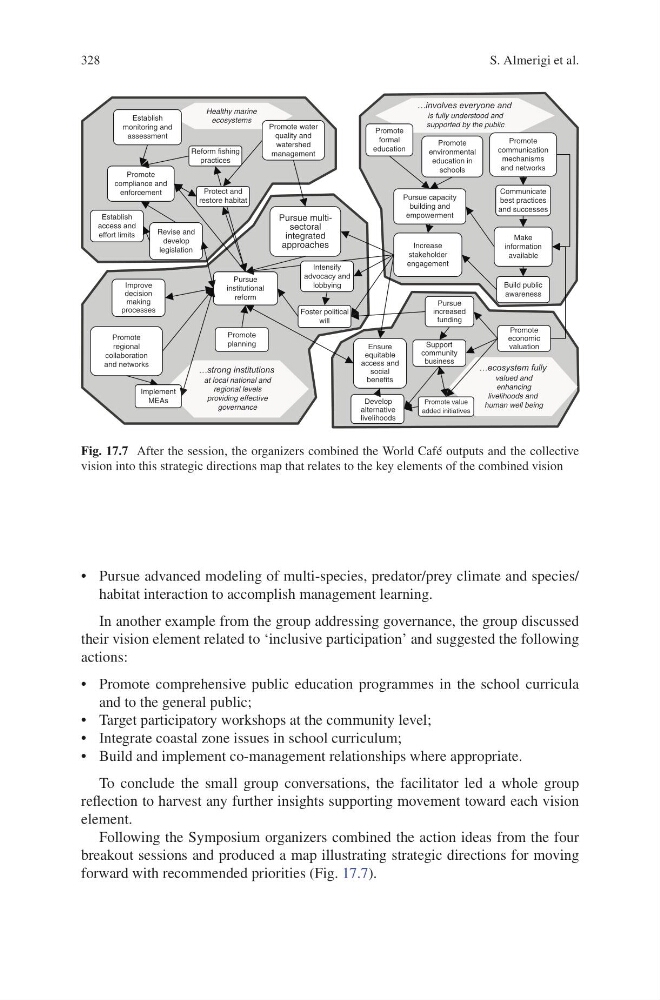
Following the Symposium organizers combined the action ideas from the four
breakout sessions and produced a map illustrating strategic directions for moving
forward with recommended priorities (Fig. 17.7 ).
Improve
decision
making
processes
Establish
access and
effort limits
Revise and
develop
legislation
Communicate
best practices
and successes
Pursue
institutional
reform
Pursue multisectoral
integrated
approaches
Make
information
available
Reform fishing
practices
Promote
economic
valuation
Promote
regional
collaboration
and networks
Pursue capacity
building and
empowerment
Build public
awareness
Promote
environmental
education in
schools
Increase
stakeholder
engagement
Promote
planning
Pursue
increased
funding
Promote
compliance and
enforcement
Develop
alternative
livelihoods
Foster political
will
Ensure
equitable
access and
social
benefits
Support
community
business
Protect and
restore habitat
Healthy marine
ecosystems
valued and
enhancing
livelihoods and
human well being
is fully understood and
supported by the public
at local national and
regional levels
providing effective
governance
Promote
communication
mechanisms
and networks
Promote value
added initiatives
Implement
MEAs
Promote water
quality and
watershed
management
Intensify
advocacy and
lobbying
Establish
monitoring and
assessment
Promote
formal
education
Fig. 17.7 After the session, the organizers combined the World Café outputs and the collective
vision into this strategic directions map that relates to the key elements of the combined vision
S. Almerigi et al.
Pursue advanced modeling of multi-species, predator/prey climate and species/
•
habitat interaction to accomplish management learning.
In another example from the group addressing governance, the group discussed
their vision element related to ‘inclusive participation’ and suggested the following
actions:
Promote comprehensive public education programmes in the school curricula
•
and to the general public;
Target participatory workshops at the community level;
•
Integrate coastal zone issues in school curriculum;
•
Build and implement co-management relationships where appropriate.
•
To conclude the small group conversations, the facilitator led a whole group
re fl ection to harvest any further insights supporting movement toward each vision
element.
Following the Symposium organizers combined the action ideas from the four
breakout sessions and produced a map illustrating strategic directions for moving
forward with recommended priorities (Fig. 17.7 ).
Improve
decision
making
processes
Establish
access and
effort limits
Revise and
develop
legislation
Communicate
best practices
and successes
Pursue
institutional
reform
Pursue multisectoral
integrated
approaches
Make
information
available
Reform fishing
practices
Promote
economic
valuation
Promote
regional
collaboration
and networks
Pursue capacity
building and
empowerment
Build public
awareness
Promote
environmental
education in
schools
Increase
stakeholder
engagement
Promote
planning
Pursue
increased
funding
Promote
compliance and
enforcement
Develop
alternative
livelihoods
Foster political
will
Ensure
equitable
access and
social
benefits
Support
community
business
Protect and
restore habitat
Healthy marine
ecosystems
valued and
enhancing
livelihoods and
human well being
is fully understood and
supported by the public
at local national and
regional levels
providing effective
governance
Promote
communication
mechanisms
and networks
Promote value
added initiatives
Implement
MEAs
Promote water
quality and
watershed
management
Intensify
advocacy and
lobbying
Establish
monitoring and
assessment
Promote
formal
education
Fig. 17.7 After the session, the organizers combined the World Café outputs and the collective
vision into this strategic directions map that relates to the key elements of the combined vision