

327
17 Working with Principles and Visions
Encourage everyone’s contributions – The process encourages all participants to
contribute to the conversation. Each participant in the Café represents a part of
the whole system’s diversity and, as each person has the chance to contribute,
more of the insights inherent in the group become accessible.
Connect diverse perspectives – As each person shares their perspective, new ideas
may emerge. Tablecloths are used, plus paper and markers, to create a “shared
visual space” through drawing the emerging ideas.
Listen Together and Notice Patterns – The quality of the listening is an important
factor determining the success of a Café. Participants are encouraged to listen
closely to each other and to try not to formulate their ideas while another is
talking.
Share Collective Discoveries – Conversations held at one table re fl ect a pattern of
wholeness that connects with the conversations at the other tables. The last phase
of the Café involves making this pattern of wholeness visible to everyone. To do
so, the facilitator holds a conversation with the individual tables and the whole
group.
To connect the conversations to the visions for EBM in the Caribbean created
earlier in the day, each breakout group was asked to discuss and put forward the
necessary actions to realize each element of their vision. To do this, each table was
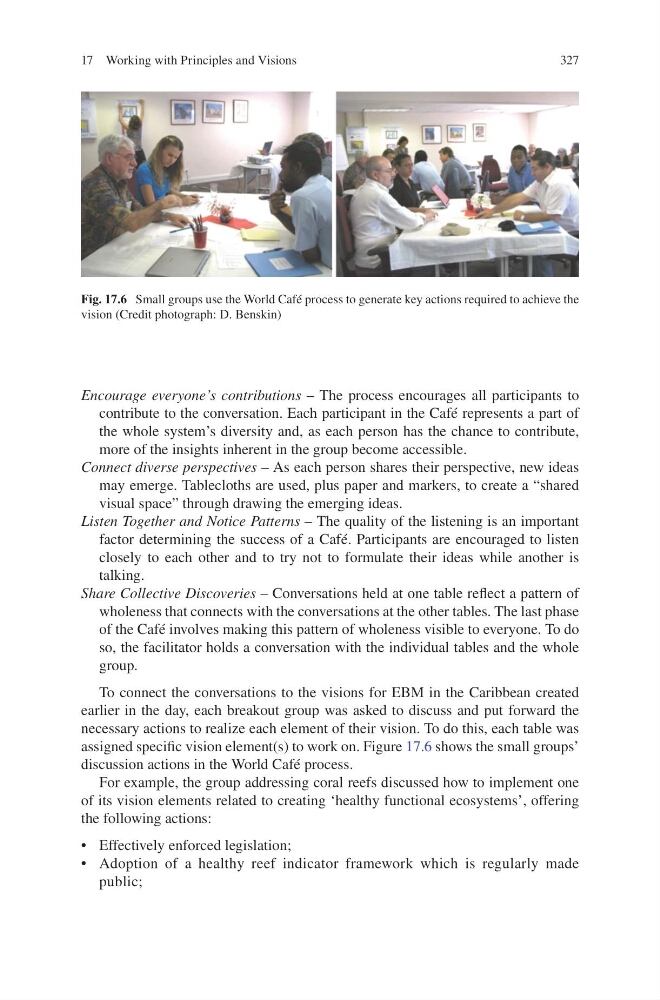
assigned speci fi c vision element(s) to work on. Figure 17.6 shows the small groups’
discussion actions in the World Café process.
For example, the group addressing coral reefs discussed how to implement one
of its vision elements related to creating ‘healthy functional ecosystems’, offering
the following actions:
Effectively enforced legislation;
•
Adoption of a healthy reef indicator framework which is regularly made
•
public;
Fig. 17.6 Small groups use the World Café process to generate key actions required to achieve the
vision (Credit photograph: D. Benskin)
17 Working with Principles and Visions
Encourage everyone’s contributions – The process encourages all participants to
contribute to the conversation. Each participant in the Café represents a part of
the whole system’s diversity and, as each person has the chance to contribute,
more of the insights inherent in the group become accessible.
Connect diverse perspectives – As each person shares their perspective, new ideas
may emerge. Tablecloths are used, plus paper and markers, to create a “shared
visual space” through drawing the emerging ideas.
Listen Together and Notice Patterns – The quality of the listening is an important
factor determining the success of a Café. Participants are encouraged to listen
closely to each other and to try not to formulate their ideas while another is
talking.
Share Collective Discoveries – Conversations held at one table re fl ect a pattern of
wholeness that connects with the conversations at the other tables. The last phase
of the Café involves making this pattern of wholeness visible to everyone. To do
so, the facilitator holds a conversation with the individual tables and the whole
group.
To connect the conversations to the visions for EBM in the Caribbean created
earlier in the day, each breakout group was asked to discuss and put forward the
necessary actions to realize each element of their vision. To do this, each table was
assigned speci fi c vision element(s) to work on. Figure 17.6 shows the small groups’
discussion actions in the World Café process.
For example, the group addressing coral reefs discussed how to implement one
of its vision elements related to creating ‘healthy functional ecosystems’, offering
the following actions:
Effectively enforced legislation;
•
Adoption of a healthy reef indicator framework which is regularly made
•
public;
Fig. 17.6 Small groups use the World Café process to generate key actions required to achieve the
vision (Credit photograph: D. Benskin)