

308
R. Mahon and P. McConney
departments and the NGO do not belong in the system-to-be-governed, but in reality,
these entities can and should be the recipients of governing interactions from each
other and from the other social components of the system. Otherwise, how are
they to learn and adapt to changing circumstances in the system? Learning and
adaptation are critical aspects of governability, and social network analysis assists
our understanding of the nature of these processes.
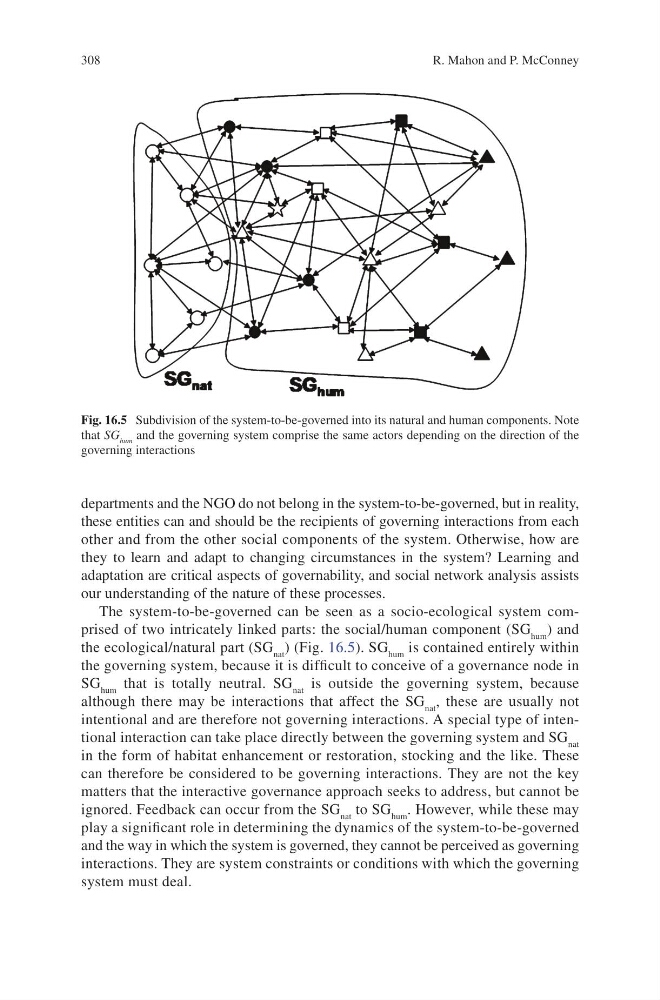
The system-to-be-governed can be seen as a socio-ecological system comprised of two intricately linked parts: the social/human component (SG hum ) and
the ecological/natural part (SG nat ) (Fig. 16.5 ). SG hum is contained entirely within
the governing system, because it is dif fi cult to conceive of a governance node in
SG hum that is totally neutral. SG nat is outside the governing system, because
although there may be interactions that affect the SG nat , these are usually not
intentional and are therefore not governing interactions. A special type of intentional interaction can take place directly between the governing system and SG nat
in the form of habitat enhancement or restoration, stocking and the like. These
can therefore be considered to be governing interactions. They are not the key
matters that the interactive governance approach seeks to address, but cannot be
ignored. Feedback can occur from the SG nat to SG hum . However, while these may
play a signi fi cant role in determining the dynamics of the system-to-be-governed
and the way in which the system is governed, they cannot be perceived as governing
interactions. They are system constraints or conditions with which the governing
system must deal.
Fig. 16.5 Subdivision of the system-to-be-governed into its natural and human components. Note
that SG hum and the governing system comprise the same actors depending on the direction of the
governing interactions
R. Mahon and P. McConney
departments and the NGO do not belong in the system-to-be-governed, but in reality,
these entities can and should be the recipients of governing interactions from each
other and from the other social components of the system. Otherwise, how are
they to learn and adapt to changing circumstances in the system? Learning and
adaptation are critical aspects of governability, and social network analysis assists
our understanding of the nature of these processes.
The system-to-be-governed can be seen as a socio-ecological system comprised of two intricately linked parts: the social/human component (SG hum ) and
the ecological/natural part (SG nat ) (Fig. 16.5 ). SG hum is contained entirely within
the governing system, because it is dif fi cult to conceive of a governance node in
SG hum that is totally neutral. SG nat is outside the governing system, because
although there may be interactions that affect the SG nat , these are usually not
intentional and are therefore not governing interactions. A special type of intentional interaction can take place directly between the governing system and SG nat
in the form of habitat enhancement or restoration, stocking and the like. These
can therefore be considered to be governing interactions. They are not the key
matters that the interactive governance approach seeks to address, but cannot be
ignored. Feedback can occur from the SG nat to SG hum . However, while these may
play a signi fi cant role in determining the dynamics of the system-to-be-governed
and the way in which the system is governed, they cannot be perceived as governing
interactions. They are system constraints or conditions with which the governing
system must deal.
Fig. 16.5 Subdivision of the system-to-be-governed into its natural and human components. Note
that SG hum and the governing system comprise the same actors depending on the direction of the
governing interactions